


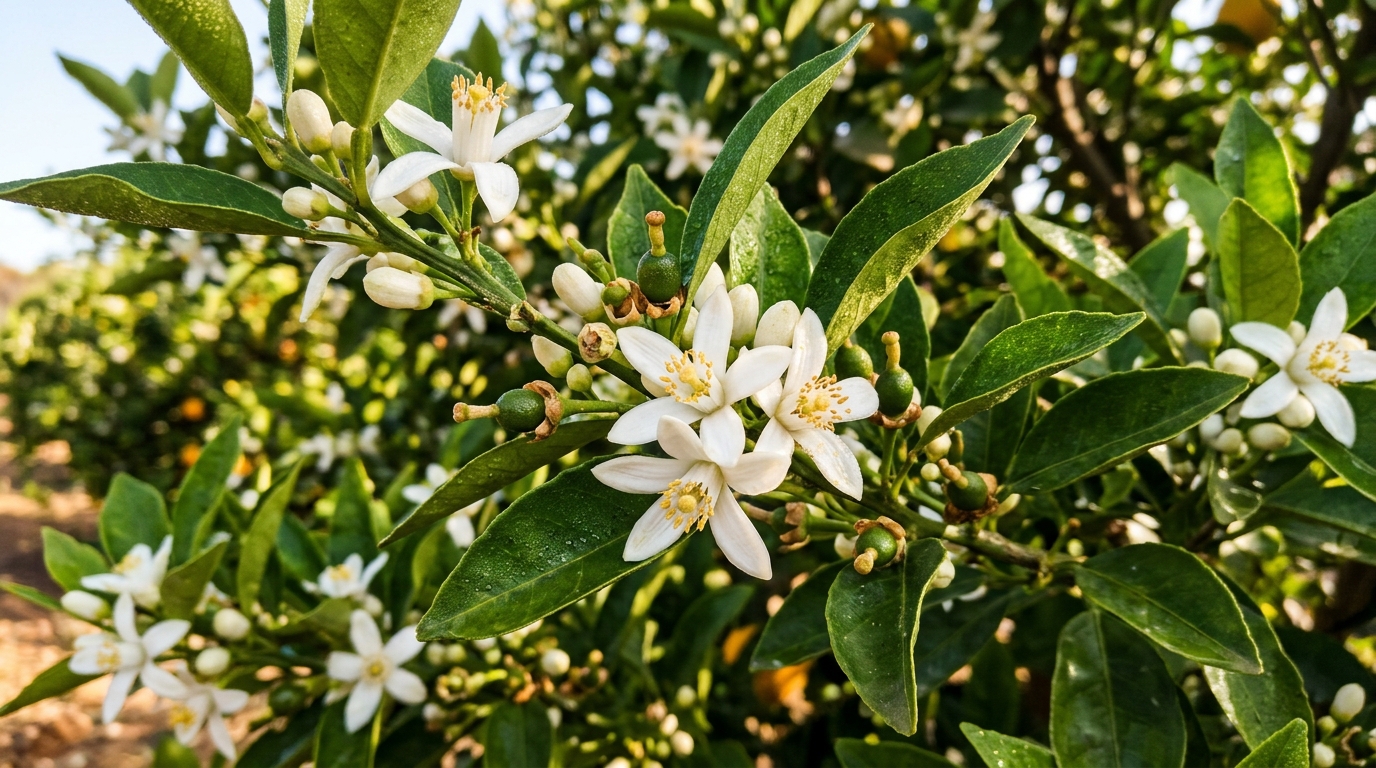
Agricultural engineers have developed a lightweight computer vision model named SDCS-YOLO designed to simultaneously segment citrus blossoms and emerging fruitlets in real time on compact edge computing devices. Detailed in research conducted by Youqing Chen, Hang Liu, Min Xiang, Junmei Wang, Rong Ye, and Tong Li at the citrus production base of Yunnan Chushi Agriculture Co., Ltd. in Longling, Baoshan, Yunnan Province, China, the framework addresses severe logistical challenges in precision orchard management. Citrus represents one of the largest fruit crops cultivated worldwide, with production expanding annually across mountainous terrains. However, conventional manual monitoring of the flowering and fruitlet drop stages requires extensive field labor, which remains difficult to maintain across topographically complex plantations. Inadequate inspection can prevent growers from identifying environmental stresses that reduce flowering rates or determining optimal intervals for fruitlet thinning. By porting deep learning instance segmentation directly onto low-power hardware deployed in the field, the researchers established an automated pathway for tracking tree phenology and estimating early fruit loads without reliance on remote cloud infrastructure.
While earlier agricultural computer vision initiatives successfully applied object detection models to locate mature fruits, count trees, and spot foliar diseases, the authors noted fundamental structural constraints in standard bounding-box approaches. Conventional target detection algorithms enclose objects within rectangular boundaries that inevitably capture surrounding foliage, branches, and background pixels. Because citrus flowers and young fruits possess rounded shapes, bounding boxes yield low spatial localization accuracy and fail to capture morphological contours. In contrast, instance segmentation delineates exact pixel boundaries for individual targets. Previous horticultural segmentation studies focused primarily on mature fruits, citrus pest identification, or green fruits nearing harvest. Very few datasets or algorithms targeted the delicate transition where blossoms wither and young fruits emerge. Because flowering and fruitlet development represent continuous, overlapping developmental phases where blossoms and developing fruitlets coexist on the same branches, omitting floral stages impairs comprehensive yield forecasting and phenological monitoring.
Field surveys conducted across orchards in Yunnan Province revealed that remote agricultural sites frequently encounter restricted wireless connectivity and lack access to centralized high-performance computing centers. Uploading massive streams of high-resolution field imagery to cloud servers introduces severe data transmission latency and elevates ongoing network operational costs. To overcome these infrastructural constraints, the investigators developed a deployment strategy centered on edge processing. All edge evaluations were conducted on a Feiyun Smart Box RTSS manufactured by China Ruitai New Era Technology Co., Ltd., equipped with an NVIDIA Jetson Orin Nano Developer Kit featuring an Ampere-architecture GPU with 7.3 gigabytes of accessible memory running Ubuntu Linux 20.04.5 LTS, CUDA 11.4, PyTorch 1.11.0, and Torchvision 0.12.0. To accelerate model training before field deployment, the baseline and modified networks were trained on a high-performance desktop workstation running Windows 11 with an Intel Core i9-12900KF central processor, an NVIDIA GeForce RTX 4090 graphics processor with 24 gigabytes of memory, CUDA 12.6, and PyTorch 2.5.1.
Because existing open-access agricultural repositories lacked annotated imagery depicting early citrus reproductive organs, the researchers built a dedicated field dataset from scratch during March 2025. Data acquisition targeted Chu’s Orange, a sweet orange cultivar, across a commercial orchard spanning 10,000 mu. Handheld image capture was carried out at distances between 30 and 50 centimeters from tree canopies using a 32-megapixel RGB camera manufactured by China Xinbai Technology Co., Ltd. To ensure broad sample representation, the team randomly selected 150 citrus trees throughout the plantation and collected images across the daytime period between 8:00 and 18:00 under varied morning, midday, and evening illumination. Because precipitation regularly coincides with citrus flowering and petal fall, the team explicitly gathered images of flowers and fruits exhibiting surface moisture and adhering raindrops alongside dry specimens. This diverse sampling ensured that subsequent models would not fail when exposed to shifting natural lighting, specular reflections from water droplets, or complex vegetative canopies.
The collected raw dataset comprised 1,857 high-resolution images captured at 6,480 by 4,860 pixels. Among these original files, 467 images contained citrus flowers exclusively, 1,020 images depicted only fruitlets, and 370 images captured both categories simultaneously. To fit within the memory constraints of edge processors and limit computational overhead during training, all images were uniformly downsampled to 640 by 640 pixels. Precise polygonal ground-truth masks were hand-annotated using Labelme version 5.1.1, enclosing 6,864 flower instances and 11,328 fruitlet instances. Citrus flowers were defined across all visible bud and open blossom stages, while fruitlets encompassed the developmental interval from initial ovary swelling until petals withered and fruit diameters reached approximately one centimeter, as measured with a digital caliper. To prevent deep neural networks from memorizing spatial locations, nine data augmentation techniques were applied, including random rotations between 25 and 45 degrees, horizontal and vertical flips, random resizing from 0.5 to 2.0 times, Gaussian noise, brightness adjustments, contrast shifts, saturation variations, and salt-and-pepper noise. Combining three randomly selected operations per image expanded the corpus to 7,428 images containing 18,192 instances, divided into training, validation, and testing sets using a 7:2:1 ratio.
To establish a lightweight yet accurate neural architecture, the researchers selected YOLOv11 as their base foundation, redesigning its internal structures to yield the specialized SDCS-YOLO model. While floating-point operations offer an indirect estimate of neural network complexity, memory access costs and hardware parallelism dictate actual execution latency on resource-constrained edge hardware. To minimize memory bottlenecks, the standard C3K2 building blocks located within the second, fourth, sixth, and eighth layers of the YOLOv11 backbone were systematically replaced with ShuffleNet V2 units. In each ShuffleNet V2 unit, input channels are split into two parallel paths, halving the channel volume processed by dense convolutions and avoiding grouped point-wise convolutions that elevate memory access operations. The processed branches are subsequently concatenated and shuffled across channels to ensure thorough information mixing. In comparative backbone trials holding other modules constant, the ShuffleNet V2 configuration reduced parameters to 2.12 million and computational complexity to 3.61 billion floating-point operations, outperforming alternative lightweight blocks including PP-LCNet, GhostNetV2, and RFEM in both inference speed and detection accuracy.
The second primary structural innovation targeted the segmentation head through a custom module designated as DCSegment. Standard convolutional heads in YOLO architectures employ static kernels that maintain fixed geometric dimensions regardless of the input features. However, citrus blossoms and young fruitlets undergo continuous morphological changes and exhibit drastic variations in scale and orientation within dense foliage. To overcome this limitation without compounding computational complexity, the authors introduced dynamic convolution into the bounding box regression branch of the segmentation head. Dynamic convolution adaptively calculates kernel parameters through a data-dependent mechanism that computes dynamic attention weights across multiple parallel convolutional kernels, constraining the weighting coefficients between zero and one with their sum normalized to unity. This adaptive formulation enables the head to dynamically alter its receptive behavior according to the specific textural and boundary characteristics of each incoming image patch, maintaining high representational capacity while preserving lightweight execution.
To enhance feature aggregation across multiple spatial scales without sacrificing execution speed, the authors modified the model neck by replacing the conventional Spatial Pyramid Pooling Fast module with a Simplified SPPF architecture derived from YOLOv6. While traditional spatial pyramid pooling applies multiple parallel pooling kernels that induce high processing delays on edge circuits, SimSPPF standardizes pooling operations through sequential five-by-five maximum pooling layers. Because two sequential five-by-five pooling operations mathematically replicate a nine-by-nine pooling window and three sequential operations equal a thirteen-by-thirteen window, this unified design extracts multi-scale context efficiently. Furthermore, SimSPPF substitutes standard SiLU activation functions with computationally simpler Rectified Linear Units, defined mathematically as the maximum between zero and the input value. In learning rate optimization trials evaluated across initial values between 0.001 and 0.010, an initial rate of 0.010 paired with stochastic gradient descent delivered the highest validation stability, whereas attempting rates above 0.010 triggered abnormal training termination after 11 epochs.
Beyond single-frame instance segmentation, the researchers introduced a quantitative tracking framework to monitor the temporal growth trajectories of individual floral organs. The segmentation head outputs a probability mask matrix where values exceeding a calibrated confidence threshold identify valid target pixels. Scaling the resulting binary mask back to the original image coordinates allows researchers to calculate the exact pixel surface area of each segmented flower or fruitlet. To track identical botanical structures across sequential monitoring images captured by stationary cameras, the system applies an automated matching metric combining spatial distance similarity and bounding box area similarity with respective weighting coefficients of 0.7 and 0.3. Distance similarity normalizes the Euclidean distance between target centroids against the image diagonal of 905 pixels, while area similarity calculates the relative scale difference between consecutive observations. When demonstrated across a simulated developmental sequence of 16 images spanning flower budding, full bloom, petal drop, and fruitlet enlargement, the algorithm successfully mapped the gradual expansion of floral pixel areas followed by the emergence and continuous enlargement of fruitlets.
Comprehensive ablation experiments and benchmark evaluations confirmed that SDCS-YOLO delivered an optimal balance between edge latency and segmentation accuracy. Operating on the NVIDIA Jetson Orin Nano edge platform, SDCS-YOLO achieved an inference speed of 31.75 frames per second, equivalent to an average execution time of 31.5 milliseconds per 640-by-640 image, compared to 25.37 frames per second for baseline YOLOv11n-seg. On the desktop workstation, the model achieved 1,175.65 frames per second. The final SDCS-YOLO model attained a precision of 0.988, a recall of 0.949, and a mean average precision at an intersection-over-union threshold of 0.5 of 0.984 for bounding box detection, alongside a mask segmentation precision of 0.991, recall of 0.951, and mean average precision of 0.986. Comparative evaluations against other segmentors revealed that while larger networks such as YOLOv9c-seg achieved slightly higher recall, their computational demands resulted in an unacceptable edge processing speed of only 3.84 frames per second. Conversely, older lightweight frameworks like YOLOv5n-seg exhibited severe classification errors, mistakenly segmenting black plastic orchard irrigation pipes as floral clusters.
The researchers further evaluated the practical robustness of the system using an independent 14-second video sequence comprising 350 frames captured at 25 frames per second by an orchard surveillance camera. SDCS-YOLO reliably segmented and tracked fruitlets located within the foreground and middle ground under variable sunlight and mild wind-induced motion blur. However, the authors documented clear operational boundaries. In the more demanding mean average precision metric calculated across intersection-over-union thresholds from 0.5 to 0.95, SDCS-YOLO scored 0.782, falling slightly below baseline YOLOv11n-seg at 0.789, YOLOv12n-seg at 0.788, and YOLOv8-seg-p6 at 0.792. Additionally, tracking continuity deteriorated when distant fruitlets occupied only a few tens of pixels or suffered severe foliage occlusion. Finally, because all empirical data were collected from a single sweet orange cultivar in Yunnan Province, the authors highlighted that while basic floral organs remain morphologically conserved across citrus species, variations in petal dimensions, flowering calendars, and canopy structures necessitate broader multi-variety validation before commercial deployment.
Subject of Research: Lightweight instance segmentation for orchard edge computing and citrus phenology tracking
Article Title: SDCS-YOLO: A lightweight model for citrus flower and fruitlet instance segmentation and dynamic monitoring based on edge computing
Article References: Chen, Y., Liu, H., Xiang, M., Wang, J., Ye, R., & Li, T. (2026). SDCS-YOLO: A lightweight model for citrus flower and fruitlet instance segmentation and dynamic monitoring based on edge computing. Journal of Agriculture and Food Research, 32, Article 103401. https://doi.org/10.1016/j.jafr.2026.103401
Image Credits: AI Generated
DOI: 10.1016/j.jafr.2026.103401
Keywords: citrus cultivation, instance segmentation, edge computing, SDCS-YOLO, deep learning, precision agriculture, computer vision, yield estimation, lightweight, model, citrus, flower
Cite Scienmag News
Marilyn Langley. (November 6, 2026). Lightweight Edge Computing Model Dynamically Segments Citrus Flowers and Developing Fruitlets. Scienmag. https://scienmag.com/lightweight-edge-computing-model-dynamically-segments-citrus-flowers-and-developing-fruitlets/
Marilyn Langley. "Lightweight Edge Computing Model Dynamically Segments Citrus Flowers and Developing Fruitlets." Scienmag, 6 November 2026, https://scienmag.com/lightweight-edge-computing-model-dynamically-segments-citrus-flowers-and-developing-fruitlets/. Accessed 7 November 2026.
Marilyn Langley. "Lightweight Edge Computing Model Dynamically Segments Citrus Flowers and Developing Fruitlets." Scienmag. November 6, 2026. https://scienmag.com/lightweight-edge-computing-model-dynamically-segments-citrus-flowers-and-developing-fruitlets/




