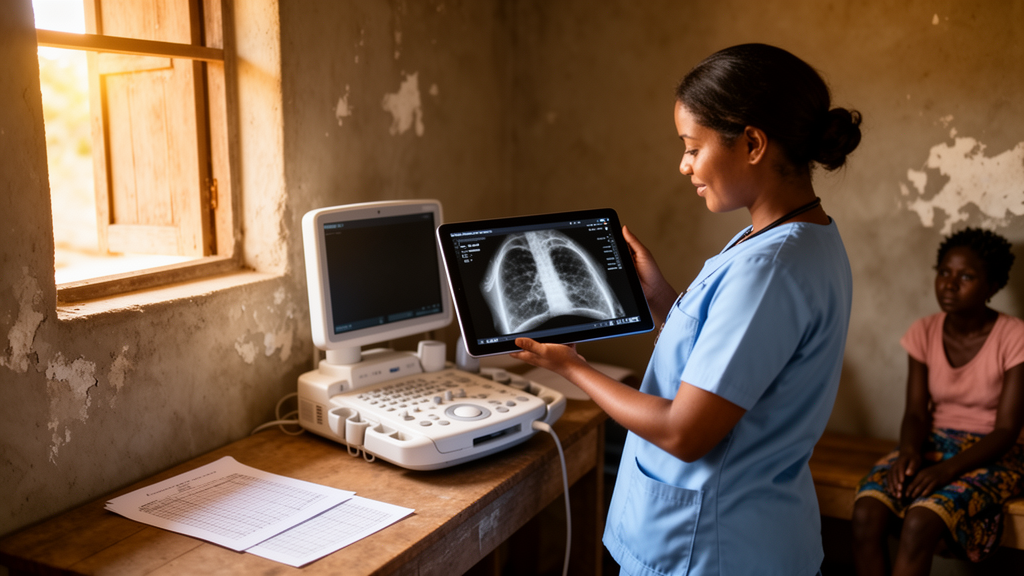
Deep learning models small enough to run on a $100 embedded computer could help close one of the starkest gaps in global cancer care: the shortage of radiologists and imaging infrastructure across low- and middle-income countries. A new narrative review published in the journal Discover Data synthesises 45 peer-reviewed studies published between 2018 and 2025 on deep learning for mammography-based breast cancer detection, with a specific focus on architectures that can operate where computing power, bandwidth and specialist staff are scarce. The authors, led by Kennedy T. Chitiza, conclude that lightweight convolutional networks such as MobileNet and EfficientNet offer the most practical trade-off between diagnostic accuracy and computational cost, but they also warn that no model has yet been validated on mammography data from the very populations these tools are meant to serve.
The scale of the underlying problem is considerable. According to World Health Organization figures cited in the review, roughly 2.3 million new breast cancer cases are diagnosed each year worldwide, leading to nearly 700,000 deaths. In many low- and middle-income countries, shortages of trained radiologists, limited imaging infrastructure and inconsistent screening coverage contribute to delayed diagnosis and poorer outcomes. Digital mammography remains the reference modality for early detection, but its performance depends heavily on image quality and the experience of the interpreting radiologist, and dense breast tissue can mask small abnormalities. Conventional computer-aided detection systems, which relied on handcrafted features and rule-based classifiers, offered limited benefit and degraded sharply when tested on heterogeneous datasets, which is one reason attention has shifted to data-driven approaches that learn features directly from mammographic images.
The review’s quantitative synthesis centres on two resource-efficient architectures. MobileNet, which uses depthwise separable convolutions to cut floating-point operations and parameters by roughly 95 percent relative to traditional convolutional networks, achieved reported diagnostic accuracies of 89 to 92 percent while running within 128 megabytes of RAM and about 0.3 gigafloating-point operations. That footprint makes it suitable for offline edge devices such as smartphones and the NVIDIA Jetson Nano, a 5-watt embedded board. EfficientNet, which balances network depth, width and resolution through compound scaling, reached 91 to 94 percent accuracy but carries a larger parameter count of 5.3 million, pushing deployment toward cloud servers that require stable internet connections above 10 megabits per second. Across the synthesised studies, these AI approaches reduced false positives by 7 to 69 percent and false negatives by about 9 percent compared with traditional computer-aided detection, though the authors stress that most of this evidence is retrospective.
Real-world edge deployment has begun to be tested. In a 2025 validation study, Intasam and colleagues compared YOLOv5, YOLOv8, YOLOv10, YOLOv11 and the hybrid transformer model RT-DETR for breast lesion detection on an NVIDIA Jetson Nano, using a dataset of 3,169 patients from Thailand. YOLOv11n reached 86 percent accuracy with an inference rate of 6.16 plus or minus 0.31 frames per second on the embedded device, which matched the detection ability of GPU systems at far lower cost. Separately, a 2025 study of ultra-lightweight architectures reported LBNet, a five-layer convolutional network with just 2.4 million parameters, about 30 percent the size of MobileNetV2, which achieved 97.28 percent accuracy on the RSNA mammography database and 99.54 percent on CBIS-DDSM while incorporating SHAP and Grad-CAM interpretability techniques.
The broader clinical evidence base for AI-assisted mammography is substantial, though drawn almost entirely from high-income settings. Kim and colleagues validated an AI algorithm on 170,000 mammograms in a multi-reader study of 14 radiologists, finding the standalone AI achieved an area under the receiver operating characteristic curve of 0.959, significantly above the human readers’ 0.940, and that AI-assisted radiologists reduced false-positive recalls by 20 percent. Lång and colleagues evaluated AI as a second reader in a screening population of more than 100,000 mammograms, with the system flagging 44 percent of exams as normal with high confidence and improving specificity by 5.3 percent. Wu and colleagues, training on over 200,000 exams, reported an AI-supported radiologist AUC of 0.857 versus 0.839 for radiologists alone, alongside a 7.1 percent reduction in false positives and an 8.5 percent reduction in false negatives. Mayo and colleagues found a 69 percent reduction in false-positive markings per image when comparing AI-based computer-aided detection with conventional CAD on 250 mammograms.
Not all results inspire confidence. A CNN-Transformer model called MAMMOAI, developed with potential application in African healthcare using preliminary data collected in Kenya, achieved 98 percent accuracy for the majority class, BI-RADS 1, yet failed to detect any BI-RADS 5 cases, the most highly malignant category, misclassifying all of them as BI-RADS 4. The review’s authors cite this as evidence that high aggregate accuracy can conceal dangerous failures on minority classes that are scarce in training data. A 2025 systematic review by Amin and colleagues, which screened 1,051 articles and selected 287, found that more than 80 percent of deep learning models for breast cancer detection were trained primarily on Caucasian datasets, imposing severe constraints when models are applied to populations with different breast density profiles. None of the 45 studies in the current review used an LMIC-specific mammography dataset; the three public datasets that dominated the field, CBIS-DDSM from the United States, INbreast from Portugal and MIAS from the United Kingdom, contain no representation from African, South Asian or Southeast Asian populations.
Domain shift compounds the problem. Models trained on high-income-country data exhibit 10 to 20 percent performance deterioration when applied to heterogeneous or low-quality samples, according to the review. Variability in imaging protocols, scanner properties and patient demographics reduces generalisability when models are transferred across populations, and class imbalance in public datasets, with far fewer malignant than benign cases, can produce models that perform well on average while failing on critical subgroups such as young women or women with dense breast tissue. The authors propose a tiered mitigation strategy: at minimum, fine-tuning a pre-trained model on a small local dataset of at least 200 annotated mammograms, which they estimate can recover 5 to 15 percent of lost performance; ideally, assembling a locally representative dataset of 500 balanced cases with domain adaptation; or, where resources allow, training from scratch on at least 2,000 local cases.
Privacy and infrastructure constraints shape the recommended deployment path. Federated learning, which trains models across multiple institutions without sharing raw patient data, surpassed centralised machine learning in 15 of 25 reviewed oncology studies according to a 2024 analysis by Ankolekar and colleagues, and could help LMICs overcome legal barriers to cross-border data pooling. The review recommends deploying federated learning on lightweight architectures such as MobileNetV2 in two to three pilot hospitals, with differential privacy parameters between 1 and 5. On the question of cost, the authors estimate that a district hospital deployment, including an edge device at roughly $100 for a Jetson Nano or $150 for a smartphone, open-source software, and about $500 per year in maintenance, totals between $1,500 and $2,500 over three years, affordable for many LMIC budgets when shared across facilities, though upfront funding remains a barrier.
The review’s authors are explicit about the limits of their evidence. All 45 included studies are retrospective, no quantitative meta-analysis was possible due to heterogeneity in datasets, preprocessing and evaluation protocols, and publication bias likely over-represents studies reporting very high accuracy. They call for multi-centre randomised controlled trials comparing radiologist-alone against radiologist-plus-AI workflows, with at least 5,000 screening mammograms per arm, non-inferiority margins on sensitivity, and endpoints including recall reduction, reading time and cost per correctly detected cancer. They also recommend embedding explainability, favouring Grad-CAM on edge devices because it adds only 5 to 10 percent inference overhead, and uncertainty estimation through Monte Carlo dropout so that low-confidence cases are automatically routed to human review. Their conclusion is measured: MobileNet and EfficientNet provide good trade-offs for low-resource settings, but locally curated datasets and prospective trials must come before any clinical implementation, or AI risks widening global health disparities rather than narrowing them.
Subject of Research: Deep learning models for mammography-based breast cancer detection in low-resource settings
Article Title: Advancements in deep learning for early breast cancer detection using artificial intelligence models in low resource settings
Article References: Chitiza, K. T., Yahya, A., Action, N., Mbire, P., Mafukidze, H. D., & Edozie, E. (2026). Advancements in deep learning for early breast cancer detection using artificial intelligence models in low resource settings. Discover Data, 4(1), Article 17. https://doi.org/10.1007/s44248-026-00116-z
Image Credits: AI Generated
DOI: 10.1007/s44248-026-00116-z
Keywords: deep learning, breast cancer, mammography, low-resource settings, MobileNet, EfficientNet, LMICs, dataset bias, federated learning, edge computing, computer-aided detection, narrative review
Cite Scienmag News
Nathaniel Bowman. (October 28, 2026). Lightweight AI Models Show Promise for Breast Cancer Detection in Low-Resource Settings. Scienmag. https://scienmag.com/lightweight-ai-models-show-promise-for-breast-cancer-detection-in-low-resource-settings/
Nathaniel Bowman. "Lightweight AI Models Show Promise for Breast Cancer Detection in Low-Resource Settings." Scienmag, 28 October 2026, https://scienmag.com/lightweight-ai-models-show-promise-for-breast-cancer-detection-in-low-resource-settings/. Accessed 28 October 2026.
Nathaniel Bowman. "Lightweight AI Models Show Promise for Breast Cancer Detection in Low-Resource Settings." Scienmag. October 28, 2026. https://scienmag.com/lightweight-ai-models-show-promise-for-breast-cancer-detection-in-low-resource-settings/