


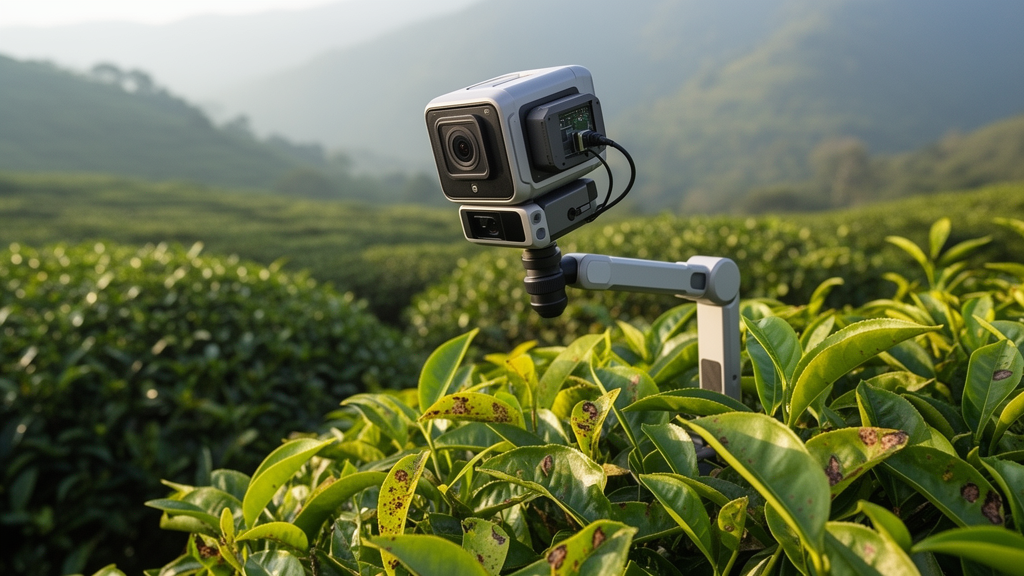
A lightweight artificial-intelligence detector developed for tea plantations achieved an mAP@0.5 of 0.980 for tea pest and disease recognition in experiments reported in the study, while using 37.1% fewer parameters, 13.6% fewer floating-point operations and 34.6% less model storage than the YOLOv8n baseline on which it was built. The system, called MSDR-Net, is designed specifically to recognize small insects and lesions in field images containing variable lighting, overlapping leaves, weeds, soil and other background clutter. The results provide promising evidence for computer-assisted monitoring, but they remain tied to the researchers’ constructed dataset and training conditions; the authors say broader external validation and tests on embedded hardware are still required.
MSDR-Net is a modified version of YOLOv8n, not a detector created independently of the YOLO family. It retains the baseline’s anchor-free prediction approach, detection head, loss-calculation strategy and basic training pipeline, while changing the feature-extraction backbone and feature-fusion components. The researchers, Jun Zhang and Xingchao Deng, targeted three practical problems: the computational cost of conventional convolutional networks, the large variation in size among tea pests and diseased regions, and the difficulty of deciding which multi-scale features should contribute to a final prediction. The resulting architecture combines depthwise separable convolution, three parallel multi-scale feature branches and a lightweight module called SimpleRouter that adaptively combines two types of processed features.
Depthwise separable convolution is the main source of the model’s size reduction. Instead of applying a full spatial convolution to every input channel and then mixing all channels at once, the method performs spatial filtering independently on each channel with a depthwise convolution. A subsequent pointwise convolution with a 1-by-1 kernel then combines information across channels. This two-stage arrangement sharply reduces the number of learned parameters and operations. In the ablation experiments, adding depthwise separable convolution to YOLOv8n lowered the parameter count from 3.007 million to 1.876 million, the computational cost from 8.1 to 5.6 GFLOPs and the model size from 5.981 to 3.818 megabytes. Its mAP@0.5 changed only slightly, from 0.977 to 0.972, indicating that most of the baseline’s detection performance was retained in the authors’ experiments.
To represent targets ranging from tiny insect eggs and spot-like lesions to adult insects and broad patches of damaged tissue, MSDR-Net divides feature extraction into parallel branches with different channel widths. The small-scale branch uses 16 channels and emphasizes fine textures; a 32-channel branch captures contours and medium-sized structures; and a 64-channel branch preserves broader contextual information. Each branch is refined with lightweight C2f_DW modules. Their outputs are concatenated to form a 112-channel feature map, with the channel allocation reflecting a practical compromise rather than a theoretically optimized setting. When the parallel module was tested without the other two changes, it produced an mAP@0.5 of 0.973. It also increased model complexity and lowered recall from 0.930 for the baseline to 0.924, showing that multi-scale extraction alone did not improve every metric.
The most distinctive component is SimpleRouter, an adaptive gate that determines how strongly to use an attention-enhanced branch relative to a standard contextual branch. It is not a capsule-network routing algorithm or a system for selecting discrete processing paths, as its original name might suggest. Instead, the module applies global average pooling to the incoming feature map, flattens the result and passes it through two fully connected layers to generate a scalar complexity score. A sigmoid function converts that score into a weight between zero and one. The final feature is then calculated as the attention-enhanced feature multiplied by this weight plus the standard feature multiplied by one minus the weight. A larger weight therefore shifts the model toward the branch that emphasizes pest- and disease-related channels and spatial regions.
Both SimpleRouter branches retain the same underlying lightweight feature-processing structure. The standard branch includes a C2f_DW module followed by an SPPF component that combines information pooled at several spatial extents. In the attention branch, the SPPF is replaced with an attention-enhanced version. CBAM recalibrates features first across channels and then across space, using averaged and maximum-pooled information to identify informative responses. Multi-scale pooling with kernel sizes of 5, 9 and 13 is used to capture different lesion patterns. In the ablation study, SimpleRouter used by itself achieved an mAP@0.5 of 0.978, the highest result among the single-module variants, although it added parameters and computation. Together with parallel multi-scale extraction, it reached 0.979, while the combination of depthwise separable convolution and SimpleRouter reached 0.976 with a parameter count of 1.873 million.
Adding all three components produced the study’s strongest overall configuration, with an mAP@0.5 of 0.980, precision of 0.971 and recall of 0.922. The complete model contained 1.890 million parameters, required 7.0 GFLOPs and occupied 3.909 megabytes. The gain in average precision did not come without a trade-off: recall fell from 0.943 in the depthwise-plus-multi-scale configuration. The authors suggest that adaptive filtering may suppress weak targets, ambiguous lesion boundaries or heavily occluded examples, leading to more missed detections in some cases. They also note that module-level runtime, latency and stricter statistical-significance analyses were not reported, so the architectural components should not be interpreted as equally beneficial on every measure.
The full MSDR-Net was compared under the same dataset split, input resolution, training schedule, augmentation strategy and evaluation criteria with YOLOv8n, YOLOv8s, YOLOv10n, YOLOv10s, YOLOv11n, YOLOv11s, YOLOv12n, YOLOv12s, RT-DETR-R18 and RT-DETR-R34. Its 0.980 mAP@0.5 tied with YOLOv10s and exceeded the other compared models. Under the stricter mAP@0.5:0.95 measure, however, it scored 0.778, comparable to YOLOv8n and slightly below YOLOv8s, which achieved 0.971 precision and the highest stricter average precision. YOLOv8s required 11.128 million parameters and 28.5 GFLOPs, about 5.9 and 4.1 times the respective totals for MSDR-Net. The study’s dataset contained seven classes: healthy tea leaves, black rot, brown blight, rust, red spider mite infestation, aphid infestation and white mold.
The data combined 1,097 retained field images collected in September and October 2025 at the Chashan Bamboo Sea tea plantation area in Yongchuan District, Chongqing, with 1,200 randomly selected images from public online datasets. Field photographs were captured at 1920 by 1080 pixels with iPhone 14 and Xiaomi 15 devices under different lighting conditions and viewing angles, while blurry, duplicated and otherwise invalid images were removed. All images were resized to 640 by 640 pixels and placed into a unified seven-label system. Original images were divided before augmentation to prevent closely related or augmented versions from appearing in different subsets, producing 6,159 images: 4,311 for training, 616 for validation and 1,232 for testing. The study also combined some differently named symptom classes in its confusion-matrix interpretation, an important qualification when considering apparent category-level performance.
Training loss curves fell rapidly during the first 20 epochs and later stabilized, with training and validation trends showing no obvious overfitting. Visualizations indicated that detections often aligned with affected regions despite changes in illumination, background and leaf overlap, and many confidence scores exceeded 0.8. The normalized confusion matrix nevertheless showed errors: rust and red spider mite symptoms were confused to some extent, and some background areas were labeled as disease or pests. Beyond model training, the researchers built a desktop prototype that accepts images, video and camera input, displays localized categories and produces associated control recommendations. A tested image received a 0.78 confidence score for red spider mite infestation. This was a functional desktop demonstration rather than a full field deployment: the authors did not systematically measure latency, throughput, power use, resource consumption or long-term reliability on embedded or mobile devices.
Subject of Research: Lightweight computer-vision detection of tea pests and diseases in field images
Article Title: Tea pests and diseases detection method based on multi scale dynamic routing network
Article References: Zhang, J., & Deng, X. (2026). Tea pests and diseases detection method based on multi scale dynamic routing network. Discover Artificial Intelligence, 6(1), Article 1047. https://doi.org/10.1007/s44163-026-02142-x
Image Credits: AI Generated
DOI: 10.1007/s44163-026-02142-x
Keywords: tea pest detection, tea disease recognition, MSDR-Net, YOLOv8n, computer vision, lightweight AI, multi-scale features, adaptive feature fusion, precision agriculture, edge deployment, pests, diseases
Cite Scienmag News
Gavin Prescott. (October 26, 2026). Lightweight AI model detects tea pests and diseases with high accuracy. Scienmag. https://scienmag.com/lightweight-ai-model-detects-tea-pests-and-diseases-with-high-accuracy/
Gavin Prescott. "Lightweight AI model detects tea pests and diseases with high accuracy." Scienmag, 26 October 2026, https://scienmag.com/lightweight-ai-model-detects-tea-pests-and-diseases-with-high-accuracy/. Accessed 26 October 2026.
Gavin Prescott. "Lightweight AI model detects tea pests and diseases with high accuracy." Scienmag. October 26, 2026. https://scienmag.com/lightweight-ai-model-detects-tea-pests-and-diseases-with-high-accuracy/


