


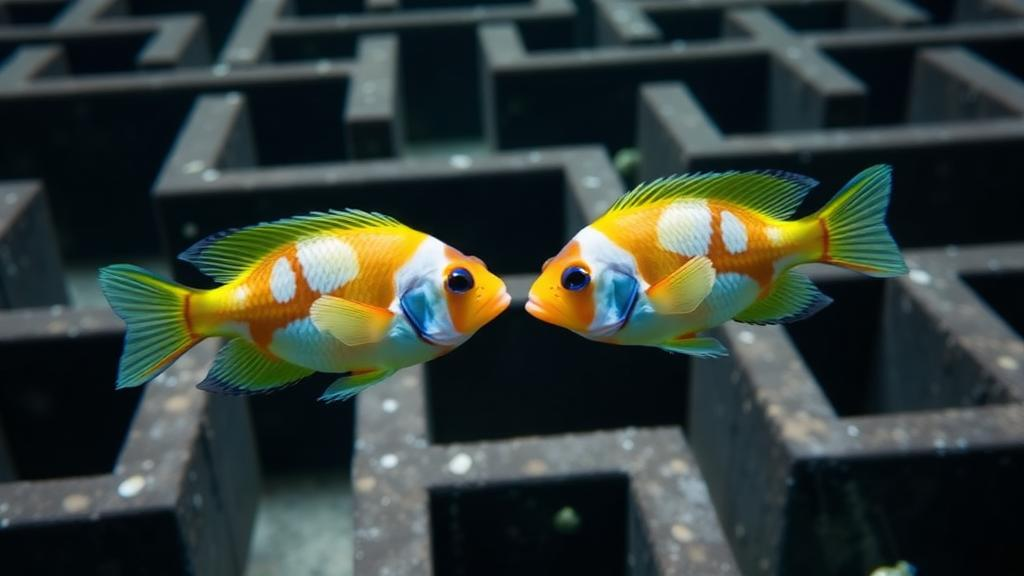
On a coral reef, the difference between finding your way home and becoming someone else’s lunch can come down to a split-second decision at a fork in the structure. For the humbug damselfish, a small black-and-white banded fish that weaves among the branching arms of corals, those decisions may be governed by something far more personal than the landscape itself: an intrinsic preference for turning left or right. A new study published in the journal Animal Cognition by Helen von Drenkmann, Annabell Klinke and Culum Brown of Macquarie University, with von Drenkmann also affiliated with Humboldt-Universität zu Berlin, reveals that the direction a fish prefers to turn can shape how it learns to navigate, which mental strategies it deploys, and how quickly it solves spatial problems. The findings carry a provocative implication for a world in which coral reefs are losing their structural complexity: the cognitive consequences of habitat degradation may depend less on the environment itself than on the behavioural quirks each animal brings to it.
The research team set out to answer a question that has become increasingly urgent for reef ecologists. Anthropogenic change, from bleaching to storm damage to sedimentation, is rapidly flattening the three-dimensional architecture of coral reefs, and scientists have long suspected that this simplification should impair the spatial abilities of the fish that depend on it. Yet the cognitive consequences of habitat change remain poorly understood, particularly in fishes. To probe the problem experimentally, the researchers reared juvenile humbug damselfish, Dascyllus aruanus, in aquaria containing either high-complexity or low-complexity coral structures. This split-rearing design allowed them to isolate the effect of structural experience on the developing brain, testing whether fish raised amid a labyrinth of branches would become better navigators than those raised in a comparatively barren environment.
The test itself was elegantly simple. Each fish was trained in a T-maze, a classic apparatus in which an animal must choose between a left and a right arm, one of which leads to a reward. Crucially, the maze could be solved in more than one way. A fish could use an egocentric strategy, essentially memorising a motor rule such as turn left at the junction, or an allocentric strategy, using external landmarks to guide its choice. The researchers measured how many trials each fish needed to reach a learning criterion and how long it took to make correct decisions. Then came the critical step: probe trials in which the cues were placed in conflict, forcing the fish to reveal which strategy it had actually been relying on. When a landmark and a turn direction pointed to different arms, the choice the fish made exposed the strategy hidden beneath its training performance.
The most striking result was not about the environment at all. Turn direction emerged as the strongest predictor of performance in the entire study. Fish that had been trained to turn left reached the learning criterion in fewer trials and consistently relied on egocentric, turn-based strategies during probe trials. This pattern, the authors argue, is indicative of a lateralisation bias, the well-documented tendency of animals, including fishes, to favour one side of the body for particular motor actions. In other words, a left turn appears to sit comfortably within the humbug damselfish’s intrinsic behavioural repertoire, making the task feel almost natural. Fish asked to turn against their preferred direction, by contrast, faced a subtle but persistent handicap that showed up in nearly every measure of learning.
Right-turning fish told a different and equally revealing story. Rather than grinding through the maze with an uncomfortable motor rule, these individuals increasingly shifted their reliance toward landmark cues during probe trials, and they made faster decisions when doing so. The researchers interpret this as evidence that allocentric strategies reduced the cost of acting against an intrinsic turn bias. Instead of forcing a right turn against their natural inclination, the fish appear to have outsourced the decision to external landmarks, effectively sidestepping the conflict between the task and their own bodies. It is a remarkable example of cognitive flexibility in a fish barely a few centimetres long, and it suggests that animals may actively choose navigation strategies not just because of what they learned, but because of what their own laterality makes easy.
What about the environment? Here the results defied expectations. Contrary to the prediction that fish raised in structurally rich aquaria would learn the maze faster overall, environmental complexity did not affect the number of trials required to reach the learning criterion. The headline measure of learning was, in effect, blind to rearing conditions. But complexity was not without consequence. Fish from the high-complexity treatment located the reward faster during early training, suggesting that experience with intricate structure confers an advantage in the earliest phase of spatial familiarisation, when an animal is first mapping a novel environment. The benefit faded as training progressed, hinting that complexity accelerates the initial acquisition of spatial information rather than raising the ceiling of eventual performance.
Complexity also left its mark on the probe trials in a subtler way. High-complexity fish showed longer decision latencies when cues conflicted, a pattern the authors suggest reflects greater sensitivity to landmark information. When the landmark and the turn direction disagreed, these fish appeared to pause, weighing the conflicting sources of information rather than defaulting immediately to a motor rule. That hesitation may represent a form of cognitive depth: an animal that has grown up navigating complex, landmark-rich environments may be more attuned to spatial cues in the world around it, and more reluctant to ignore them when they contradict a learned habit. In a degraded reef, where landmarks vanish and structure collapses, such sensitivity could become a liability rather than an asset.
The broader significance of the study lies in its challenge to how scientists interpret spatial cognition experiments. If turn biases and strategy use can dominate performance measures, then studies that ignore laterality risk misattributing differences in learning to environmental effects when the real driver is an intrinsic behavioural constraint. A population of fish with a different mix of left- and right-turners might appear cognitively superior or inferior for reasons that have nothing to do with their habitat. The authors highlight the importance of considering these intrinsic factors when evaluating how animals cope with environmental change, a caution that extends well beyond damselfish to any species tested in mazes or navigation tasks.
For coral reefs, the stakes are concrete. As climate change and local stressors strip away the branching corals that humbug damselfish call home, the fish will face environments where landmark-based navigation, the strategy that helped right-turning individuals overcome their biases, may become less reliable. Understanding how turn preference, strategy choice and habitat structure interact offers a more nuanced picture of which individuals and populations are likely to cope with simplification, and which will struggle. The study, conducted under Macquarie University animal ethics approval and supported by a DAAD PROMOS fellowship and an International Macquarie Research Excellence Scholarship, was published open access, allowing researchers and reef managers alike to examine the full dataset and analysis code. In the end, the humble humbug damselfish delivers a lesson that resonates far beyond the T-maze: the mind that navigates the world is shaped both by the world it inhabits and by the body it brings to the task, and neither can be understood alone.
Subject of Research: Turn bias, habitat complexity and spatial learning strategies in humbug damselfish
Article Title: Leaning left: how turn bias and habitat complexity shape spatial cognition in a coral-reef fish
Article References: von Drenkmann, H., Klinke, A., & Brown, C. (2026). Leaning left: how turn bias and habitat complexity shape spatial cognition in a coral-reef fish. Animal Cognition. https://doi.org/10.1007/s10071-026-02116-7
Image Credits: AI Generated
DOI: 10.1007/s10071-026-02116-7
Keywords: spatial cognition, humbug damselfish, coral reef fish, lateralisation, turn bias, egocentric navigation, allocentric navigation, T-maze, habitat complexity, landmark cues, animal cognition, behavioural ecology
Cite Scienmag News
Glenn Wilkins. (October 11, 2026). Left-Turning Reef Fish Outsmart Their Rivals in Maze Tests of Spatial Cognition. Scienmag. https://scienmag.com/left-turning-reef-fish-outsmart-their-rivals-in-maze-tests-of-spatial-cognition/
Glenn Wilkins. "Left-Turning Reef Fish Outsmart Their Rivals in Maze Tests of Spatial Cognition." Scienmag, 11 October 2026, https://scienmag.com/left-turning-reef-fish-outsmart-their-rivals-in-maze-tests-of-spatial-cognition/. Accessed 11 October 2026.
Glenn Wilkins. "Left-Turning Reef Fish Outsmart Their Rivals in Maze Tests of Spatial Cognition." Scienmag. October 11, 2026. https://scienmag.com/left-turning-reef-fish-outsmart-their-rivals-in-maze-tests-of-spatial-cognition/


