


The University of Freiburg is establishing a new tenure track professorship in Earth and Planetary Geodynamics at the Faculty of Environment and Natural Resources, made possible by a 1.71 million euro grant from the Volkswagen Foundation. The new tenure track professorship is part of a comprehensive strategic initiative for combining Earth system sciences with planetary sciences at the University that also includes the establishment of a new Earth System Simulation Lab (EaSySim) and the introduction of an Earth Sciences master’s degree programme.

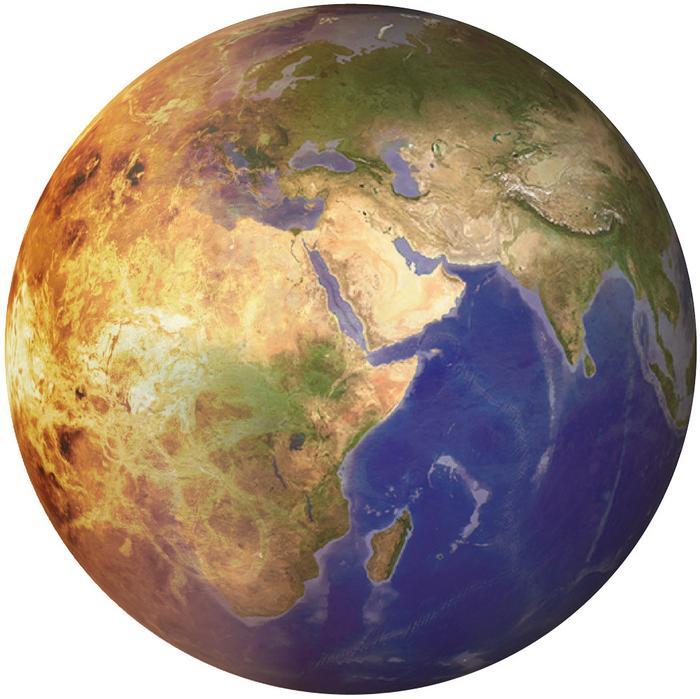
Credit: Anna Gülcher, Creative Commons BY-NC-SA 4.0.
The University of Freiburg is establishing a new tenure track professorship in Earth and Planetary Geodynamics at the Faculty of Environment and Natural Resources, made possible by a 1.71 million euro grant from the Volkswagen Foundation. The new tenure track professorship is part of a comprehensive strategic initiative for combining Earth system sciences with planetary sciences at the University that also includes the establishment of a new Earth System Simulation Lab (EaSySim) and the introduction of an Earth Sciences master’s degree programme.
The aim of the initiative is to systematically include planetary influences on Earth’s system and its subsystems in research and teaching by comparing Earth with the Earth-like planet Venus. Prof. Dr. Heiner Schanz, Dean of the Faculty of Environment and Natural Resources, emphasizes the strategic importance of the initiative: ‘By integrating planetary perspectives, we can gain valuable insights into Earth’s past, present, and future. At the same time, the University of Freiburg will thus position itself nationally and internationally as a centre for Earth System Sciences. We’re grateful to the Volkswagen Foundation for their support.’
The twin planets Earth and Venus
Prof. Dr. Thomas Kenkmann, professor for General Geology and Structural Geology and coordinator of the strategic concept for strengthening Earth System Sciences, explains the advantages of combining Earth System and Planetary Sciences: ‘The consistent integration of findings from research on Venus will enhance our understanding of the planetary factors that influence climate stability, the availability of liquid water, and planetary habitability.’
Also participating in the initiative is Dr. Anna Gülcher from NASA’s Jet Propulsion Laboratory and the California Institute of Technology in Pasadena (California, USA). Her research focuses on the study of Earth and Venus as ‘twin planets’ with an emphasis on modelling geodynamic processes. In addition, Anna Gülcher is participating in NASA’s upcoming Venus mission (VERITAS). ‘The University of Freiburg’s Faculty of Environment and Natural Resources is enabling intensive collaboration with colleagues from Planetary and Earth Sciences as well as from Environmental Natural and Social Sciences, which I find extremely interesting’, says Anna Gülcher.
Strategic realignment of Earth system sciences
The new tenure track professorship is a key element in a comprehensive strategic realignment of Earth System Sciences at the University of Freiburg’s Faculty for Environment and Natural Resources. Under the title ‘EPSS@UFR – Earth and Planetary System Sciences’, the new strategy includes several interlinked measures to accompany the innovative combination of Earth System Sciences and planetary sciences.
The new Earth System Simulation Lab (EaSySim) will provide infrastructure and computing capacity for modelling and simulations and support the development of a research agenda and joint research projects with national and international partners. A redesigned master’s programme in Earth Sciences will offer students the option of concentrating on Earth and Planetary Sciences, Environmental Earth Sciences, Hydrology, or Environmental Modelling and Data Science. The initiative also aims to enhance science communication and outreach activities, for example through the creation of multimedia online content and a partnership with the Freiburg Planetarium.
Fact sheet:
- Prof. Dr. Thomas Kenkmann is professor for General Geology and Structural Geology at University of Freiburg’s Faculty of Environment and Natural Resources. He is coordinating the strategic concept ‘EPSS@UFR – Earth and Planetary System Sciences’ for strengthening Earth system sciences at the faculty.
- Dr. Anna Gülcher is an Earth and planetary scientist at NASA’s Jet Propulsion Laboratory and at the California Institute of Technology in Pasadena (California, USA). A focal point of the research she will be contributing to the ‘EPSS@UFR – Earth and Planetary System Sciences’ initiative is the modelling of geodynamic processes on Earth and Venus.
Contact:
Office of University and Science Communications
University of Freiburg
Tel.: +49(0)761/203-4302
Email: kommunikation@zv.uni-freiburg.de
Cite Scienmag News
Violet Maxwell. (July 17, 2024). Learning from Venus: Combining earth system sciences with planetary sciences. Scienmag. https://scienmag.com/learning-from-venus-combining-earth-system-sciences-with-planetary-sciences/
Violet Maxwell. "Learning from Venus: Combining earth system sciences with planetary sciences." Scienmag, 17 July 2024, https://scienmag.com/learning-from-venus-combining-earth-system-sciences-with-planetary-sciences/. Accessed 7 September 2026.
Violet Maxwell. "Learning from Venus: Combining earth system sciences with planetary sciences." Scienmag. July 17, 2024. https://scienmag.com/learning-from-venus-combining-earth-system-sciences-with-planetary-sciences/

