


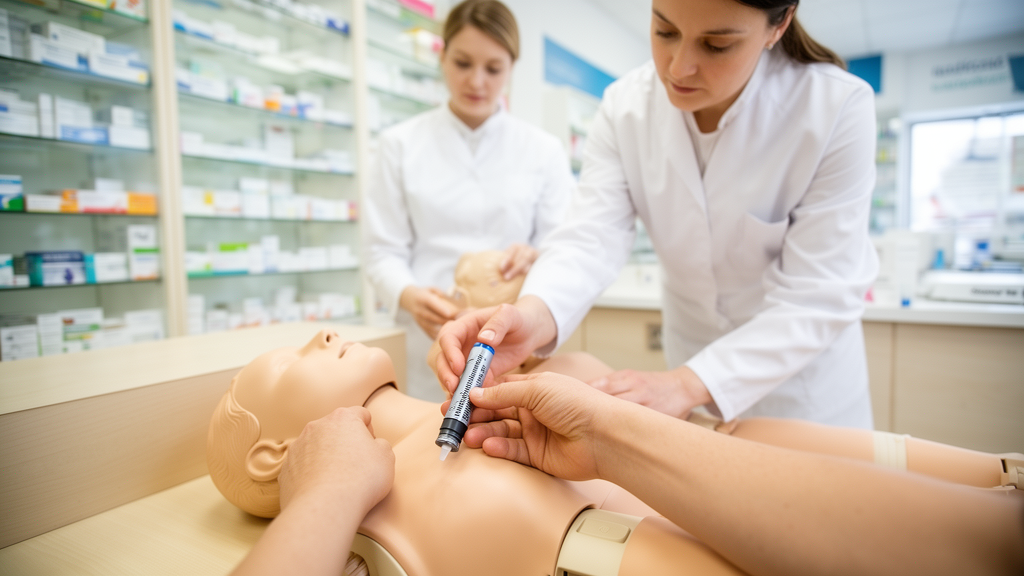
Community pharmacists and pharmacy assistants in Latvia showed important gaps in recognizing and managing anaphylaxis despite demonstrating moderate general knowledge, according to a descriptive cross-sectional study conducted from November 2025 to January 2026. In a face-to-face practical assessment, no participant completed every step for using an epinephrine autoinjector correctly, and only 24.5% performed the initial administration steps correctly. The findings indicate that awareness of basic features of anaphylaxis did not necessarily translate into readiness to deliver emergency treatment in routine pharmaceutical care.
The study included 124 respondents who completed a structured electronic questionnaire: 57.3% were pharmacists and 42.7% were pharmacy assistants. Most participants were women (96.0%), and the median age was 34 years, with an interquartile range of 28–41. Pharmacists had significantly longer work experience than pharmacy assistants (p = 0.019). Prior exposure to anaphylaxis and epinephrine autoinjector training was limited. Only 21.8% of respondents had attended relevant training, with participation higher among pharmacists than assistants (31.0% versus 9.4%; p = 0.004). Most participants, 69.4%, had not used a training device, while only 4.0% reported that such devices were available in their pharmacy. The median knowledge score was 6, with an interquartile range of 5–8.
Questionnaire results revealed that participants generally understood several recognizable features of anaphylaxis. A majority correctly identified the onset of the condition, with 86.3% answering the relevant knowledge question correctly, and 93.5% knew that anaphylaxis can occur without a previous allergy. Performance was much weaker on clinically consequential treatment questions. Only 38.7% gave the correct answer concerning antihistamine use, while just 8.9% correctly recognized the indication for administering a second dose of epinephrine. The study therefore identified a marked difference between recognition of basic clinical features and knowledge of when and how epinephrine should be used. Knowledge scores were higher among younger participants and among those reporting relevant training, continuing education, direct patient contact, or previous experience with epinephrine autoinjectors.
The practical component used an epinephrine autoinjector training device and an eight-step evaluation checklist. Of the participants included in the practical assessment, reported as 147 observations in the study, none performed all administration steps correctly. Correct execution of the initial steps was demonstrated by 24.5%, illustrating that difficulty was not confined to later technical stages of device use. The findings do not establish that an anaphylaxis event would have been managed inadequately in every pharmacy, and the study was conducted in one country with voluntary participation. It also assessed theoretical knowledge and simulated technical performance rather than patient outcomes. Even with those limitations, the results point to a specific preparedness problem: many pharmacy workers could identify some features of anaphylaxis but were unfamiliar with important treatment decisions and lacked reliable technique in using an epinephrine autoinjector.
The researchers emphasized targeted, practice-oriented training as a way to strengthen competencies in both anaphylaxis recognition and management within pharmaceutical care. Their findings connect limited formal training and infrequent access to training devices with gaps in knowledge and observed technique, although the cross-sectional design cannot establish causation. The study was not a clinical trial and did not test whether a training program would improve emergency care or prevent severe outcomes. Its combination of questionnaire data and direct observation of autoinjector technique nevertheless exposed deficiencies in two linked areas: understanding when epinephrine is indicated and executing its administration correctly. The authors’ conclusion was that moderate general awareness was insufficient and that more focused education and practical rehearsal were needed to strengthen the readiness of pharmacists and pharmacy assistants to respond to anaphylaxis.
Subject of Research: Assessment of Latvian community pharmacy workers’ anaphylaxis knowledge and epinephrine autoinjector skills
Article Title: Gaps in knowledge and skills in pharmaceutical care for anaphylaxis
Article References: Veinberga, E. G., Lapiņa, L., & Urtāne, I. (2026). Gaps in knowledge and skills in pharmaceutical care for anaphylaxis. BMC Health Services Research. https://doi.org/10.1186/s12913-026-15607-7
Image Credits: AI Generated
DOI: 10.1186/s12913-026-15607-7
Keywords: anaphylaxis, epinephrine, epinephrine autoinjectors, pharmacists, pharmacy assistants, pharmaceutical care, Latvia, cross-sectional study, clinical training, knowledge assessment, Gaps, knowledge
Cite Scienmag News
Ophelia Keating. (October 26, 2026). Latvian pharmacy workers show gaps in anaphylaxis knowledge and autoinjector skills. Scienmag. https://scienmag.com/latvian-pharmacy-workers-show-gaps-in-anaphylaxis-knowledge-and-autoinjector-skills/
Ophelia Keating. "Latvian pharmacy workers show gaps in anaphylaxis knowledge and autoinjector skills." Scienmag, 26 October 2026, https://scienmag.com/latvian-pharmacy-workers-show-gaps-in-anaphylaxis-knowledge-and-autoinjector-skills/. Accessed 26 October 2026.
Ophelia Keating. "Latvian pharmacy workers show gaps in anaphylaxis knowledge and autoinjector skills." Scienmag. October 26, 2026. https://scienmag.com/latvian-pharmacy-workers-show-gaps-in-anaphylaxis-knowledge-and-autoinjector-skills/


