


Every year, dentists place hundreds of millions of resin composite fillings, and every one of those restorations depends on an invisible, microscopic handshake between the adhesive layer and the underlying dentin. When that bond fails, the consequences range from sensitivity and leakage to full restoration loss and secondary decay. The trouble is that clinicians and researchers have never had a reliable way to measure how well a dentin-composite bond is holding together without destroying the specimen in the process. Traditional shear bond strength testing, the gold standard in dental materials research, requires loading the bonded interface until it breaks, which means the sample is sacrificed and no longitudinal monitoring is possible. A new study published in the Annals of Biomedical Engineering now offers a way around this fundamental limitation, combining the shimmering interference patterns of laser speckle imaging with machine learning regression to predict bond strength from light alone.
The research, led by Doaa Youssef of the Engineering Applications of Lasers Department at the National Institute for Laser Enhanced Sciences at Cairo University, together with colleagues from the National Research Centre in Cairo, set out to answer a deceptively simple question: can the statistical texture of light scattered from a bonded tooth interface reveal how strong that bond actually is? The answer, according to their results, is a qualified but impressive yes. Their machine learning models predicted mechanically measured shear bond strength with coefficients of determination above 0.91 and test errors of roughly a quarter of a megapascal, a level of agreement that surprised even the authors given the notorious heterogeneity of dentin as an optical and structural material.
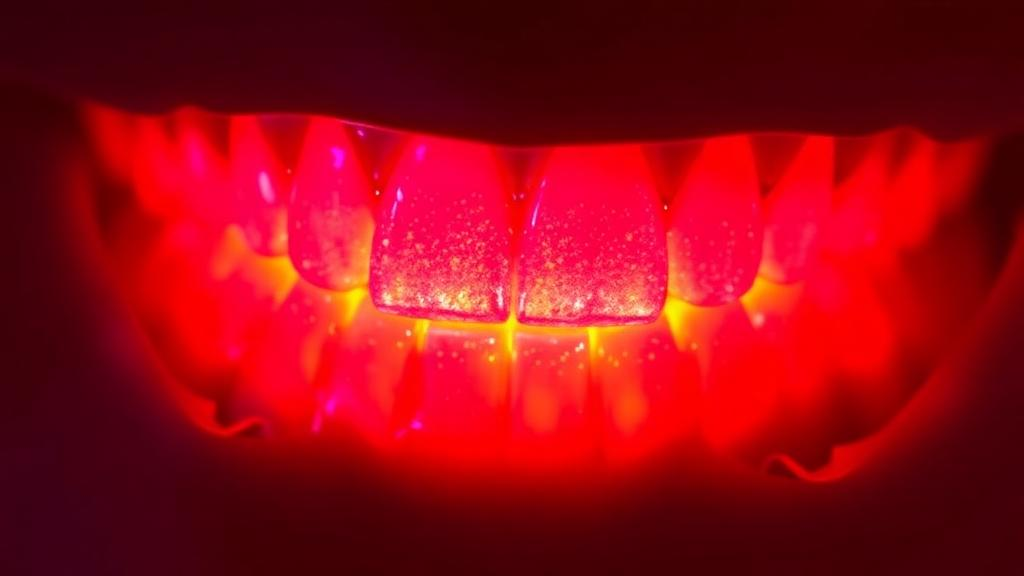
To understand why this matters, it helps to appreciate what laser speckle imaging actually captures. When coherent laser light strikes a biologically rough surface, the scattered waves interfere with one another, producing a granular pattern of bright and dark spots known as a speckle pattern. That pattern is not random noise; it is a fingerprint of the surface and subsurface structure that produced it. Variations in mineral density, resin infiltration, tubule orientation, and adhesive thickness all leave their imprint on the spatial statistics of the speckle field. In dentistry, speckle techniques have previously been explored for detecting dental erosion and measuring pulp blood flow, but using them to characterize the integrity of a bonded interface is a genuinely novel application, and one that demands careful image processing to extract meaningful descriptors from the raw granular images.
The experimental design was deliberately constructed to generate a wide range of interfacial conditions, because a predictive model is only as good as the variability it has learned from. The team prepared dentin-composite specimens using different bonding protocols involving an adhesive system modified with gold nanoparticles, combined with laser irradiation applied at controlled stages of the bonding procedure. Gold nanoparticles have attracted attention in dental adhesives for their antibacterial properties and their potential to enhance optical contrast, and prior work by some of the same authors had shown that combining nanoparticles with diode or Er,Cr:YSGG laser conditioning can influence bond strength on etch-and-rinse adhesive systems. By systematically varying these parameters, the researchers produced specimens whose interfacial quality spanned a meaningful spectrum, from weaker bonds to stronger ones, providing the ground truth against which the optical predictions could be validated.
For the optical measurements, the team illuminated the bonded interface with a helium-neon laser operating at a wavelength of 632 nanometers, a classic choice in coherent optics that produces highly stable, well-characterized speckle patterns. The recorded speckle images were then processed using morphological techniques, a family of image analysis operations that probe the shape, size, and contrast of the granular structures within the pattern. From these processed images, the researchers extracted a battery of statistical features designed to quantify the heterogeneity of the interface. The underlying logic is that a well-bonded, homogeneously infiltrated interface should scatter light differently from a defective one riddled with microgaps, resin-rich zones, or poorly demineralized dentin, and that this difference should be legible in the morphological statistics of the speckle field.
With dozens of candidate features in hand, the next challenge was deciding which ones actually carried predictive information about bond strength, rather than redundant or noisy descriptors. Here the researchers turned to a random forest model, an ensemble learning method introduced by Leo Breiman in 2001 that builds many decision trees on random subsets of the data and aggregates their outputs. Crucially, random forests provide a natural measure of feature importance through permutation testing: the values of a given feature are randomly shuffled, and the resulting drop in model performance indicates how much that feature contributed to the predictions. Applying this procedure, the team ranked all of their speckle-derived features and selected the top seven as the input variables for the final regression models, a dimensionality reduction step that guards against overfitting and keeps the eventual clinical workflow lean.
Two regression algorithms were then trained to map those seven optical features onto specimen-level shear bond strength measurements. The first was support vector regression, a kernel-based method rooted in the support vector machine framework of Cortes and Vapnik, which fits a function within a tolerance margin and is well suited to small, nonlinear datasets typical of laboratory studies. The second was the random forest itself, repurposed from feature ranking to direct prediction. The hyperparameters of both models were tuned using Bayesian optimization, a sample-efficient strategy for searching expensive parameter spaces that has become standard practice in machine learning pipelines where each evaluation is costly. The result was a pair of models whose predictions tracked the mechanical measurements with remarkable fidelity across the tested range of bond strengths.
The headline numbers are worth dwelling on. Support vector regression achieved a calibration coefficient of determination of 0.914 with a test root mean square error of 0.234 megapascals, while the random forest reached a calibration R-squared of 0.919 with a test error of 0.228 megapascals. In practical terms, this means that the optical speckle signature of an intact, untested specimen contained enough information to estimate its breaking strength to within a fraction of a megapascal, without the specimen ever being loaded to failure. Both models showed strong agreement between predicted and mechanically measured values, and the close performance of the two algorithms suggests that the predictive power resides in the optical features themselves rather than in the idiosyncrasies of any particular learner.
The implications for dental research and, eventually, clinical practice are substantial. In the laboratory, a non-destructive readout of bond integrity would allow the same specimen to be monitored repeatedly over time, enabling true longitudinal studies of adhesive degradation, thermocycling effects, and fatigue without consuming hundreds of extracted teeth. In the clinic, a chairside optical probe capable of assessing the quality of a bonded restoration before the patient leaves the operatory could catch weak bonds early, when rebonding is trivial, rather than years later when the failure has propagated into fracture or decay. The authors are careful to frame their work as a proof of concept: the study was conducted under controlled in vitro conditions, and the morphological speckle descriptors characterize interfacial heterogeneity rather than directly imaging the chemistry of the bond. Translating the approach to clinically relevant conditions, with the optical complexity of whole teeth, saliva, pulpal fluid, and intraoral lighting, remains the critical next step that the researchers themselves identify.
Still, the study adds a compelling entry to a growing body of evidence that coherent light, properly interrogated, can reveal mechanical properties that once required destruction to measure. Laser speckle techniques have already been used to evaluate tissue viscoelasticity, articular cartilage surface roughness, wound healing progression, breast tumor blood flow, and even the surface quality of additively manufactured titanium, and this work extends that lineage into one of the most commercially and clinically consequential interfaces in restorative dentistry. If follow-up studies validate the approach on whole teeth and in simulated oral environments, the humble granular pattern of scattered laser light could become a routine quality-control instrument for the billions of dental bonds placed around the world each year, turning what was once a destructive laboratory measurement into a quick, painless flash of red light and a machine learning prediction.
Subject of Research: Non-destructive optical assessment of dentin-composite bond integrity using laser speckle imaging and machine learning regression
Article Title: Non-Destructive Assessment of Dentin Composite Bond Integrity using Laser Speckle Imaging and Machine Learning Regression
Article References: Youssef, D., Sadony, D. M., Sabry, M. A., Hassan, S. N., & Samir, H. (2026). Non-Destructive Assessment of Dentin Composite Bond Integrity using Laser Speckle Imaging and Machine Learning Regression. Annals of Biomedical Engineering. https://doi.org/10.1007/s10439-026-04342-z
Image Credits: AI Generated
DOI: 10.1007/s10439-026-04342-z
Keywords: laser speckle imaging, dentin-composite bond, shear bond strength, machine learning regression, support vector regression, random forest, gold nanoparticles, dental adhesives, non-destructive testing, biomedical optics, restorative dentistry, feature importance
Cite Scienmag News
Ophelia Keating. (October 2, 2026). Laser Speckle Imaging and AI Predict the Strength of Dental Fillings Without Breaking Them. Scienmag. https://scienmag.com/laser-speckle-imaging-and-ai-predict-the-strength-of-dental-fillings-without-breaking-them/
Ophelia Keating. "Laser Speckle Imaging and AI Predict the Strength of Dental Fillings Without Breaking Them." Scienmag, 2 October 2026, https://scienmag.com/laser-speckle-imaging-and-ai-predict-the-strength-of-dental-fillings-without-breaking-them/. Accessed 4 October 2026.
Ophelia Keating. "Laser Speckle Imaging and AI Predict the Strength of Dental Fillings Without Breaking Them." Scienmag. October 2, 2026. https://scienmag.com/laser-speckle-imaging-and-ai-predict-the-strength-of-dental-fillings-without-breaking-them/


