Titanium aluminide alloys promise to revolutionize aerospace engineering, offering the kind of lightweight strength that jet engine designers dream about, but printing them reliably has remained a stubborn challenge. Now, a team of researchers at Shanghai University, working with a collaborator at City University of Hong Kong, has revealed how a single, seemingly mundane dial on a 3D printer—the laser power setting—can dramatically reshape the microscopic architecture and mechanical performance of one of the most important titanium aluminide alloys in existence. Their findings, published in the Journal of Materials Science, show that turning up the laser can nearly double the strength of the printed material, but at a cost that engineers will need to weigh carefully.
The alloy in question, Ti–48Al–2Cr–2Nb, often abbreviated TiAl-4822, is a lightweight intermetallic material that has already flown in the low-pressure turbine blades of modern commercial aircraft. Its appeal lies in a remarkable combination of low density and high-temperature capability, properties that could shave hundreds of kilograms from an engine. Yet the alloy is notoriously brittle at room temperature and exquisitely sensitive to how it is processed. Traditional casting routes demand painstaking thermal control, and additive manufacturing introduces an entirely new set of complications: as each layer of material is deposited, the heat from the laser re-melts and re-heats the layers beneath, creating what metallurgists call an interlayer heat-affected zone, or HAZ.
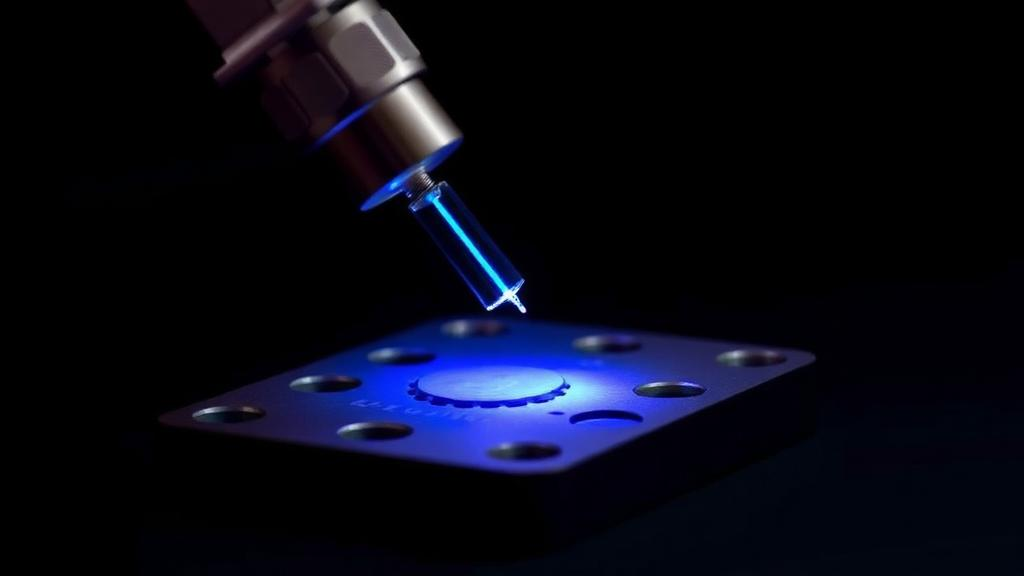
This heat-affected zone is where the new study focuses its attention. In directed energy deposition, or DED, a focused laser beam melts metal powder onto a substrate, building a part layer by layer. Every new pass of the laser acts like a miniature heat treatment on the material below it, pushing the previously solidified layers through temperatures that can transform their microstructure. The researchers systematically varied the laser power from 350 to 750 watts to see how these thermal excursions would alter the HAZ and, in turn, the tensile properties of the finished alloy. What they found was a tightly coupled chain of cause and effect linking heat, chemistry, and mechanical behavior.
The first effect is thermal. Higher laser power means more energy pumped into each layer, which slows the rate at which the material cools after melting. Slow cooling gives atoms more time to diffuse and grains more opportunity to grow. The team measured this directly: as laser power climbed from 350 to 750 watts, the average grain size in the heat-affected zone coarsened from 5.2 plus or minus 0.32 micrometers to 10.4 plus or minus 0.69 micrometers. In other words, doubling the laser power roughly doubled the grain size, a change that would ordinarily be expected to weaken a metal according to the classic Hall-Petch relationship between grain size and strength.
But the second effect proved to be chemical, and it ran in the opposite direction. Titanium aluminides contain volatile aluminum, which evaporates readily under the intense heat of a laser beam. As laser power increased, so did aluminum evaporation, and the aluminum content within the heat-affected zone dropped from 47.10 plus or minus 0.45 atomic percent to 43.77 plus or minus 0.36 atomic percent. This compositional shift is far from cosmetic. In the Ti-Al phase system, aluminum content dictates which phases are stable, and depleting aluminum pushes the alloy toward the formation of the alpha-2 phase, a brittle, ordered intermetallic compound with the composition Ti3Al.
The measurements confirmed this prediction. Alpha-2 precipitation increased within the heat-affected zone, eventually reaching a volume fraction of 18.2 percent at the highest laser powers. This hard, brittle phase acted like a reinforcing skeleton embedded within the softer gamma-TiAl matrix, blocking dislocation motion and forcing cracks to follow more tortuous paths. The result was a striking mechanical transformation: the ultimate tensile strength of the alloy rose from 445.51 plus or minus 28 megapascals at the lowest laser power to 633.52 plus or minus 31 megapascals at the highest—an increase of more than 40 percent. For a material class often dismissed as too fragile for structural use, those numbers turn heads.
Strength, however, came at the expense of ductility. Elongation at failure fell from 0.75 plus or minus 0.035 percent to 0.51 plus or minus 0.023 percent as laser power increased. In absolute terms, both values are small, reflecting the inherent brittleness of gamma titanium aluminides at room temperature, but the trend is unambiguous. The same alpha-2 precipitates that strengthen the alloy also provide easy nucleation sites for cracks, and the coarsened grain structure gives those cracks longer, unobstructed paths to propagate. The researchers describe this as a strength-ductility trade-off governed jointly by thermal history and compositional drift—two levers that a single process parameter, laser power, controls simultaneously.
The significance of this work lies in its mechanistic clarity. Previous studies of additively manufactured titanium aluminides have catalogued microstructures and mechanical properties, but the explicit linkage between laser power, cooling rate, aluminum evaporation, alpha-2 precipitation, and tensile behavior in the interlayer heat-affected zone provides a predictive framework rather than a mere observation. It means that process engineers can now reason about the HAZ as a design space: choosing a laser power is not just setting an energy input but programming a specific combination of grain size, chemistry, and phase fraction into the most vulnerable regions of the part.
There are broader implications for the aerospace industry, where DED is increasingly viewed as a route to repairing expensive turbine components or printing near-net-shape parts that would otherwise be machined from costly forgings. Because titanium aluminide parts spend much of their service life at elevated temperatures, the room-temperature brittleness measured in tensile tests is only part of the story, but the HAZ remains a critical weak point in any as-built component. The Shanghai team’s results suggest that a moderate laser power might offer a balanced compromise, capturing some of the strength gains from alpha-2 precipitation without sacrificing all of the alloy’s limited ductility or promoting excessive grain coarsening.
The study also adds to a growing body of evidence that additive manufacturing is not simply a way to shape metals but a way to engineer them, with process parameters acting as the metallurgist’s toolkit. For TiAl-4822, the laser is now understood to be a dual instrument: it sets the thermal clock that governs grain growth, and it drives the chemical evaporation that governs phase formation. By mapping how these two effects combine across the range of 350 to 750 watts, the researchers have given the additive manufacturing community a practical guide for tuning the properties of one of the most demanding—and most promising—lightweight alloys in the aerospace materials portfolio. The work was supported by the National Natural Science Foundation of China and the Science and Technology Commission of Shanghai Municipality.
Subject of Research: Effect of laser power on the interlayer heat-affected zone microstructure and tensile properties of DED-fabricated Ti–48Al–2Cr–2Nb titanium aluminide alloy
Article Title: Effect of laser power on interlayer heat-affected zone microstructure and tensile properties of Ti–48Al–2Cr–2Nb alloy fabricated by directed energy deposition
Article References: He, D., Zhang, X., Xue, T., Huang, J., Zhang, Z., Cheng, P., Feng, Q., Ren, Y., Chen, G., Gao, P., & Li, C. (2026). Effect of laser power on interlayer heat-affected zone microstructure and tensile properties of Ti–48Al–2Cr–2Nb alloy fabricated by directed energy deposition. Journal of Materials Science. https://doi.org/10.1007/s10853-026-13591-1
Image Credits: AI Generated
DOI: 10.1007/s10853-026-13591-1
Keywords: titanium aluminide, TiAl-4822, directed energy deposition, laser power, heat-affected zone, additive manufacturing, alpha-2 phase, aluminum evaporation, tensile strength, grain coarsening, aerospace materials, microstructure
Cite Scienmag News
Denise Maddox. (October 13, 2026). Laser Power Holds the Key to Stronger 3D-Printed Titanium Aluminide Alloys. Scienmag. https://scienmag.com/laser-power-holds-the-key-to-stronger-3d-printed-titanium-aluminide-alloys/
Denise Maddox. "Laser Power Holds the Key to Stronger 3D-Printed Titanium Aluminide Alloys." Scienmag, 13 October 2026, https://scienmag.com/laser-power-holds-the-key-to-stronger-3d-printed-titanium-aluminide-alloys/. Accessed 13 October 2026.
Denise Maddox. "Laser Power Holds the Key to Stronger 3D-Printed Titanium Aluminide Alloys." Scienmag. October 13, 2026. https://scienmag.com/laser-power-holds-the-key-to-stronger-3d-printed-titanium-aluminide-alloys/