


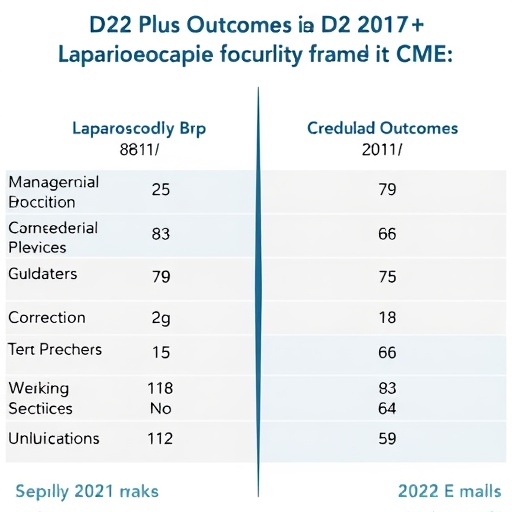
In the evolving landscape of gastric cancer surgery, recent research published in BMC Cancer sheds light on the comparative efficacy of two intricate surgical techniques—laparoscopic D2 lymphadenectomy alone versus D2 lymphadenectomy augmented by complete mesogastric excision (CME). This nuanced investigation specifically focuses on patients with distal gastric cancer who also exhibit a high body mass index (BMI), a subgroup notoriously challenging due to anatomical and technical complexities heightened by excess adipose tissue.
This study, authored by Yong Sun, Lei Hou, and Enhong Zhao from the Department of Gastrointestinal Surgery at the Affiliated Hospital of Chengde Medical University in Hebei, China, delivers crucial insights into short-term postoperative outcomes, which are indispensable for optimizing treatment protocols for gastric cancer in obese patients. These outcomes encompass factors such as surgical safety, lymph node retrieval rates, operative duration, blood loss, and early postoperative complications.
Laparoscopic D2 lymphadenectomy is a well-established, minimally invasive surgical procedure targeting thorough dissection of regional lymph nodes in gastric cancer patients. The addition of complete mesogastric excision aims to enhance oncologic clearance by removing the mesogastrium—the fatty connective tissue enveloping the stomach along with associated lymphovascular structures—thereby potentially improving long-term cancer control. Yet, the benefits of CME remain controversial, particularly in high-BMI populations where surgical maneuverability is hindered.
The corrected article in question addresses this precise clinical dilemma. By comparing the pure laparoscopic D2 lymphadenectomy against D2 plus CME, the authors evaluate whether the extended dissection impacts operative difficulty and patient recovery adversely or if it provides a superior oncologic benefit outweighing the risks. Such data are invaluable given the rising global prevalence of obesity and its impact on gastric cancer surgical outcomes.
Key findings highlight that while D2 lymphadenectomy plus CME demands longer operative times and may present a steeper technical challenge due to amplified tissue manipulation and visibility constraints in high-BMI bodies, it also facilitates a more comprehensive lymph node harvest. This amplified lymphadenectomy could translate into improved staging accuracy and potentially better long-term prognosis, although the study consciously centers on short-term metrics to establish foundational safety and feasibility profiles.
Hemostasis control and intraoperative blood loss metrics emerge as critical evaluative parameters in the study. Excess visceral fat in obese patients often complicates vascular management, making precise excision necessary to minimize hemorrhagic complications. The reported data suggest that although the combined procedure entails a modest increase in blood loss compared to standard D2 lymphadenectomy, such increases remain within clinically acceptable ranges, emphasizing surgical proficiency and careful technique application.
Postoperative recovery indices including time to first ambulation, hospital stay duration, and incidence of complications such as anastomotic leakage, infections, or delayed gastric emptying were also meticulously recorded. Encouragingly, the data indicate no statistically significant increase in adverse events in the D2 plus CME group, inferring that the more aggressive surgical approach does not compromise patient safety when executed by experienced surgeons trained in advanced laparoscopic procedures.
Another dimension explored pertains to oncologic benefits—specifically, the extent to which CME enhances radicality. The mesogastrium houses a substantial proportion of lymphatic tissue that may harbor micrometastases. Its complete excision thus holds theoretical advantages in eradicating occult disease. This principle underpins the study’s rationale for integrating CME into standard D2 lymphadenectomy, particularly given the metabolic and anatomical challenges presented by obesity.
The authors also examine the technical nuances that define this combined approach. Achieving adequate visualization and instrument triangulation in high-BMI patients mandates meticulous port placement and utilization of advanced laparoscopic instruments. Additionally, the dissection technique requires precise identification of anatomical landmarks to avoid injury to critical structures like the pancreas and major blood vessels while ensuring comprehensive mesogastric removal.
Statistical analyses incorporated in the report underscore the robustness of the findings. Despite the observational nature of the study, propensity score matching and multivariate regression analyses were applied to mitigate confounding variables, thereby strengthening the inference validity about the procedural comparative outcomes.
Importantly, this article corrects and updates previous data, reflecting the authors’ commitment to scientific accuracy and the transparent reporting of their findings. Such corrections serve the larger academic community by refining the evidence base for surgical oncology practices, offering surgeons worldwide critical data to tailor interventions for obese distal gastric cancer patients more effectively.
The implications extend beyond immediate clinical practice. As gastric cancer remains a major global health burden, innovations in surgical technique that address patient heterogeneity—especially the growing fraction with obesity—are vital. This study paves the way for future multicenter randomized controlled trials to ascertain whether the short-term advantages observed align with meaningful long-term survival benefits.
Moreover, the findings contribute to a paradigm shift concerning the surgical management of obese cancer patients. Historically viewed as high-risk for extended surgeries, these patients may benefit from more radical approaches when meticulous surgical strategy and advanced technology are leveraged. This evolution could enhance personalized medicine approaches, integrating patient-specific anatomical considerations into operative planning.
The comparison of these two surgical strategies also highlights the pivotal role of surgeon expertise and institutional volume in optimizing outcomes. Institutions equipped with specialized training programs and high case volumes are likely better positioned to implement complex procedures like laparoscopic D2 lymphadenectomy plus CME safely, creating a possible impetus for centralizing care for obese gastric cancer patients.
In conclusion, this critically important study contributes key evidence supporting the feasibility and safety of supplementing laparoscopic D2 lymphadenectomy with complete mesogastric excision in patients with high BMI and distal gastric cancer. While it accentuates the procedural demands and slightly increased operative intensity, it also identifies potential oncological advantages and acceptable recovery profiles.
The surgical oncology community stands to benefit significantly from such rigorous data, fostering informed surgical decision-making tailored to increasingly prevalent demographic health profiles worldwide. As obesity intertwines with global cancer epidemiology, optimizing technical interventions becomes imperative for achieving superior patient outcomes.
Future research should seek to expand upon these promising findings by evaluating long-term oncologic results, quality-of-life metrics, and cost-effectiveness analyses. Such comprehensive assessments will be critical for delineating the definitive role of CME in gastric cancer surgery amidst the burgeoning challenge posed by obesity.
Cite Scienmag News
Nathaniel Bowman. (September 10, 2025). Laparoscopic D2 vs D2 Plus CME Outcomes. Scienmag. https://scienmag.com/laparoscopic-d2-vs-d2-plus-cme-outcomes/
Nathaniel Bowman. "Laparoscopic D2 vs D2 Plus CME Outcomes." Scienmag, 10 September 2025, https://scienmag.com/laparoscopic-d2-vs-d2-plus-cme-outcomes/. Accessed 5 September 2026.
Nathaniel Bowman. "Laparoscopic D2 vs D2 Plus CME Outcomes." Scienmag. September 10, 2025. https://scienmag.com/laparoscopic-d2-vs-d2-plus-cme-outcomes/


