

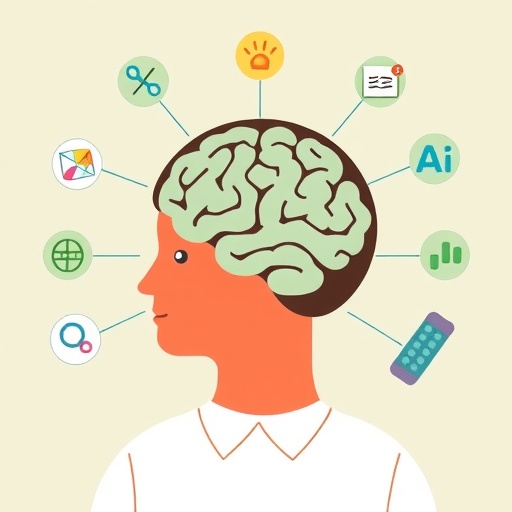
In recent years, the intersection of language and psychological science has increasingly garnered attention as researchers seek innovative methods to assess mental health and well-being. A groundbreaking study published in Communications Psychology in 2026 by Mesquiti, Cosme, Nook, and colleagues marks a remarkable advancement in this domain. Their research demonstrates that language-based assessments, which analyze individuals’ use of words and linguistic patterns, can robustly predict psychological well-being and subjective experiences of happiness and distress. This revelation heralds new possibilities for non-invasive, scalable monitoring of mental states, presenting a potential paradigm shift in psychological diagnostics and wellness tracking.
Traditional measures of psychological well-being have long relied on self-report surveys, clinical interviews, and behavioral observations. While these methods have proven valuable, they come with significant limitations such as social desirability bias, recall inaccuracies, and the intensive labor of administration and interpretation. The study by Mesquiti et al. circumvents these challenges through the exploitation of linguistic cues extracted from naturalistic language samples—ranging from social media entries to spoken transcripts—capitalizing on the subtle yet revealing ways that our choice of words mirrors our internal emotional life and cognitive processing.
At the heart of their investigation lies computational linguistics and natural language processing (NLP), disciplines focused on enabling machines to understand and analyze human language. The researchers applied sophisticated algorithms to analyze large language corpora from diverse populations, quantifying variables like emotional valence, cognitive complexity, and thematic content. These linguistic markers, when correlated with standardized psychological measures, revealed consistent predictive relationships with individuals’ reported psychological well-being and subjective states, including levels of anxiety, depression, and overall life satisfaction.
One of the standout features of the study is its methodological rigor, including the use of longitudinal data. Participants provided language samples over an extended period, enabling researchers to track the temporal dynamics of psychological states as reflected in language. This approach moves beyond static snapshots, capturing the fluctuations and trajectories of well-being in relation to real-life experiences and stressors. Such temporal sensitivity could transform how clinicians and researchers monitor treatment progress or predict crisis points before they fully manifest.
The implications for public health and mental healthcare are profound. Language-based assessments can be implemented remotely using digital platforms, offering a low-cost, accessible means of continuous mental health monitoring at scale. This is particularly critical given global shortages of mental health professionals and the stigma often associated with seeking psychological help. Early detection of deteriorating well-being through language analysis might facilitate timely intervention, potentially preventing the onset of clinical disorders or mitigating their severity.
Moreover, the nuanced linguistic indicators uncovered by the study offer insights into the complex mind-body nexus. For instance, the presence of particular linguistic structures indicative of rumination, self-focus, or emotional suppression were found to predict heightened psychological distress. These findings dovetail with theoretical models in psychology linking cognitive and emotional styles with mental health outcomes, reinforcing the validity of language features as biomarkers of inner psychological states.
Importantly, the study elucidates that language is not a mere conduit of communication but a rich, embodied expression of the self that encapsulates emotional, cognitive, and social dimensions. By decoding these embedded signals, researchers herald a future where mental health assessments are far more personalized, culturally sensitive, and less intrusive than traditional methods. This personalization is facilitated by machine learning models trained on diverse linguistic datasets, ensuring adaptability across different languages, dialects, and cultural contexts.
While the promise of language-based assessments is considerable, the authors acknowledge several caveats. Variability in linguistic style across demographic groups, education levels, and cultural backgrounds necessitates careful model calibration to avoid biases. Ethical considerations surrounding privacy and consent also demand robust governance frameworks to ensure that language data is handled with confidentiality and used responsibly. The authors emphasize transparency and participant empowerment as key principles guiding the development of these tools.
Further research is anticipated to refine linguistic indicators associated with specific mental health disorders, such as differentiating patterns predictive of anxiety versus depression or distinguishing transient distress from chronic conditions. Integration with multimodal data streams—such as physiological monitoring and behavioral tracking—could enhance predictive accuracy and provide a more holistic picture of well-being. Such interdisciplinary approaches underscore the expanding frontier of digital mental health in the era of big data.
The study opens fertile ground for clinical innovation, including automated therapeutic feedback systems that gently prompt users to recognize negative cognitive styles reflected in their language. These real-time feedback loops could encourage adaptive coping strategies and emotional regulation skills, augmenting traditional therapy. Additionally, language-based monitoring could inform public policy by mapping population-level mental health trends linked with sociocultural events or economic shifts.
From a broader societal perspective, understanding how language reflects mental health challenges reduces stigma by normalizing psychological distress as part of human experience expressible through everyday communication. Language offers a democratized window into health, accessible anytime and anywhere. This modality holds particular promise for reaching vulnerable populations marginalized by geographical, socioeconomic, or linguistic barriers.
In closing, the research by Mesquiti and colleagues exemplifies how cross-pollination of psychology, linguistics, and computational technology is revolutionizing how we conceptualize and measure mental well-being. Their findings underscore the immense informational value embedded in our words, heralding a future where mental health care is not only more accurate and accessible but profoundly intertwined with the very language that shapes human connection and understanding.
As we continue to unravel the layers of meaning beneath our everyday speech and writing, this innovative work paves the way for a more compassionate science of mind—one that listens deeply and interprets boldly to foster flourishing minds across the globe.
Subject of Research:
Prediction of psychological and subjective well-being through language-based assessments
Article Title:
Language-based assessments can predict psychological and subjective well-being
Article References:
Mesquiti, S., Cosme, D., Nook, E.C. et al. Language-based assessments can predict psychological and subjective well-being. Commun Psychol (2026). https://doi.org/10.1038/s44271-026-00400-3
Image Credits: AI Generated


