


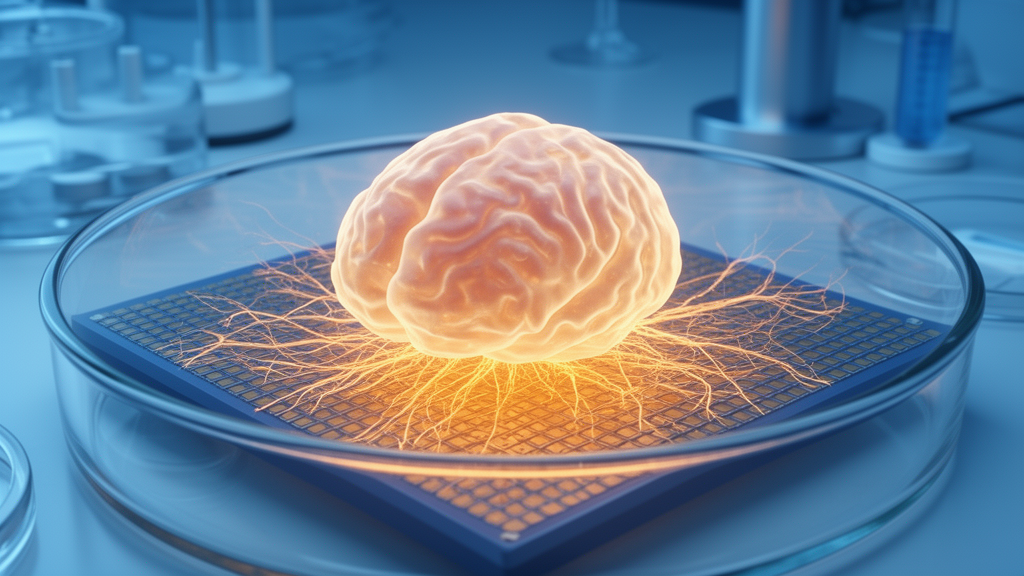
In an experiment that blurs the line between living tissue and machine, researchers at the University of Bristol have shown that human brain organoids — miniature clusters of lab-grown neurons — can be taught to recognize Braille letters using nothing more than electrical pulses delivered through a set of tiny electrodes. The study, published in Frontiers in Artificial Intelligence, demonstrates that these biological neural networks can process tactile information from a robotic fingertip with enough fidelity to classify all 26 letters of the Braille alphabet, achieving 83 percent accuracy when three organoids work together as a team.
The research addresses one of the most pressing challenges in modern computing: energy consumption. While silicon-based neuromorphic chips like IBM’s TrueNorth and Intel’s Loihi operate in the milliwatt range by fusing memory and computation, scaling these systems toward cortex-level complexity pushes projected power demands into the kilowatt-to-megawatt bracket. The human brain, by contrast, performs comparable computation on roughly 20 watts. Brain organoids, with their three-dimensional architecture and genuine synapses that reorganize and learn, consume orders of magnitude less energy than any silicon alternative — making them an attractive substrate for what researchers call organoid intelligence, or OI.
But tapping that potential requires solving a fundamental communication problem. External sensors speak in digital signals; living neural networks speak in spikes of electrical activity. The Bristol team, led by Tianyi Liu, Hemma Philamore, and Benjamin Ward-Cherrier, developed a transferable encoding strategy that bridges this gap by converting event-based tactile sensor data into electrical stimulation patterns that organoids can interpret. The approach preserves three classes of task-relevant information — spatial location, temporal structure, and contact intensity — while compressing high-dimensional sensor streams into a compact set of stimulation parameters compatible with low-density microelectrode arrays.
The experimental platform relied on FinalSpark’s Neuroplatform, a cloud-accessible electrophysiology system that hosts human forebrain organoids cultured to approximately 500 micrometers in diameter. Each organoid contains mature neurons, astrocytes, and oligodendrocytes displaying robust network activity, and can remain electrophysiologically active for up to roughly 100 days under favorable conditions. Four custom air-liquid interface microelectrode arrays each accommodate four organoids, with eight electrodes per organoid spaced 200 micrometers apart. Voltage signals are sampled at 30 kilohertz with 16-bit resolution, and all hardware functions are accessible through a Python API.
Before attempting the Braille task, the team systematically characterized how organoids respond to different stimulation parameters. They discovered that spike count increases almost linearly as the number of pulses rises, and that phase amplitudes below 4 microamperes rarely evoke spikes while higher amplitudes produce steadily larger responses. Phase duration and trigger delay, while not showing clear correlations with spike number, produce distinct temporal patterns that can encode timing information. When a single pulse is delivered, most responses return to pre-stimulation levels within 60 milliseconds, though increasing the pulse count extends the evoked activity to approximately 100 milliseconds. These findings motivated the use of an approximately 500-millisecond decoding window for the Braille experiment.
For the tactile sensing side, the researchers mounted an Evetac optical tactile sensor — which resolves vibrations up to 498 hertz and captures shear forces and incipient slip — on the end effector of a four-axis Dobot MG400 robotic arm. The sensor contains a soft silicone gel embossed with black markers, an internal LED ring, and a DVXplorer Mini event camera that generates asynchronous pixel events in Address-Event Representation format. A 3D-printed Braille board held all 26 English letters, and the robotic arm slid the sensor across each character at five different depths, from 0 to 0.4 millimeters, yielding 1,300 recordings in total.
The encoding pipeline partitions the sensor output into eight spatial regions corresponding to the organoid’s eight electrodes. Four features are extracted from each region: event count (representing overall tactile intensity), event duration (representing contact duration), time of peak activity (indicating when the character reaches that region), and event deviation (representing temporal variation in intensity). These features are linearly mapped to four stimulation parameters — number of pulses, phase duration, trigger delay, and phase amplitude — creating a biologically constrained interface that translates digital touch into neural language.
When the team applied a support vector machine classifier to the organoid’s spike responses, a single organoid achieved approximately 61 percent accuracy across the 26 Braille classes. Remarkably, the organoid’s response patterns remained relatively consistent across different pressing depths, suggesting intrinsic robustness to variations in stimulus strength. When three organoids were run in parallel and their outputs concatenated into a 24-dimensional feature vector, accuracy jumped to 83 percent. The researchers hypothesize this improvement arises from partially complementary response transformations across the three organoids — differences in network connectivity, developmental state, and ongoing dynamics cause the same stimulus to evoke similar but non-identical patterns, providing the classifier with both shared and organoid-specific discriminative features.
The multi-organoid configuration also demonstrated enhanced robustness against artificially introduced noise. When the team applied four disturbance models — additive Gaussian noise, additive uniform noise, data loss, and outlier corruption — the single-organoid system’s accuracy dropped by 2.1 to 26.5 percent relative to its clean baseline, while the three-organoid system dropped by only 0.8 to 18.1 percent. A direct comparison with decoding from the stimulation pattern alone showed that while clean performances were closely matched at 82 and 83 percent respectively, the three-organoid system consistently retained higher accuracy under all corruption settings, indicating that the organoid stage is not a redundant intermediate step but actively contributes to noise tolerance.
The researchers emphasize that this open-loop experiment should be interpreted as an encoding and decoding study rather than a direct test of organoid learning or long-term plasticity. Future work will explore closed-loop platforms where organoid-generated spikes influence subsequent inputs, potentially revealing whether feedback mechanisms enhance learning and induce adaptive changes in network dynamics. The team also plans to test the encoding framework across a wider task set including static indentation, texture tracking, and edge orientation detection, and to systematically evaluate configurations with varying numbers of organoids. The ultimate goal is ambitious: routing organoid output into peripheral or cortical tissue to create bidirectional bio-hybrid loops that could serve as testbeds for neuro-prosthetic concepts before in-vivo implementation — a vision where living neural tissue and silicon sensors collaborate as equal partners in computation.
Subject of Research: Encoding tactile stimuli for Braille recognition using human forebrain organoids on low-density microelectrode arrays
Article Title: Encoding tactile stimuli for Braille recognition with organoids
Article References: Liu, T., Philamore, H., & Ward-Cherrier, B. (2026). Encoding tactile stimuli for Braille recognition with organoids. Frontiers in Artificial Intelligence, 9, Article 1800219. https://doi.org/10.3389/frai.2026.1800219
Image Credits: AI Generated
DOI: 10.3389/frai.2026.1800219
Keywords: brain organoids, organoid intelligence, bio-hybrid computing, Braille classification, tactile sensing, microelectrode array, neuromorphic sensors, electrical stimulation, event-based encoding, neural organoids, biocomputing, robotic touch
Cite Scienmag News
Cassandra Pierce. (October 17, 2026). Lab-Grown Brain Tissue Learns to Read Braille in Bio-Hybrid Computing Breakthrough. Scienmag. https://scienmag.com/lab-grown-brain-tissue-learns-to-read-braille-in-bio-hybrid-computing-breakthrough/
Cassandra Pierce. "Lab-Grown Brain Tissue Learns to Read Braille in Bio-Hybrid Computing Breakthrough." Scienmag, 17 October 2026, https://scienmag.com/lab-grown-brain-tissue-learns-to-read-braille-in-bio-hybrid-computing-breakthrough/. Accessed 17 October 2026.
Cassandra Pierce. "Lab-Grown Brain Tissue Learns to Read Braille in Bio-Hybrid Computing Breakthrough." Scienmag. October 17, 2026. https://scienmag.com/lab-grown-brain-tissue-learns-to-read-braille-in-bio-hybrid-computing-breakthrough/


