


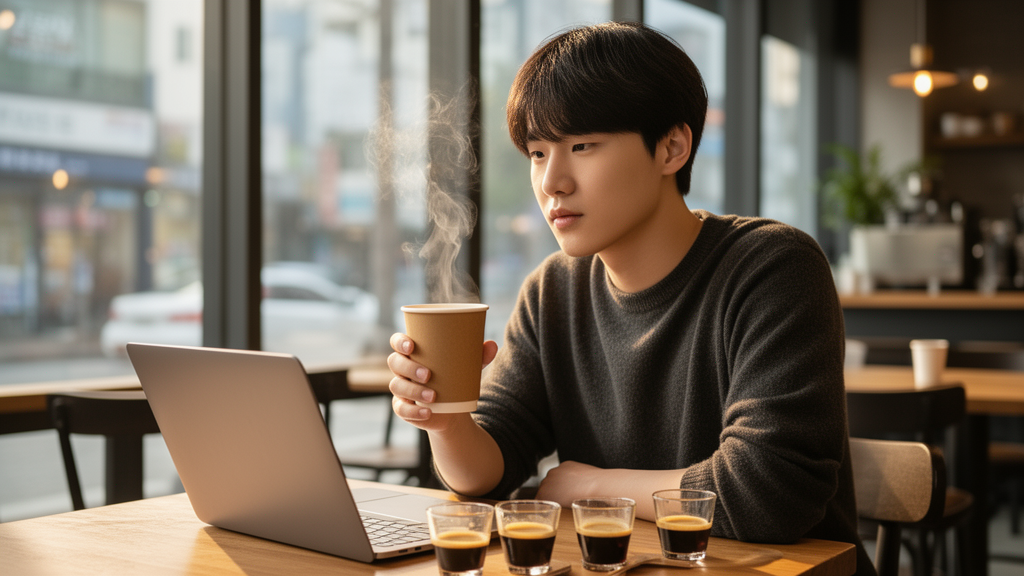
Caffeine is the most widely consumed psychoactive substance on the planet, and a new nationwide analysis suggests that South Korea’s love affair with it is deepening year by year. Researchers at Pusan National University Hospital combed through nine years of data from the Korea National Health and Nutrition Examination Survey, known as KNHANES, covering 2016 through 2024. Their conclusion, published in Frontiers in Nutrition, is that average daily caffeine intake among Korean adults has risen steadily, and that the share of people consuming amounts approaching or exceeding internationally recognized safety thresholds has grown along with it. The driver, perhaps unsurprisingly, is coffee, but the details of how Koreans drink it turn out to matter as much as how much.
The study is notable for its sheer scale. The researchers analyzed dietary recall data from 48,991 adults aged 19 and older, drawn from three consecutive waves of the national survey. Each participant completed a 24-hour dietary recall, listing everything consumed in a single day, and the team used beverage food codes and product information to identify caffeinated drinks. These were sorted into five categories: coffee, tea, energy drinks, cola-type beverages, and cocoa-based drinks. Caffeine content was then assigned to each beverage using mean concentrations from national monitoring data published by Korea’s Ministry of Food and Drug Safety, applied uniformly across all survey years to keep the estimates comparable over time.
The numbers tell a clear story. Mean daily caffeine intake increased by roughly 1.66 milligrams per day for each year of the study period, a statistically significant climb with a 95 percent confidence interval of 1.05 to 2.27 milligrams. More striking was what happened at the upper end of the distribution: the odds of consuming 400 milligrams or more in a day, the level many health authorities treat as the upper reference for adults, rose by about 5 percent per year. Men showed a steeper rise in average intake than women, at 2.22 milligrams per day annually versus 1.10, and the upward trend was concentrated among adults of working age. People aged 65 and older showed no significant change in mean intake at all.
Coffee’s dominance is nearly absolute. Among the 64.5 percent of participants classified as caffeine consumers, 90.8 percent drank coffee, far ahead of cola at 13.4 percent, tea at 4.7 percent, energy drinks at 1.6 percent, and cocoa beverages at a negligible 0.2 percent. Because participants could report more than one beverage in a day, those proportions sum to more than 100 percent, but the hierarchy is unambiguous. Energy drinks, despite their cultural reputation as the caffeine vector of anxious youth, barely register in the national picture. In Korea, caffeine is a coffee story, full stop.
But the kind of coffee is changing, and that shift may explain the rising numbers. The researchers observed a gradual move away from prepared coffee mixes, the sweet powdered sachets that long defined Korean office coffee culture, toward brewed and specialty coffee made from roasted beans or capsules. This matters for exposure because the drinks are not chemically equivalent. The assigned concentrations in the study put prepared coffee mixes at 571.9 milligrams of caffeine per liter, but roasted bean or capsule coffee at 522.8 milligrams per liter, and brewed servings tend to come in larger volumes. A tall Americano delivers more caffeine than a small sachet cup, and the specialty coffee boom means more people are drinking several of them a day.
The demographic patterns add a layer of social texture to the data. Caffeine consumers were more likely to be male, younger, employed, and better educated and wealthier than non-consumers. In the regression models, women aged 30 to 44 stood out with significantly elevated odds of high caffeine intake even after full adjustment for body mass index, socioeconomic status, and lifestyle factors, with an adjusted odds ratio of 1.62 compared with women aged 19 to 29. Women aged 45 to 64 also showed higher odds once lifestyle factors were accounted for. For men, the elevated odds seen in 30-to-44-year-olds in crude analyses faded after full adjustment, suggesting that occupation, income, and habits like smoking and drinking explain much of that group’s apparent risk.
The biology of why this matters is well mapped. Caffeine works primarily by antagonizing adenosine receptors of the A1 and A2A subtypes, blocking the neural pathways that promote sleepiness and ramping up sympathetic nervous system activity. That blockade triggers the release of catecholamines and cortisol, sharpening alertness in the short term but potentially creating a feedback loop in which fatigue, dependence, and escalating consumption feed one another. Sympathetic activation raises heart rate and blood pressure through beta-adrenergic stimulation, while the compound’s effects on the central nervous system, including suppression of rapid eye movement sleep, contribute to anxiety and disturbed sleep. The authors point out that this cycle is characteristic of working-age populations, the very group driving Korea’s rising intake.
The contrast with Western data is striking. Analyses of US NHANES data have generally found total caffeine intake stable or modestly declining over recent decades, even as coffee remains the dominant source, and European Food Safety Authority assessments suggest average adult intake across Europe sits below 400 milligrams per day with limited evidence of rising population-level exposure. Korea is moving in the opposite direction, with increasing odds of high intake among adults aged 19 to 64. The divergence, the authors suggest, reflects cross-cultural differences in coffee-drinking habits, the rapid growth of specialty coffee culture, longer working hours, and a greater reliance on caffeine for alertness among economically active adults. Older Koreans, meanwhile, consume far less caffeine than their American counterparts, likely reflecting generational preferences, greater sensitivity to caffeine’s effects, and deliberate avoidance tied to chronic disease management or sleep concerns.
The study’s limitations are worth keeping in view. A single 24-hour recall captures one day, not habitual intake, and day-to-day variation in caffeine consumption is substantial. The fixed mean concentrations, while ensuring comparability across survey years, cannot account for brand-specific differences or individual preparation methods, and caffeine from chocolate, medications, and supplements was excluded entirely. The repeated cross-sectional design also means the data show trends, not causes. Still, the methodological care is considerable: the team harmonized food codes across changing survey systems, manually reviewed ambiguous records, and applied survey weights, stratification, and clustering throughout to keep the estimates nationally representative.
What emerges is a portrait of a society whose caffeine exposure is quietly escalating with its coffee culture. The authors argue that the rising odds of high intake among working-age adults call for continued surveillance, age- and sex-specific public health guidance, better labeling practices, and consumer education about what, exactly, is in the cup. As brewed coffee displaces the sachet, the milligrams add up faster than most drinkers realize, and the national numbers now show it.
Subject of Research: Trends in beverage-derived caffeine intake among Korean adults from 2016 to 2024
Article Title: Beverage-based caffeine intake and high consumption trends among Korean adults, 2016–2024: a nationwide population-based study
Article References: Kim, J., Kim, G. L., Tak, Y. J., Lee, S. H., Ra, Y. J., & Yi, Y. H. (2026). Beverage-based caffeine intake and high consumption trends among Korean adults, 2016–2024: a nationwide population-based study. Frontiers in Nutrition, 13, Article 1913422. https://doi.org/10.3389/fnut.2026.1913422
Image Credits: AI Generated
DOI: 10.3389/fnut.2026.1913422
Keywords: caffeine intake, coffee consumption, KNHANES, South Korea, public health, nutritional epidemiology, energy drinks, specialty coffee, sleep disruption, dietary surveys, temporal trends, Frontiers in Nutrition
Cite Scienmag News
Daisy Hatcher. (October 19, 2026). Korean Adults Are Drinking More Caffeine Than Ever, Nationwide Study Finds. Scienmag. https://scienmag.com/korean-adults-are-drinking-more-caffeine-than-ever-nationwide-study-finds/
Daisy Hatcher. "Korean Adults Are Drinking More Caffeine Than Ever, Nationwide Study Finds." Scienmag, 19 October 2026, https://scienmag.com/korean-adults-are-drinking-more-caffeine-than-ever-nationwide-study-finds/. Accessed 19 October 2026.
Daisy Hatcher. "Korean Adults Are Drinking More Caffeine Than Ever, Nationwide Study Finds." Scienmag. October 19, 2026. https://scienmag.com/korean-adults-are-drinking-more-caffeine-than-ever-nationwide-study-finds/


