

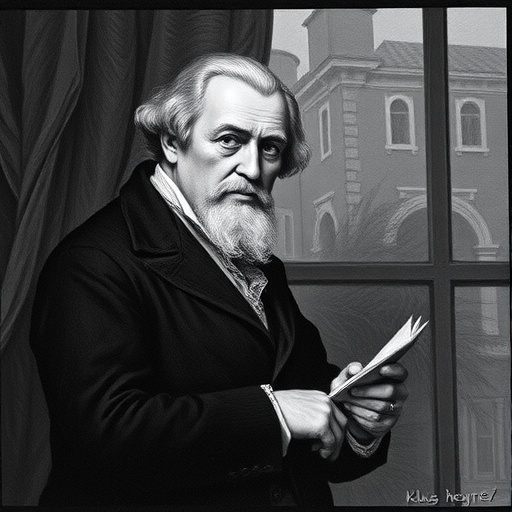
FRANKFURT — The Klaus Heyne Award for Research in German Romanticism has recognized two exceptional scholarly contributions in 2026, further establishing Goethe University Frankfurt’s reputation as a hub for innovative humanities research. The dual laureates, Dr. Kirill Chepurin and Dr. Elisabeth Ansel, explore divergent yet thematically intertwined facets of Romanticism, delving into philosophical and visual narratives that redefine contemporary understanding of this critical intellectual epoch.
Dr. Kirill Chepurin’s monograph, Bliss against the World: Schelling, Theodicy, and the Crisis of Modernity, published by Oxford University Press in 2024, undertakes a nuanced reassessment of Friedrich Wilhelm Joseph Schelling’s philosophical oeuvre. Schelling, a towering figure in German Romanticism, is reevaluated through the lens of a little-studied yet pivotal concept—“bliss” (Seligkeit). Chepurin argues that this transcendent state operates as a vital corrective to predominant interpretations that prioritize “happiness” (Glück-Seligkeit), thus unraveling the fabric of a modernity burdened by crisis and disenchantment.
Chepurin’s intellectual journey, stemming from his doctoral defense at Humboldt University Berlin in 2022, conceptualizes “bliss” as a dialectical antagonism toward both modernity’s rationalistic paradigms and traditional Christian frameworks. This reconfiguration illuminates Schelling’s envisioning of a reality characterized by undivided immanence, ontological indifference, and an emancipated freedom devoid of hierarchical constructs, possessions, and moral imperatives. The relentless movement towards this “unblissful” present’s dissolution encapsulates a quintessential Romantic aspiration for metaphysical renewal.
The scholarly jury responsible for the Klaus Heyne Award, comprising academia’s luminaries including Prof. Dr. Roland Borgards and Prof. Dr. Mechthild Fend, has praised Chepurin’s monograph for pioneering new critical pathways. The work persuasively contests established periodizations in Schelling studies, blending early and late phases into a holistic interpretation centered on “bliss.” Moreover, the monograph foregrounds an urgent critique of Schelling’s entanglements with racist and colonialist ideologies, exposing the darker undercurrents of his philosophical vision that intersect uncomfortably with the ideal of “bliss.”
The implications of Chepurin’s findings extend beyond historical exegesis, entering ethical and visionary domains germane to 21st-century discourses. The conceptual reframing offers a blueprint for rethinking freedom and metaphysics in contexts marked by sociopolitical upheaval and ecological precarity. Supported by his Heyne Award prize, Chepurin plans to orchestrate a major international conference at Goethe University in 2027, consolidating and expanding the dialogue sparked by his seminal research.
Chepurin’s interdisciplinary background—initially rooted in mathematics and mathematical logic from Moscow—has enriched his philosophical rigor and methodological clarity. His academic trajectory, marked by prominent fellowships and research appointments across Berlin, Hamburg, and Berkeley, converges in his current position as Research Fellow at the Institute for Cultural Inquiry in Berlin. His upcoming tenure as Assistant Professor of the Humanities at Bilkent University, Ankara, promises further scholarly production bridging European and global intellectual traditions.
In parallel, Dr. Elisabeth Ansel’s award-winning essay, “Ossianic images and visual translation processes in J.M.W. Turner and Carl Gustav Carus,” published by Manchester University Press in 2025, contributes a compelling art-historical perspective on Romanticism’s transnational character. By scrutinizing the visual reinterpretations of the Ossian myth by the eminent painter William Turner and the German polymath Carl Gustav Carus, Ansel reveals the porous cultural boundaries shaping late 18th and early 19th-century iconographies.
The Ossian phenomenon—revolving around James Macpherson’s controversial 1760s publications of purportedly ancient Gaelic poetry—provoked a resonance that transcended literary domains, galvanizing widespread reception in visual arts. Ansel’s comparative analysis scrutinizes celebrated works such as Turner’s Staffa, Fingal’s Cave (1831/32) and Carus’s Insel Staffa (pre-1846), disentangling their reception histories not as confined national romantic expressions but as rich sites of cultural translation and hybridization.
Rejecting reductive nationalist categorizations, Ansel frames Ossianic motifs as catalysts of “pluriform Romanticism,” reflecting dynamic transnational exchanges. Her method foregrounds the circulation, adaptation, and reframing of motifs between British and German artistic milieus, exemplifying broader patterns of Romanticism’s cosmopolitan diffusion. This approach invites renewed consideration of Romantic art historiography beyond rigid “school” classifications, emphasizing fluidity and multifaceted dialogue.
Ansel’s scholarly formation spans a remarkable interdisciplinary terrain with studies in Classics at Dublin, Law in Leipzig, and Art History combined with Sociology and Law at Technische Universität Dresden. Her doctoral dissertation on Jack B. Yeats and Irish Modernism, awarded summa cum laude in 2021, underscores her analytical sophistication and command of cross-cultural artistic currents. Her academic engagements through fellowships in Europe and the United States enrich her capacity to navigate complex cultural intersections.
The dual conferral of the Klaus Heyne Award in 2026 marks a milestone, introducing two distinct prize categories: a 4,000-euro award for monographs alongside a substantial 10,000-euro provision earmarked for organizing scholarly conferences, and a 1,000-euro prize recognizing superior essays. These new distinctions underline Goethe University’s commitment to fostering research that bridges traditional disciplinary boundaries and stimulates vibrant scholarly communities.
Enshrined in the legacy of Prof. Dr. Klaus Heyne, whose passion for German Romanticism and dedication to academic mentorship inspired this prize, the award has now entered its third iteration. Heyne’s vision privileges not only the celebration of outstanding young researchers but also the cultivation of innovative approaches that interrogate Romanticism’s relevance to contemporary thought and cultural practice.
The official awarding ceremony, slated for 22 June 2026 at Goethe University, will showcase these exemplary intellectual achievements and facilitate exchanges that propel ongoing Romanticism studies into new epochs. By honoring philosophical and art-historical investigations simultaneously, the Klaus Heyne Award embodies an integrative scholarly spirit characteristic of the very Romanticism it celebrates.
As the contributions of Dr. Chepurin and Dr. Ansel vividly demonstrate, Romanticism’s enduring vitality springs from its capacity to address fundamental questions of identity, freedom, culture, and metaphysical meaning. Their research revitalizes critical dialogues that transcend disciplinary silos, highlighting the Romantic imperative to reinterpret tradition in light of modern crises and aspirations.
This dynamic interplay between philosophy and visual culture, evident in the award recipients’ projects, also exemplifies the expanding frontiers of Romantic scholarship—embracing ethical critiques, cross-cultural perspectives, and the interrogation of problematic historical legacies alongside profound aesthetic innovations.
In an era increasingly defined by global interconnectedness and intellectual pluralism, these pioneering studies open pathways toward a more inclusive, critical, and nuanced understanding of Romanticism. They underscore the imperative for humanities research to engage rigorously with historical complexity while generating insights resonant with contemporary societal challenges.
The Klaus Heyne Award’s strategic support for both monographic depth and essayistic agility reflects Goethe University’s avant-garde approach to academic patronage. This model nurtures a new generation of scholars equipped to rethink the contours of German Romanticism and its multifaceted impact on culture and philosophy worldwide.
Subject of Research: German Romanticism with a focus on philosophical and artistic dimensions
Article Title: “Reimagining Romanticism: Klaus Heyne Award Honors Groundbreaking Research by Dr. Kirill Chepurin and Dr. Elisabeth Ansel”
News Publication Date: 2026
Web References: N/A
References: Chepurin, Kirill. Bliss against the World: Schelling, Theodicy, and the Crisis of Modernity. Oxford University Press, 2024; Ansel, Elisabeth. “Ossianic images and visual translation processes in J.M.W. Turner and Carl Gustav Carus.” In Picturing the Romantic: New Perspectives on European Romanticism(s) in the Visual Arts. Manchester University Press, 2025.
Image Credits: Claudia Peppel (ICI)
Keywords: German Romanticism, Friedrich Wilhelm Joseph Schelling, bliss, theodicy, modernity crisis, Ossian myth, J.M.W. Turner, Carl Gustav Carus, visual translation, transnational Romanticism, philosophical aesthetics, cultural hybridization


