


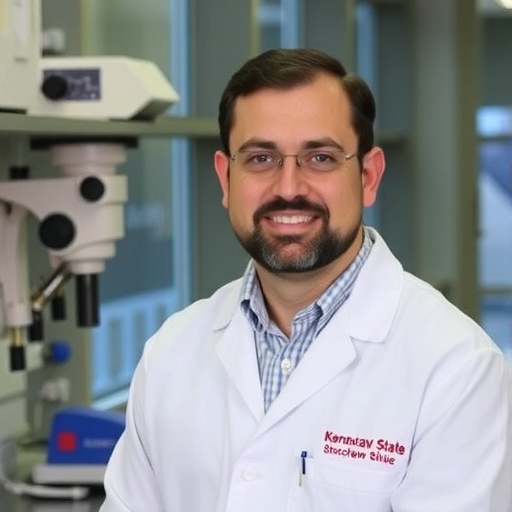
In the realm of gastroenterology, one of the most perplexing challenges faced by clinicians is the diagnosis and treatment of chronic gastrointestinal (GI) disorders. Millions suffer from persistent digestive issues that severely diminish quality of life, yet conventional diagnostic tools frequently fall short in detecting subtle abnormalities within the stomach and related organs. Enter Lei Shi, an assistant professor of mechanical engineering at Kennesaw State University, whose groundbreaking interdisciplinary research aims to revolutionize how GI disorders are understood, diagnosed, and treated through cutting-edge biomechanical modeling and computational simulation.
Shi’s work is situated within the Southern Polytechnic College of Engineering and Engineering Technology (SPCEET) at Kennesaw State University, where engineering principles merge with medical science to tackle complex biological problems. Supported by a National Science Foundation (NSF) grant, Shi’s team is pioneering the creation of patient-specific “digital twins” of the human stomach—sophisticated virtual models that replicate both the physical structure and electrical dynamics of this vital organ. These digital twins are crafted using an integrative approach that combines advanced medical imaging techniques, biomechanical tissue testing, and high-fidelity computational modeling.
At the core of this research lies the hypothesis that conventional diagnostic methods may miss critical changes occurring at the microscopic mechanical level within gastrointestinal tissues. Despite normal appearances on traditional endoscopy or imaging, the stomach may harbor subtle stiffness variations or disruptions in its intrinsic electrical signaling that profoundly impact its motility and function. Shi’s models incorporate these nuanced biomechanical and electrophysiological properties to create a dynamic simulation environment that parallels the real physiological behavior of the stomach with remarkable precision.
To build these models, Dr. Shi’s research collaborates closely with clinicians at Emory University, who provide a rich dataset that includes CT scans, endoscopic images, and a specialized diagnostic measurement called manometry. Manometry gauges pressure fluctuations and tissue deformation throughout the stomach and esophagus during digestion, giving unique insights into the organ’s biomechanical activity. Using this data, Shi’s lab runs a battery of mechanical tests—such as tensile and biaxial assays—to quantify tissue elasticity, stiffness, and response to physiological loading conditions.
“Two stomachs may appear identical, but their biomechanical properties could be worlds apart,” Shi explains. His experiments reveal how variations in tissue elasticity affect the contraction patterns and peristaltic waves essential for moving food through the digestive system. The integration of electrical signaling data into the modeling framework further enhances the fidelity of these digital twins. By simulating electrical wave propagation and its influence on tissue movement, the model captures critical feedback loops between the stomach’s mechanical and electrical subsystems.
This innovative approach holds tremendous potential not just for diagnosis but also for personalized therapeutic interventions. Current clinical evaluations provide limited predictive power when it comes to treatment efficacy or disease progression. However, digital twins offer a virtual testbed to simulate how varied therapeutic strategies—ranging from pharmacological to surgical—might alter gastric behavior. This paves the way toward precision medicine strategies where interventions can be optimized on a case-by-case basis, reducing trial-and-error and improving patient outcomes.
SPCEET Dean Lawrence Whitman emphasizes the transformative nature of this research, noting that it represents a symbiotic fusion of engineering, computational science, and clinical medicine. “Dr. Shi’s work exemplifies how multidisciplinary collaboration can lead to breakthroughs that improve lives,” Whitman remarks. The research is not confined to the stomach alone; Shi envisions extending his modeling techniques to the entire gastrointestinal tract, from the esophagus through the intestines, encompassing complex interactions such as the brain-gut axis, which influences digestion, mood, and immunity.
Incorporating machine learning algorithms is another frontier Shi plans to explore, aiming to accelerate the analysis and predictive capabilities of these models. By leveraging pattern recognition and data-driven insights, the research will evolve from static simulations to adaptive virtual platforms capable of real-time diagnostics. Drawing on Shi’s prior success modeling the heart, uterus, and cervix, this work uses analogous computational methods to expedite development and accuracy.
A unique aspect of this project is its immersive training environment for emerging scientists and engineers. Currently, Shi mentors Ph.D. students actively contributing to experimental mechanics and modeling, providing invaluable hands-on experience. “The interdisciplinary nature of this research enriches our understanding far beyond traditional engineering,” notes Yue Li, a doctoral candidate involved in the project. The collaboration fosters skill development in mechanical testing, data integration, and computational simulation, preparing students for careers at the nexus of engineering and biomedicine.
Emerging from the Intelligent Biomechanics lab on KSU’s Marietta Campus, this undertaking exemplifies how technological innovation can address healthcare’s persisting enigmas. By constructing detailed digital surrogates of the stomach, Shi’s team is opening new vistas in comprehending GI disorders that have long eluded accurate detection. Their comprehensive approach, uniting biomechanics with electrophysiology and medical imaging, propels the ambition of personalized digestive healthcare into a new era.
As the digital twin technology matures, it promises to influence clinical workflows significantly, reducing diagnostic ambiguity and enhancing treatment precision. Future integration with wearable sensors and real-time imaging could enable continuous monitoring of gastrointestinal function, offering unprecedented insight into disease onset and progression. Ultimately, Lei Shi’s pioneering work positions mechanical engineering at the forefront of transforming digestive health, embodying the next generation of intelligent medical technology.
News Publication Date: [Not provided]
Web References:
- Kennesaw State University Southern Polytechnic College of Engineering and Engineering Technology: https://www.kennesaw.edu/spceet/index.php
- Lei Shi’s Lab Homepage: https://facultyweb.kennesaw.edu/lshi/index.php
Cite Scienmag News
Ophelia Keating. (August 25, 2025). Kennesaw State Researcher Leverages Engineering Expertise to Uncover Solutions for Stomach Diseases. Scienmag. https://scienmag.com/kennesaw-state-researcher-leverages-engineering-expertise-to-uncover-solutions-for-stomach-diseases/
Ophelia Keating. "Kennesaw State Researcher Leverages Engineering Expertise to Uncover Solutions for Stomach Diseases." Scienmag, 25 August 2025, https://scienmag.com/kennesaw-state-researcher-leverages-engineering-expertise-to-uncover-solutions-for-stomach-diseases/. Accessed 4 September 2026.
Ophelia Keating. "Kennesaw State Researcher Leverages Engineering Expertise to Uncover Solutions for Stomach Diseases." Scienmag. August 25, 2025. https://scienmag.com/kennesaw-state-researcher-leverages-engineering-expertise-to-uncover-solutions-for-stomach-diseases/


