


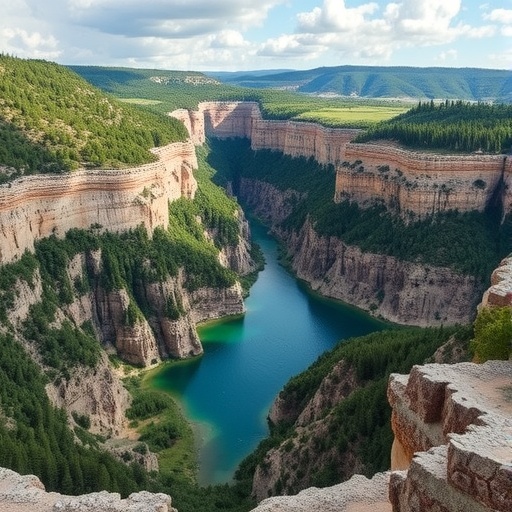
In the quest to unravel Earth’s complex carbon cycle and its implications for climate regulation, a groundbreaking study from Guizhou University illuminates the profound role of karst reservoirs as powerful agents of carbon sequestration. Published in the journal Carbon Research, this investigation offers a mechanistic insight into how biological processes in karst landscapes contribute to the burial of carbon in sediments, effectively locking it away in forms resistant to degradation. This research goes beyond mere quantification—it uncovers the intricate interplay between geological formations and biological activity that culminates in exceptional carbon storage capacity, challenging prevailing assumptions in global carbon budgeting.
Karst regions, characterized by soluble carbonate rocks like limestone, are unique geochemical theaters where dynamic interactions between water, rock, and biota profoundly influence carbon fluxes. The Songbaishan Reservoir in China, selected as the focal point for this study, exemplifies these processes. This reservoir is enriched with dissolved inorganic carbon (DIC) derived from the weathering of surrounding carbonate formations, which serves as a substrate for aquatic photosynthesis. The research team employed a suite of advanced analytical methodologies—including stable isotope investigations, detailed fractionation of organic carbon pools, and ultra-high resolution mass spectrometry—to dissect the cycling and burial pathways of carbon within the system.
Central to these findings is the biological carbon pump (BCP), a critical mechanism wherein autotrophic planktonic organisms assimilate dissolved inorganic carbon and convert it into organic biomass. During warmer months, thermal stratification establishes a stable upper water column layer, fostering prolific algal blooms. This phase dramatically enhances in-reservoir (autochthonous) production of organic carbon. The investigators quantified this internal generation of organic carbon and found the burial rates in the sediment to be remarkably high—averaging 89.5 grams of carbon per square meter annually. This rate significantly surpasses those documented in many non-karstic freshwater reservoirs, highlighting the potency of karst systems in carbon sequestration.
Yet the significance of the study lies not solely in volume but in the nature and stability of the carbon that is buried. Sediment analyses revealed that approximately 60% of the organic carbon preserved in the Songbaishan sediments comprises recalcitrant organic carbon (ROC). ROC is defined by molecular structures highly resistant to microbial decomposition, conferring long-term persistence in sedimentary environments. This transformation from labile biomass into stable ROC underscores a two-step mechanism: initial biotic synthesis via the BCP, followed by alteration and stabilization processes within the sediment matrix. This dichotomy is pivotal in sustaining the long-term carbon sink function of karst reservoirs.
Professor Wanfa Wang, leading the research, emphasizes that this dual-phase process—biological production followed by sedimentary stabilization—constitutes the cornerstone of karst reservoirs’ enhanced capacity for carbon storage. The elevated ROC/TOC (total organic carbon) ratios observed provide a novel, quantifiable metric for assessing carbon sequestration efficacy in freshwater systems. This insight is poised to refine models of carbon cycling in karst landscapes and could recalibrate estimations of global carbon sink capacities.
The implications of these findings extend beyond regional hydrology to global climate mitigation strategies. Karst landscapes constitute a substantial fraction of the Earth’s surface area, yet their contribution to carbon sequestration has often been underestimated or overlooked in large-scale carbon budgets. This study signals the need for incorporating the biological and geochemical idiosyncrasies of karst reservoirs into predictive climate models. Such integration could unlock new pathways for leveraging natural ecosystems in carbon management and climate resilience initiatives.
Methodologically, the research stands out for its comprehensive approach, integrating isotopic tracing to differentiate between allochthonous (externally sourced) and autochthonous carbon inputs, while high-resolution mass spectrometry untangles the molecular composition and degradation states of sedimented organic matter. Organic carbon fractionation techniques further delineate pools according to biodegradability, enabling precise estimation of recalcitrance. This multipronged analytical strategy allowed the team to elucidate carbon fate with unprecedented detail, offering a template for similar studies in varying ecohydrological contexts.
The study sheds light on temporal dynamics as well. Seasonal variations govern the stratification and productivity cycles within the reservoir. Warmer periods promote intensified biological activity and carbon fixation, while colder intervals see diminished photosynthetic rates and potential remobilization of labile organic compounds. However, the net effect remains overwhelmingly one of long-term carbon sequestration, with recalcitrant fractions ensuring stable burial across annual cycles. Understanding these temporal patterns is vital for managing reservoir operations to optimize carbon storage outcomes.
Moreover, these insights open avenues for enhancing carbon sequestration through reservoir management, such as regulating water column mixing or nutrient inputs to sustain high biological productivity while promoting the stabilization of organic carbon in sediments. Such ecosystem-based approaches may complement technological interventions in carbon mitigation, offering cost-effective, sustainable mechanisms rooted in natural processes.
This research exemplifies the synergy between geology and biology in climate science. It underscores the importance of interdisciplinary approaches that combine geochemical expertise with ecological understanding to unravel complex environmental phenomena. As climate change intensifies, detailed comprehension of carbon sinks like karst reservoirs becomes indispensable for crafting effective mitigation policies.
In conclusion, the study not only elevates the scientific understanding of carbon burial mechanisms in karst reservoir systems but also provides practical frameworks and metrics that can guide future research and environmental management. By revealing the centrality of the biological carbon pump and the formation of recalcitrant organic carbon in sustaining long-term carbon storage, it charts a promising course towards harnessing natural reservoirs in the global response to climate challenges.
News Publication Date: 26-May-2026
Web References: DOI link
Keywords
Environmental sciences, Earth sciences, Bioactivity, Organic carbon, Carbon sequestration
Cite Scienmag News
Violet Maxwell. (May 28, 2026). Karst Reservoirs Uncovered: Nature’s Potent Carbon Storage Champions. Scienmag. https://scienmag.com/karst-reservoirs-uncovered-natures-potent-carbon-storage-champions/
Violet Maxwell. "Karst Reservoirs Uncovered: Nature’s Potent Carbon Storage Champions." Scienmag, 28 May 2026, https://scienmag.com/karst-reservoirs-uncovered-natures-potent-carbon-storage-champions/. Accessed 5 September 2026.
Violet Maxwell. "Karst Reservoirs Uncovered: Nature’s Potent Carbon Storage Champions." Scienmag. May 28, 2026. https://scienmag.com/karst-reservoirs-uncovered-natures-potent-carbon-storage-champions/


