

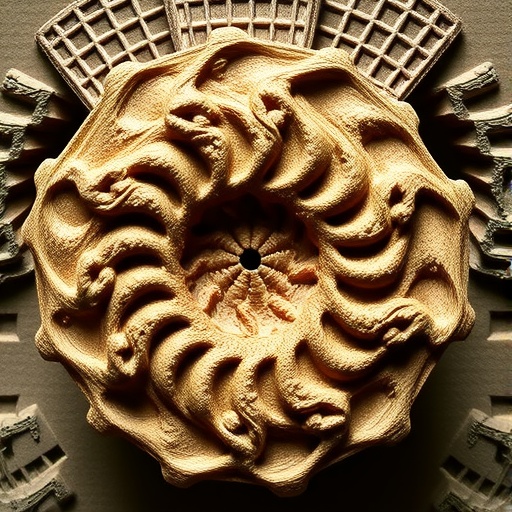
In a groundbreaking study, researchers have made significant strides in our understanding of Jurassic ammonites, particularly focusing on the calcitic coverings of their lower jaws. The team led by Demény, Bujtor, and Domokos has revealed that these structures exhibit intricate Bouligand-like patterns, which have sparked interest in both paleontological and biomimetic research communities. This research was made public through the journal “Commun Earth Environ,” with substantial implications for how we interpret the morphological adaptations of ancient marine organisms.
The discovery of Bouligand-like structures in the calcitic coverings provides novel insights into the evolutionary mechanisms that may have governed the development of these fascinating creatures. Bouligand structures, known for their unique multilayered arrangement, showcase natural engineering that has inspired a variety of fields, including material science and architecture. Understanding their occurrence in Jurassic ammonites could inform future innovations in bio-inspired design and the creation of advanced materials mimicking natural processes.
Accompanying this primary discovery is an extensive dataset of stable carbon and oxygen isotopes that facilitates further analysis of the environmental conditions in which these ammonites thrived. With this data now publicly available through the EarthChem Library, the research opens the door for interdisciplinary collaboration, laying a foundation for geochemists, paleobiologists, and evolutionary biologists to examine the relationships between ancient organisms and their ecosystems.
The implications of these findings are far-reaching. For one, they hint at a possible link between the physical structures of ammonites and their ecological strategies. As prey and predation dynamics were in constant flux during the Jurassic, understanding the adaptive significance of jaw structures could illuminate the evolutionary pressures at play during that time. The research team aims to utilize isotopic data combined with morphological studies to further unravel these ecological interactions.
In their quest to decipher the functional roles of these calcitic jaws, the researchers employed advanced imaging techniques to visualize the structural intricacies. Using methods such as electron microscopy, they identified the specific arrangement of calcium carbonate crystals which resulted in the Bouligand-like motifs. This not only highlights the sophistication of ammonite morphology but also underscores the evolutionary innovations that sustained them in the competitive marine environments of the past.
Furthermore, the emergence of complex organic structures in the fossil record poses important questions concerning the evolution of biomineralization. This process, whereby living organisms produce minerals, has intrigued scientists for years, revealing how soft tissues can lead to hard structures. The discovery in these ammonites sheds light on the evolutionary trajectory of biomineralization, suggesting that such capabilities may have provided advantages in mobility, predation, and perhaps even reproductive success during the Jurassic period.
The study’s relevance is not confined to paleontology; its findings resonate with contemporary discussions in material science. The intricate, layered structures observed in the jurassic ammonites’ jaw coverings offer a blueprint that scientists could use to create new composite materials with enhanced strength and durability. This move toward bio-inspired materials not only has the potential to revolutionize construction and manufacturing industries but also emphasizes the importance of looking to nature for innovative solutions to modern challenges.
As climate change and other environmental pressures continue to threaten biodiversity today, examining how ancient species adapted offers valuable lessons for modern conservation strategies. The ammonite’s success story during the Jurassic—a period characterized by dramatic shifts in climate and sea levels—proves the resilience of life in the face of adversity. Drawing parallels between their adaptations and those needed in our current ecosystems could foster a deeper understanding of how species might cope with rapid environmental changes in the future.
In addition, the isotopic analyses detailed in Supplementary Table 1 provide a nuanced view of the relationship between these organisms and their surrounding environments. By analyzing carbon and oxygen isotopes, the researchers inferred aspects of water temperature, chemistry, and productivity that influenced the ammonites’ ecological niches. Such insights are invaluable for reconstructing paleoenvironments and understanding the geological contexts within which these species evolved.
The study prominently reinforces the interconnectedness of life forms through geological time, illustrating how even the slightest variations in environmental conditions can lead to dramatic evolutionary changes. This reflects a broader pattern seen throughout Earth’s history, where fluctuations in climate and geology precipitate adaptations in various taxa. Recognizing these connections between past and present serves as a crucial reminder of the fragility of ecosystems and the interdependencies within them.
Moreover, the pursuit of this research exemplifies the collaborative nature of modern science. By integrating fossil records with geochemical analysis and state-of-the-art imaging techniques, the team has pushed the boundaries of what is possible in paleontological studies. Such interdisciplinary work not only enriches the findings but also encourages other researchers to adopt similar integrative approaches to study ancient lifeforms.
As we move forward, the implications of these findings will undoubtedly inspire future research endeavors. The continuation of such studies will contribute to a more holistic understanding of marine biodiversity’s history and the potential adaptive strategies of organisms facing ongoing environmental fluctuations. This research stands as a testament to how technological advancements paired with creative thinking can unlock the mysteries of the past.
In conclusion, the discovery of Bouligand-like structures in Jurassic ammonites signifies a momentous contribution to the fields of paleontology, geology, material science, and conservation. As we glean insights from these ancient organisms, they provide not only a glimpse into a bygone era but also lessons that can shape the future of biodiversity and ecological resilience in our rapidly changing world.
Cite Scienmag News
Violet Maxwell. (November 19, 2025). Jurassic Ammonite Jaws Show Bouligand-like Structures. Scienmag. https://scienmag.com/jurassic-ammonite-jaws-show-bouligand-like-structures/
Violet Maxwell. "Jurassic Ammonite Jaws Show Bouligand-like Structures." Scienmag, 19 November 2025, https://scienmag.com/jurassic-ammonite-jaws-show-bouligand-like-structures/. Accessed 4 November 2026.
Violet Maxwell. "Jurassic Ammonite Jaws Show Bouligand-like Structures." Scienmag. November 19, 2025. https://scienmag.com/jurassic-ammonite-jaws-show-bouligand-like-structures/