

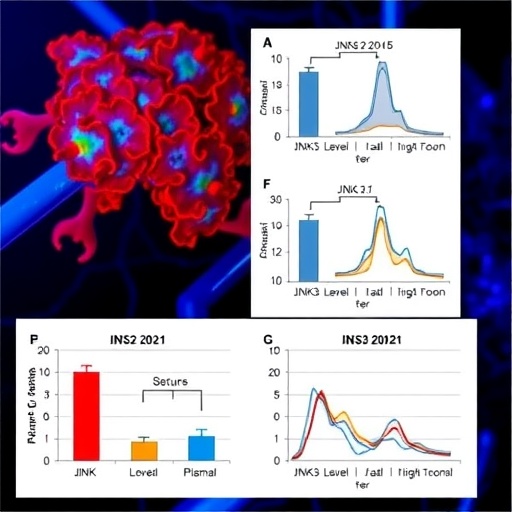
In an exciting development that could revolutionize the early diagnosis and monitoring of Parkinson’s disease, scientists have unveiled a groundbreaking biomarker detectable in blood plasma: JNK3. This novel approach promises to transform the landscape of neurodegenerative disease diagnostics by offering a less invasive, more accessible means of assessing neuronal damage at the molecular level.
Parkinson’s disease, a chronic and progressive movement disorder, results primarily from the loss of dopaminergic neurons in the substantia nigra region of the brain. Despite its prevalence, accurate early detection remains a significant challenge in clinical neurology. Current diagnostic methods rely heavily on symptom observation and neuroimaging, which often detect the disease only after substantial neuronal degeneration has occurred. Enter JNK3 quantification—a technological stride forward that allows clinicians to measure neuronal injury through a simple blood test.
JNK3, or c-Jun N-terminal kinase 3, is a member of the MAP kinase family selectively expressed in neurons. Its activation is intimately involved in neuronal apoptosis and stress responses, making it a key molecular player in neurological disorders. Prior to this study, JNK3’s role was primarily recognized in cell signaling contexts within animal models and limited pathological analyses. The recent work, however, demonstrates that JNK3 levels in plasma can serve as a direct indicator of neuronal damage in Parkinson’s disease patients.
Detecting JNK3 in plasma entails sophisticated biochemical techniques, most notably the utilization of high-sensitivity immunoassays tailored to differentiate JNK3 from other isoforms and related kinases. Researchers employed cutting-edge antibody-based assays combined with mass spectrometry validation to achieve the sensitivity and specificity required. The methodology involved capturing plasma samples from Parkinson’s patients and age-matched healthy controls, followed by exhaustive quantitative analysis to ascertain differential JNK3 expression.
This biomarker’s identification hinges on the pathophysiology of Parkinson’s disease itself. As dopaminergic neurons undergo degeneration, downstream signaling cascades, including the activation of JNK3, become dysregulated. The subsequent release of phosphorylated JNK3 fragments or its associated proteins into the circulatory system offers a molecular fingerprint reflective of neuronal injury. Such a pattern is invaluable for detecting early-stage neurodegeneration before overt clinical symptoms manifest profoundly.
Moreover, longitudinal studies encompassing Parkinson’s patients over various disease stages revealed a strong correlation between plasma JNK3 concentrations and disease severity, as measured by established clinical scales such as the Unified Parkinson’s Disease Rating Scale (UPDRS). This correlation suggests that monitoring JNK3 levels could be employed not only for diagnosis but also for tracking disease progression and therapeutic efficacy.
The implications of this research extend into therapeutic development and personalized medicine. By quantifying neuronal damage in real time, clinicians may better tailor treatment strategies to individual disease trajectories. It opens avenues to evaluate neuroprotective therapies swiftly and objectively, accelerating drug discovery and clinical trials aimed at halting or reversing neurodegeneration.
This landmark study also addresses the critical need for minimally invasive diagnostic tools in neurodegenerative diseases. Cerebrospinal fluid (CSF) sampling, though informative, involves lumbar punctures that are cumbersome and carry risks. Blood-based biomarkers like plasma JNK3 pave the way for widespread screening and ongoing patient monitoring with significantly reduced discomfort and risk.
However, integrating JNK3 quantification into clinical practice requires overcoming several challenges. Standardization of assay protocols, establishment of reference intervals across diverse populations, and validation against larger multi-center cohorts are necessary steps. Furthermore, researchers must clarify the specificity of elevated JNK3 for Parkinson’s disease relative to other neurodegenerative disorders such as Alzheimer’s disease or multiple system atrophy.
The discovery also invigorates neurological research beyond Parkinson’s disease. The pathophysiological role of JNK3 in various models of neuronal cell death suggests potential applications in traumatic brain injury, stroke, and other neurodegenerative conditions. Understanding how JNK3 modulation affects neuron viability may unlock novel neurotherapeutic targets.
Beyond the molecular and clinical implications, this advancement highlights the power of interdisciplinary collaboration among neurologists, molecular biologists, and bioengineers. The fusion of fundamental neuroscience with state-of-the-art assay technology exemplifies how translational research can bridge gaps from bench to bedside, delivering tangible benefits to patients.
Ethical considerations also arise as biomarkers become clinically available. Early detection raises questions regarding patient counseling, the psychological impact of pre-symptomatic diagnosis, and decisions regarding interventions without definitive cures. Protocols must be developed to handle these nuances sensitively and responsibly.
In summary, the quantification of JNK3 in plasma heralds a new era in Parkinson’s disease diagnosis and management. It introduces a biomarker with the promise of early detection, accurate disease monitoring, and accelerated therapeutic evaluation, potentially transforming patient outcomes. While hurdles remain, the scientific and medical communities are enthusiastic about this promising avenue.
Looking forward, ongoing research will undoubtedly refine the assay techniques, explore combinatorial biomarker panels incorporating JNK3, and extend investigations into broader neurodegenerative contexts. Such advances will be critical in realizing the full potential of JNK3 as a clinical tool and in deciphering the complex molecular underpinnings of neuronal degeneration.
Ultimately, the aspiration is that patients with Parkinson’s disease will benefit from earlier intervention, personalized therapies, and improved quality of life through innovations like plasma JNK3 quantification. This discovery stands as a beacon of hope in the relentless fight against debilitating neurodegenerative disorders, signaling transformative progress on the horizon.
Subject of Research: Identification and quantification of JNK3 in plasma as a biomarker for neuronal damage in Parkinson’s disease.
Article Title: JNK3 quantification in plasma: a novel biomarker for neuronal damage in Parkinson’s disease.
Article References: Vacchi, E., Giani, A., Perta, N. et al. JNK3 quantification in plasma: a novel biomarker for neuronal damage in Parkinson’s disease. npj Parkinsons Dis. (2025). https://doi.org/10.1038/s41531-025-01224-4
Image Credits: AI Generated


