

Monday, October 26, 2026
Science
No Result
View All Result
  • Login
  • HOME
  • SCIENCE NEWS
  • CONTACT US
  • HOME
  • SCIENCE NEWS
  • CONTACT US
No Result
View All Result
Scienmag
No Result
View All Result
Home Science News Earth Science

January Pollarding Emerges as Best Practice for Sustainable Acacia Fuelwood in Ethiopia

October 26, 2026
in Earth Science
Violet Maxwell
By Violet Maxwell Scienmag Editorial Profile - Natural Hazards
Reading Time: 3 mins read
0
January Pollarding Emerges as Best Practice for Sustainable Acacia Fuelwood in Ethiopia

January Pollarding Emerges as Best Practice for Sustainable Acacia Fuelwood in Ethiopia

65
SHARES
587
VIEWS
Share on FacebookShare on Twitter
ADVERTISEMENT

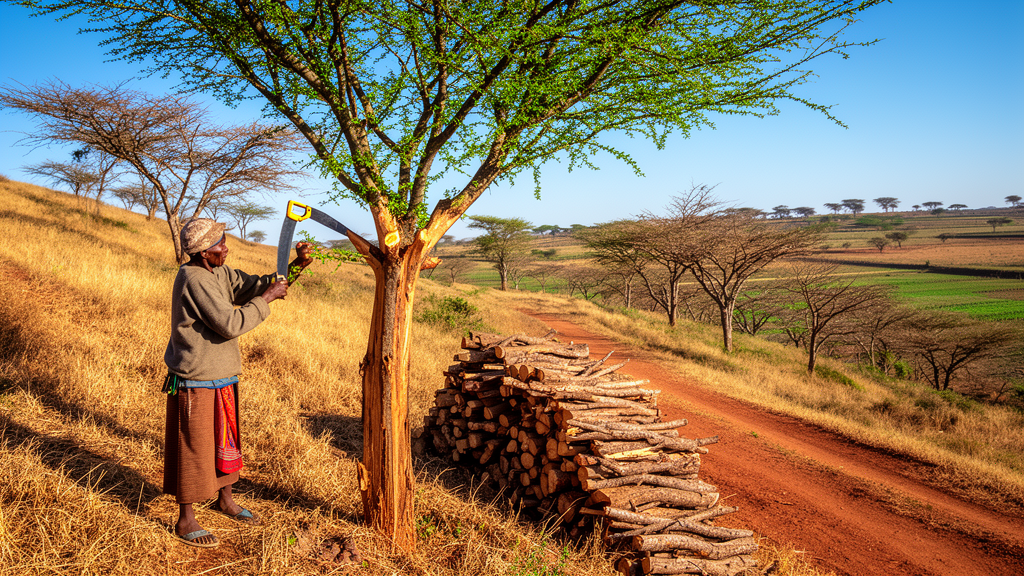
In the parkland agroforestry systems of Eastern Amhara, Ethiopia, the tree Acacia seyal supplies rural households with fuelwood, building poles, forage, gums, and tannins. A new field study has tested how two traditional management practices, pollarding and coppicing, affect the trees' productivity and survival, and the results point to a clear best option: pollarding carried out in January. The research was conducted in two districts, Habru (Molla Georgis Kebele) and Gubalafto (Jarssa Kebele), using a randomized complete block design with three replications.

Trees were subjected to pollarding or coppicing in three different seasons: July, October, and January. The researchers then measured how the treatments influenced single-tree volume, total tree volume, and the survival of new sprouts. The findings, published as an open-access article in Discover Sustainability, showed that pollarding and coppicing significantly influenced single-tree volume, which ranged from 0.022 to 0.027 cubic meters.

However, neither practice had a significant effect on total tree volume, suggesting that the choice of management technique matters more for individual tree form than for stand-level wood output. The most striking difference appeared in sprout survival. Pollarded trees produced new sprouts with survival rates of 85 to 92 percent across all seasons, while coppiced trees achieved only 38 to 42 percent.

This gap indicates that coppicing, which cuts trees close to the ground, is far less reliable for regenerating Acacia seyal than removing only the upper branches. Season also proved important. Pollarding in January emerged as the most suitable practice for two reasons.

First, it reduced the impact on crops growing beneath and around the trees in the parkland system. Second, it aligned with local socio-cultural activities, including weddings, Edir gatherings, funerals, and annual ceremonies. Trees like Acacia seyal provide multiple products simultaneously with crop production, but the study's authors note a gap in knowledge about sustainable management practices specifically for fuelwood and charcoal production.

Based on their results, the researchers recommend promoting January pollarding through extension services as a way to balance ecological sustainability with community needs. At the same time, they suggest discouraging coppicing during dry months, when the low sprout survival rates observed in the trial would undermine tree regeneration and long-term wood supply. The team also recommends integrating these practices into local agroforestry guidelines to enhance sustainable fuelwood production.

Because the study was limited to two kebeles in Eastern Amhara and a single tree species, the authors' conclusions apply to the conditions they tested; nevertheless, the combination of biological evidence and socio-cultural fit makes January pollarding a practical candidate for wider adoption in similar parkland systems. For communities that depend on Acacia seyal for daily energy needs, the message is straightforward: the timing and technique of harvesting determine whether the resource persists. Choosing pollarding over coppicing, and scheduling it for January, could keep both the trees and the traditions they support alive.

Subject of Research: Silvicultural management of Acacia seyal in Ethiopian parkland agroforestry for sustainable fuelwood and charcoal production

Article Title: Silvicultural management practices of Acacia seyal under parkland agroforestry for sustainable fuel wood and charcoal production in Eastern Amhara, Ethiopia

Article References: Hodaddis, K., Tigabu, R., Derbie, W., Gezahagne, G., Andualem, A., Gebeyehu, A., Muluken, W., Abeje, E., & Berhanie, K. (2026). Silvicultural management practices of Acacia seyal under parkland agroforestry for sustainable fuel wood and charcoal production in Eastern Amhara, Ethiopia. Discover Sustainability. https://doi.org/10.1007/s43621-026-04619-2

Image Credits: AI Generated

DOI: 10.1007/s43621-026-04619-2

Keywords: Acacia seyal, parkland agroforestry, fuelwood, charcoal, pollarding, coppicing, Ethiopia, Eastern Amhara, tree management, sprout survival, Discover Sustainability, silviculture

Cite Scienmag News

Violet Maxwell. (October 26, 2026). January Pollarding Emerges as Best Practice for Sustainable Acacia Fuelwood in Ethiopia. Scienmag. https://scienmag.com/january-pollarding-emerges-as-best-practice-for-sustainable-acacia-fuelwood-in-ethiopia/


Violet Maxwell. "January Pollarding Emerges as Best Practice for Sustainable Acacia Fuelwood in Ethiopia." Scienmag, 26 October 2026, https://scienmag.com/january-pollarding-emerges-as-best-practice-for-sustainable-acacia-fuelwood-in-ethiopia/. Accessed 26 October 2026.

Violet Maxwell. "January Pollarding Emerges as Best Practice for Sustainable Acacia Fuelwood in Ethiopia." Scienmag. October 26, 2026. https://scienmag.com/january-pollarding-emerges-as-best-practice-for-sustainable-acacia-fuelwood-in-ethiopia/

Tags: Acacia seyalAcacia seyal tree productivityagroforestry systems in Eastern AmharacharcoalcoppicingDiscover SustainabilityEastern Amharaeffects of pollarding on sprout survival EthiopiaEthiopiafuelwoodJanuary pollarding for agroforestryopen-access research on sustainable forestryparkland agroforestrypollardingrural fuelwood sourcing Ethiopiaseasonal impact on Acacia managementsilviculturesprout survivalstand-level wood output vs individual tree growthsustainable Acacia fuelwood management Ethiopiatraditional pollarding and coppicing practices Ethiopiatree managementtree pruning practices for biomass productiontree survival rates in Ethiopian agroforestry
Share26Tweet16
Previous Post

When AI Inference Crosses Borders in Seconds, Who Can Legally Reconstruct What Happened?

Next Post

AI market swings track technology stocks more than clean energy

Related Posts

AI market swings track technology stocks more than clean energy
Earth Science

AI market swings track technology stocks more than clean energy

October 26, 2026
Effective government, regulation and rule of law track innovation in poorer economies
Earth Science

Effective government, regulation and rule of law track innovation in poorer economies

October 26, 2026
Indigenous Knowledge Systems Linked to Climate Resilience Across Ghana’s Ecological Zones
Earth Science

Indigenous Knowledge Systems Linked to Climate Resilience Across Ghana’s Ecological Zones

October 26, 2026
From Literacy to Competence: Systematic Review Maps Sustainability Education’s Conceptual Shift
Earth Science

From Literacy to Competence: Systematic Review Maps Sustainability Education’s Conceptual Shift

October 26, 2026
Firm size, R&D and exports linked to sustainable energy management in Vietnam
Earth Science

Firm size, R&D and exports linked to sustainable energy management in Vietnam

October 26, 2026
Water limits dominate Greece’s food, energy and ecosystem trade-offs, model finds
Earth Science

Water limits dominate Greece’s food, energy and ecosystem trade-offs, model finds

October 26, 2026
Next Post
AI market swings track technology stocks more than clean energy

AI market swings track technology stocks more than clean energy

  • Mothers who receive childcare support from maternal grandparents show more optimized

    Mothers who receive childcare support from maternal grandparents show more parental warmth, finds NTU Singapore study

    27656 shares
    Share 11059 Tweet 6912
  • University of Seville Breaks 120-Year-Old Mystery, Revises a Key Einstein Concept

    1061 shares
    Share 424 Tweet 265
  • Bee body mass, pathogens and local climate influence heat tolerance

    682 shares
    Share 273 Tweet 171
  • Researchers record first-ever images and data of a shark experiencing a boat strike

    546 shares
    Share 218 Tweet 137
  • Groundbreaking Clinical Trial Reveals Lubiprostone Enhances Kidney Function

    531 shares
    Share 212 Tweet 133
Science

Embark on a thrilling journey of discovery with Scienmag.com—your ultimate source for cutting-edge breakthroughs. Immerse yourself in a world where curiosity knows no limits and tomorrow’s possibilities become today’s reality!

RECENT NEWS

  • AI market swings track technology stocks more than clean energy
  • January Pollarding Emerges as Best Practice for Sustainable Acacia Fuelwood in Ethiopia
  • When AI Inference Crosses Borders in Seconds, Who Can Legally Reconstruct What Happened?
  • AI learns to hear emotion in solo violin through contrastive self-teaching

Categories

  • Agriculture
  • Anthropology
  • Archaeology
  • Athmospheric
  • Biology
  • Biotechnology
  • Blog
  • Bussines
  • Cancer
  • Chemistry
  • Climate
  • Earth Science
  • Editorial Policy
  • Marine
  • Mathematics
  • Medicine
  • Pediatry
  • Policy
  • Psychology & Psychiatry
  • Science Education
  • Science News
  • Social Science
  • Space
  • Technology and Engineering

Subscribe to Blog via Email

Enter your email address to subscribe to this blog and receive notifications of new posts by email.

Join 5,151 other subscribers

© 2025 Scienmag - Science Magazine

Welcome Back!

Login to your account below

Forgotten Password?

Retrieve your password

Please enter your username or email address to reset your password.

Log In
No Result
View All Result
  • HOME
  • SCIENCE NEWS
  • CONTACT US

© 2025 Scienmag - Science Magazine

Discover more from Science

Subscribe now to keep reading and get access to the full archive.

Continue reading