


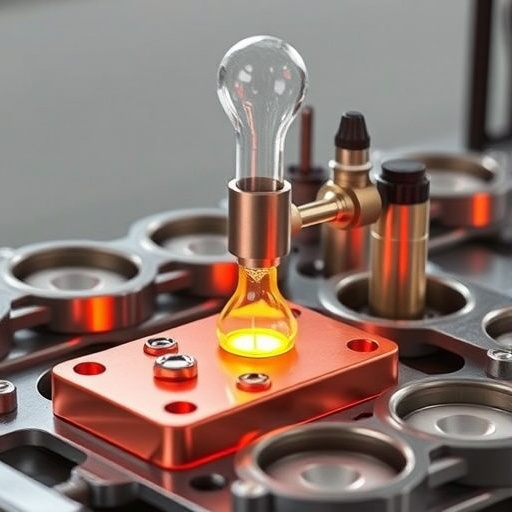
In the relentless pursuit of advanced materials with remarkable properties, high-entropy alloys (HEAs) have emerged as a revolutionary class, boasting exceptional strength, corrosion resistance, and thermal stability. Traditionally, synthesizing these alloys relies heavily on rapid cooling solidification techniques that kinetically trap high-temperature, mixed-element states. However, such methods encounter intrinsic challenges in controlling the crystallinity, structural uniformity, and morphology of the resultant HEAs, especially when striving to combine intrinsically immiscible elements that naturally resist mixing.
Breaking new ground, a team of researchers led by Zhang, Gallant, and Chen has introduced a transformative synthesis strategy that circumvents the limitations of quenching-based approaches. Their novel method, termed isothermal solidification, pioneers an entirely different pathway by facilitating rapid elemental mixing and alloy formation through liquid–liquid interface reactions carried out at comparatively low temperatures ranging from ambient (25°C) to moderately warm (80°C) conditions. This approach does not depend on sudden temperature drops but leverages a controlled, stable environment where diverse metals can diffuse and incorporate into an evolving alloy phase.
At the heart of the process lies the use of a gallium (Ga)-based liquid metal. Gallium’s unique properties—low melting point, excellent wetting ability, and high solubility for multiple metals—make it an ideal sacrificial reagent and mixing matrix. When Ga is brought into contact with an aqueous solution containing metal ions, reduction reactions occur selectively at the liquid metal/solution interface. Metal ions deposit and diffuse rapidly into the Ga liquid phase, enabling unprecedented compositional tuning and swift homogenization within the metallic melt without the need for elevated temperatures or rapid quenching.
One of the standout outcomes of this technique is the ability to precisely dictate the crystallinity of the HEAs produced. The researchers demonstrated the formation of alloys spanning the entire spectrum—from single crystals to mesocrystals, through polycrystals, and even amorphous structures. This level of control opens vast possibilities for tailoring physical and mechanical properties to specific applications by leveraging unique atomic arrangements and grain boundary characteristics intrinsic to each structural category.
Morphological versatility is another striking feature of this isothermal solidification pathway. The process supports the synthesis of HEA materials across zero-dimensional (nanoparticles), two-dimensional (thin films or nanosheets), and three-dimensional (bulk) morphologies. Such dimensional control is highly sought after in catalysis, electronics, and structural applications where material shape critically influences performance.
Significantly, the reaction conditions allow for complete consumption of the Ga medium, culminating in gallium-free HEAs—thus avoiding contamination or residual phases that could detract from material purity and properties. In cases where Ga is deliberately retained, it can be incorporated as an alloying component, providing additional compositional flexibility that can endow novel characteristics or functional advantages.
To elucidate the underlying mechanisms, the research team employed advanced in situ liquid phase transmission electron microscopy (TEM) combined with theoretical modeling. These studies revealed the fascinating dynamics of nucleation and growth during isothermal alloy formation. Unlike the classical steady-state nucleation seen in conventional solidification, the researchers observed fluctuating nucleation behaviors leading to enhanced element intermixing and the stabilization of high-entropy solid solutions at relatively low temperatures.
The implications of this work extend well beyond HEAs alone. The isothermal solidification technique heralds a new paradigm for alloy synthesis, one that harnesses the power of interfacial chemistry and liquid metal dynamics to manufacture multicomponent materials with finely tuned compositions and structural features from low-temperature environments. It offers a strategic avenue to overcome the brittleness, phase segregation, and poor machinability that sometimes plague HEAs produced by rapid solidification.
Moreover, the gentle processing conditions promise lower energy consumption and improved scalability, which are critical for industrial adoption. With ongoing research, similar liquid metal-mediated approaches could be adapted to fabricate other complex material systems, opening doors to innovations in energy storage, catalysis, and electronic device architectures.
This breakthrough also poses exciting prospects for fundamental materials science. By providing a controlled platform to study kinetic trapping of high-entropy configurations without quenching artifacts, the technique offers rich insight into how entropy-driven stabilization competes with thermodynamic miscibility constraints at the atomic level. Such understanding is invaluable for the intentional design of next-generation alloys with tailored properties optimized from the atomic scale upwards.
In conclusion, the pioneering study by Zhang and colleagues marks a watershed moment in materials synthesis. By unlocking a previously unexplored low-temperature, isothermal route to synthesize HEAs with diverse crystallinity, morphology, and compositional precision, they lay down a robust foundation for future research and technological applications in the expanding domain of multicomponent alloys. This elegant fusion of chemistry, physics, and engineering epitomizes the exciting frontier of materials innovation set to transform industries and redefine our capabilities in alloy design.
Cite Scienmag News
Neil Sanderson. (September 25, 2025). Isothermal Solidification Powers High-Entropy Alloy Synthesis. Scienmag. https://scienmag.com/isothermal-solidification-powers-high-entropy-alloy-synthesis/
Neil Sanderson. "Isothermal Solidification Powers High-Entropy Alloy Synthesis." Scienmag, 25 September 2025, https://scienmag.com/isothermal-solidification-powers-high-entropy-alloy-synthesis/. Accessed 6 September 2026.
Neil Sanderson. "Isothermal Solidification Powers High-Entropy Alloy Synthesis." Scienmag. September 25, 2025. https://scienmag.com/isothermal-solidification-powers-high-entropy-alloy-synthesis/


