


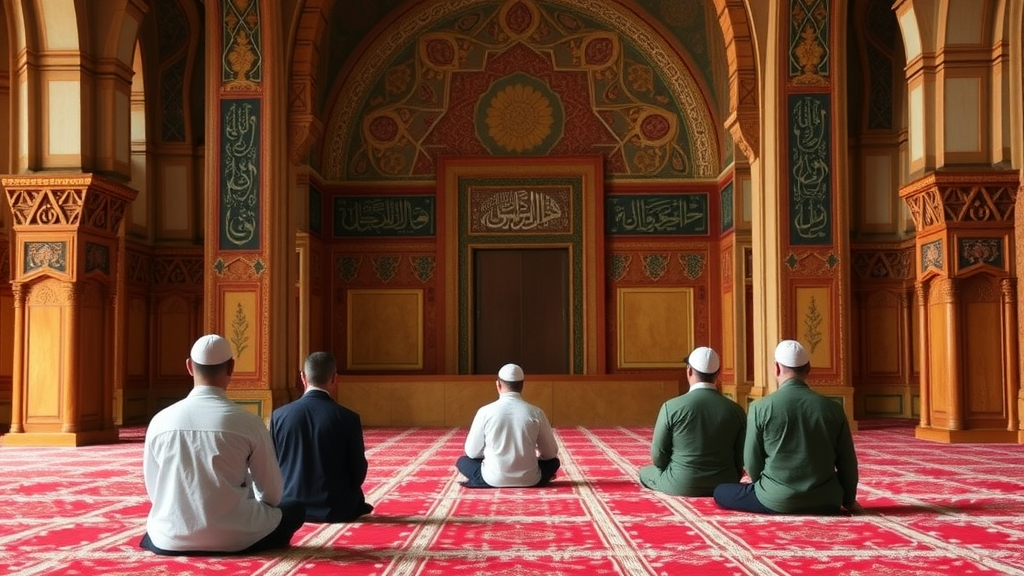
Mindfulness has traveled an extraordinary distance over the past four decades, moving from monastic settings in Asia to hospital clinics, corporate boardrooms, and smartphone applications across the globe. Yet as secular mindfulness programs have multiplied, a growing body of scholarship has asked a deceptively simple question: whose definitions, whose ethics, and whose ultimate purposes are embedded in the contemplative practices now dispensed as standardized mental health interventions? A newly published commentary in the journal Mindfulness, authored by Aamer Aldbyani of Shandong Xiehe University in China and Mohammed Fahd Obaid Al-Harbi of Umm al-Qura University in Saudi Arabia, engages this question directly by challenging how a prominent recent review of mindfulness definitions treats the Islamic contemplative tradition.
The commentary responds to a 2025 review by Chems-Maarif and colleagues that sought to refine the definition of mindfulness, a concept most secular clinicians trace to Jon Kabat-Zinn’s formulation of paying attention, on purpose, in the present moment, non-judgmentally. While the review has been widely praised for clarifying a notoriously slippery construct, Aldbyani and Al-Harbi argue that its framing risks flattening contemplative traditions outside the Buddhist and secular mainstream. In particular, they contend that Islamic forms of mindful awareness, including practices such as dhikr (remembrance of God), muraqaba (spiritual observation or vigilance), and the attentive concentration cultivated in salah (ritual prayer), cannot be adequately understood when stripped of their ethical, theological, and teleological context.
The technical core of the argument concerns what the authors call framing. In their view, a contemplative experience is never merely a bare cognitive event, such as sustained attention to the breath, that can be extracted from one tradition and transplanted into another without residue. Instead, every contemplative act operates within a web of ethical commitments, metaphysical beliefs about the nature of reality and the divine, and a teleology, that is, an account of the ultimate aim of practice. In secular mindfulness, the stated aim is often stress reduction, emotion regulation, or well-being enhancement. In Islamic contemplative life, by contrast, the ultimate aim is relational and devotional: drawing nearer to God, cultivating God-consciousness known as taqwa, and aligning one’s inner states and outward conduct with divine guidance. The commentary insists that these differing ends are not decorative additions but constitutive features that shape what the practitioner is actually doing when the practice unfolds.
This argument has practical consequences for measurement. Much of the empirical mindfulness literature relies on self-report instruments derived from secular conceptualizations, such as scales measuring attention, awareness, and non-judgmental acceptance. Aldbyani and Al-Harbi point to their own earlier narrative theoretical review, which identified five dimensions of Islamic mindfulness and mapped them against the five facets commonly measured in secular mindfulness research. Their mapping suggests meaningful parallels, for instance between attentional presence in secular models and the concentrated presence cultivated in prayer, but also important divergences where Islamic practice incorporates elements, such as devotional intention and relational awareness of God, that have no direct secular analogue. Related constructs from the consciousness sciences, including nondual awareness, which researchers have recently begun to measure with dedicated instruments, offer one possible bridge for comparing across traditions, yet the authors caution that even these frameworks carry implicit metaphysical assumptions drawn from their originating contexts.
The empirical record cited in the commentary underscores why these conceptual debates matter beyond theory. Studies of Muslim prayer have reported associations between mindful engagement in salah and better mental health outcomes, and electroencephalography research on salah has documented changes in alpha activity linked to autonomic nervous system regulation. Quasi-experimental and randomized studies have examined Islamic spiritual mindfulness among nursing students, breathing-based dhikr therapy for insomnia, and Islamic spiritual breathing exercises for anxiety in hypertensive patients, with generally favorable findings on stress, anxiety, and quality-of-life measures. Research on muraqaba within Islamic psychotherapy and surveys of immigrant and refugee Muslim women have further suggested that faith-embedded contemplative practices function as genuine resources for psychological well-being, not merely as cultural curiosities.
At the same time, the literature reveals persistent barriers. Studies from the United Kingdom and the United States have documented obstacles that Muslim clients face when offered conventional mindfulness-based interventions, including concerns about the Buddhist framing of some programs, uncertainty about religious permissibility, and the absence of culturally and religiously adapted content. Facilitators identified in this research include the demonstrated compatibility between contemplative attention and existing Islamic practice, clinician sensitivity to religious concerns, and the availability of adaptations that explicitly root mindfulness in Islamic vocabulary and ritual life. The commentary argues that definitional debates sit at the root of these barriers: when mainstream science defines mindfulness as though only one lineage of contemplative technique existed, members of other traditions are implicitly asked to bracket their own frameworks in order to benefit from the intervention.
The theological dimension of the argument is perhaps its most distinctive contribution. Aldbyani and Al-Harbi emphasize that in Islamic thought, awareness of the present moment is inseparable from awareness of God’s presence and of moral accountability. The Sufi tradition in particular, with its disciplined practices of remembrance, self-examination, and purification of the heart, has long elaborated a systematic psychology of attention that parallels and sometimes anticipates contemporary concerns with metacognition and self-regulation. Classical and contemporary scholarship on dhikr treats repetitive remembrance not as a mere relaxation technique but as a means of transforming the practitioner’s relationship to desire, distraction, and ultimately the divine. Reading such practices through a purely clinical lens, the authors suggest, yields a distorted picture in which the most important variable, the practitioner’s orientation toward God, is subtracted from the analysis.
The teleological point follows directly. If the purpose of a contemplative practice shapes its phenomenology, then comparing Islamic and secular mindfulness solely on outcome measures such as stress reduction risks a category error. A Muslim practitioner engaged in dhikr is not simply attempting to down-regulate physiological arousal; she is performing an act of worship whose success is defined, in part, by fidelity to a devotional ideal rather than by a score on a well-being questionnaire. This does not mean that empirical research on such practices is invalid, as the growing evidence base attests. It means, rather, that researchers and clinicians should be explicit about the limits of their constructs, and should resist the assumption that secular definitions of mindfulness occupy a neutral, view-from-nowhere position from which all other traditions can be adjudicated.
The commentary also carries a message for cultural humility in psychology and psychiatry. With nearly two billion Muslims worldwide, and with mental health services in many countries serving substantial Muslim populations, the question of how contemplative interventions are defined and adapted is a matter of global clinical significance. The authors, whose earlier work has examined mindfulness among college students in Yemen and Egypt, faith-based coping among displaced Muslim women affected by war, and Islamic perspectives on mindfulness in Black American Muslim communities, frame the present piece as part of a sustained effort to bring Islamic contemplative science into dialogue with mainstream mindfulness research on equal terms. Their work has been supported by Umm Al-Qura University in Saudi Arabia.
Ultimately, the commentary issues an invitation rather than a rejection. It does not dispute the value of the definitional refinement project undertaken by Chems-Maarif and colleagues; indeed, it treats that project as an essential step toward scientific clarity. What it demands instead is a definition of mindfulness capacious enough to acknowledge that contemplative experience is always framed, in every tradition, by ethics, theology, and ultimate purpose. For scientists, that means building measures and models that can register these framings rather than averaging them away. For clinicians, it means offering Muslim clients interventions that honor, rather than bypass, the theological architecture within which their practices already live. As mindfulness science matures, the emerging consensus among scholars in this debate appears to be that pluralism in definitions is not a weakness to be engineered away, but a feature of a field finally beginning to see the full landscape of human contemplative life.
Subject of Research: Islamic mindfulness and the ethical, theological, and teleological framing of contemplative experience
Article Title: Islamic Mindfulness and the Ethical, Theological, and Teleological Framing of Contemplative Experience: A Commentary on Chems-Maarif et al. (2025)
Article References: Aldbyani, A., & Al-Harbi, M. F. O. (2026). Islamic Mindfulness and the Ethical, Theological, and Teleological Framing of Contemplative Experience: A Commentary on Chems-Maarif et al. (2025). Mindfulness. https://doi.org/10.1007/s12671-026-02983-8
Image Credits: AI Generated
DOI: 10.1007/s12671-026-02983-8
Keywords: Islamic mindfulness, mindfulness definition, dhikr, muraqaba, salah prayer, contemplative science, Muslim mental health, mindfulness-based interventions, Sufism, nondual awareness, religious adaptation, teleology
Cite Scienmag News
Glenn Wilkins. (September 12, 2026). Islamic Mindfulness Gains Scientific Ground as Scholars Reframe Contemplative Experience Ethically. Scienmag. https://scienmag.com/islamic-mindfulness-gains-scientific-ground-as-scholars-reframe-contemplative-experience-ethically/
Glenn Wilkins. "Islamic Mindfulness Gains Scientific Ground as Scholars Reframe Contemplative Experience Ethically." Scienmag, 12 September 2026, https://scienmag.com/islamic-mindfulness-gains-scientific-ground-as-scholars-reframe-contemplative-experience-ethically/. Accessed 5 October 2026.
Glenn Wilkins. "Islamic Mindfulness Gains Scientific Ground as Scholars Reframe Contemplative Experience Ethically." Scienmag. September 12, 2026. https://scienmag.com/islamic-mindfulness-gains-scientific-ground-as-scholars-reframe-contemplative-experience-ethically/


