


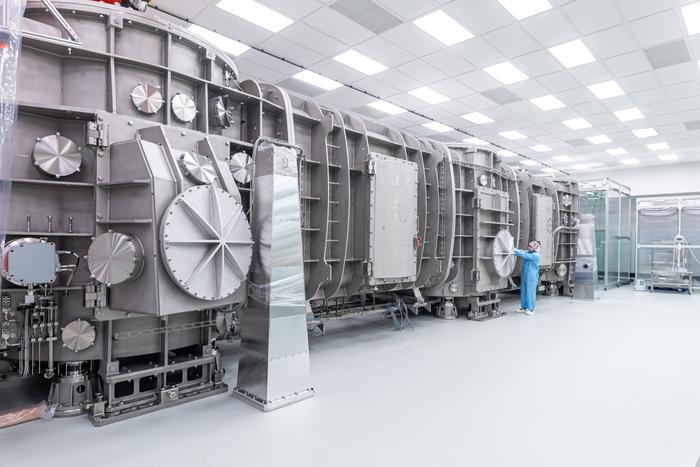
Since the laser was invented in the 1960s, scientists have been working to increase lasers’ peak power and to design machines producing coherent light at progressively shorter wavelengths that can improve image resolution and enable probing of quantum nuclear states.

Credit: Photo courtesy of ELI Beamlines.
Since the laser was invented in the 1960s, scientists have been working to increase lasers’ peak power and to design machines producing coherent light at progressively shorter wavelengths that can improve image resolution and enable probing of quantum nuclear states.
Progress has been made with regard to peak power, most notably with the invention of chirped pulse amplification by University of Rochester researchers in the 1980s, a breakthrough that garnered the Nobel Prize in Physics in 2018. However, developing lasers that produce very-high-energy light, such as gamma rays, has remained elusive. That’s in part because “coherent” light waves are in sync with each other, creating a stronger effect in combination. This effect is harder to achieve at higher-photon energies. And while lasers can now produce coherent light in the visible, ultraviolet, and x-ray ranges of the electromagnetic spectrum, doing so beyond the x-ray range—which is where gamma rays exist—remains a challenge.
To overcome this obstacle, Rochester researchers secured National Science Foundation (NSF) funding in collaboration with colleagues from ELI Beamlines in the Czech Republic to investigate the coherence properties of the radiation emitted when dense bunches of electrons collide with a strong laser field. In doing so, the researchers aim to understand how to produce coherent gamma rays and use these new radiation sources for research and applications to create antimatter, study nuclear processes, and image dense objects or materials, such as scanning shipping containers.
“The ability to make coherent gamma rays would be a scientific revolution in creating new kinds of light sources, similar to how the discovery and development of visible light and x-ray sources changed our fundamental understanding of the atomic world,” says Antonino Di Piazza, a professor of physics at the University of Rochester and a distinguished scientist at the University’s Laboratory for Laser Energetics, who is the lead investigator on the NSF grant.
US–Europe connections facilitate laser science advancements
The project combines the theoretical expertise of Rochester scientists with the theoretical and experimental capabilities of ELI Beamlines in the Czech Republic, strengthening ties between the US and Europe in the field of high-intensity lasers.
The scientists will use complex theories and high-tech experiments to study how fast-moving electrons interact with the laser to emit high-energy light. They’ll start by looking at simpler cases, such as how one or two electrons emit light, before moving on to more complicated scenarios with many electrons, to produce coherent gamma rays. Such a result builds on the work of scientists who have created coherent x-rays, including the teams at SLAC National Accelerator Laboratory, European XFEL, and SACLA.
“We are not the first scientists who have tried creating gamma rays in this way,” says Di Piazza. “But we are doing so using a fully quantum theory—quantum electrodynamics—which is an advanced approach to addressing this problem.”
If successful, this project could lead to the creation of a gamma-ray free electron laser, a major goal in the scientific community, according to Di Piazza. “Of course,” he says, “step one is to show that the science is possible before building such a device.”
This work will also contribute to advancing the science case for a potential future NSF OPAL high-power laser user facility at the University of Rochester, another NSF-funded project on which Di Piazza is a co-principal investigator, and which has the potential to be a unique open-access resource for the global scientific community. NSF OPAL is part of NSF X-lites, an international network of networks studying extreme light in intensity, time, and space formed to address the grand challenge questions defined at the frontiers of laser-matter coherent interactions at the shortest distances, highest intensities, and fastest times.
Cite Scienmag News
Bethany Barker. (July 23, 2024). Is a gamma-ray laser possible? Scienmag. https://scienmag.com/is-a-gamma-ray-laser-possible/
Bethany Barker. "Is a gamma-ray laser possible?" Scienmag, 23 July 2024, https://scienmag.com/is-a-gamma-ray-laser-possible/. Accessed 4 September 2026.
Bethany Barker. "Is a gamma-ray laser possible?" Scienmag. July 23, 2024. https://scienmag.com/is-a-gamma-ray-laser-possible/

