


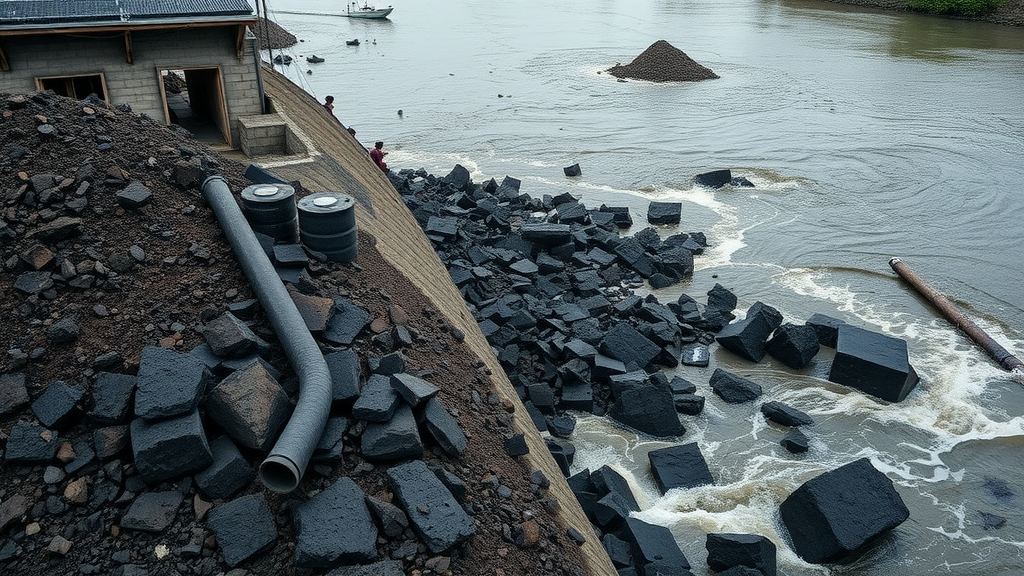
More than a decade after the catastrophic collapse of the Fundão tailings dam in Mariana, southeastern Brazil, the sediments of the Doce River remain geochemically alive. A new five-year study of the river’s lower fluvial–estuarine system shows that the iron oxyhydroxide minerals released with roughly 43 million cubic meters of mining tailings in November 2015 are still the dominant hosts of potentially toxic elements, including arsenic, chromium, nickel, cobalt, lead, zinc, and molybdenum. Crucially, the research demonstrates that these minerals are far from inert repositories: they continue to reorganize under the influence of seasonal floods, saltwater intrusion, and shifting redox conditions, meaning the disaster’s environmental legacy is still evolving today.
The investigation, published in Environmental Geochemistry and Health, monitored bottom sediments at four strategic sites between March 2019 and July 2024: the Aimorés and Mascarenhas reservoirs upstream, and two estuarine stations near the river mouth, one of which is directly influenced by saltwater wedge intrusion. Researchers collected twenty-four mud-fraction samples covering both wet and dry seasonal cycles, using a sterile Van Veen grab sampler to retrieve the uppermost centimeters of sediment. This spatiotemporal design allowed the team to separate the slow mineralogical fingerprint inherited from the tailings from the faster changes driven by present-day environmental forcing.
To dissect the iron chemistry, the team combined selective dissolution procedures with X-ray diffraction, diffuse reflectance spectroscopy, magnetic susceptibility measurements, and multivariate statistics. Acid ammonium oxalate extraction targeted poorly crystalline iron forms such as ferrihydrite and lepidocrocite, while citrate–bicarbonate–dithionite extraction captured more crystalline phases like goethite and hematite. Alkali fusion provided total elemental inventories for iron, manganese, and the trace-element suite of arsenic, cadmium, cobalt, chromium, molybdenum, nickel, lead, vanadium, and zinc, quantified by ICP-MS with certified reference materials confirming recoveries between 93 and 109 percent.
The results reveal a sediment system dominated by crystalline iron oxyhydroxides. Dithionite-extractable iron ranged from roughly 15 to 70 grams per kilogram, while oxalate-extractable iron stayed below 20 grams per kilogram. Yet the ratio between the two fractions varied dramatically, from 0.14 to 0.82, with the strongest fluctuations at the estuarine stations. This temporal decoupling, the authors argue, is evidence of ongoing post-depositional transformation: crystalline phases are periodically destabilized by reducing conditions, and subsequent oxidation events generate short-range-order phases with high sorptive capacity, resetting the geochemical clock again and again.
X-ray diffraction confirmed goethite as the dominant iron oxyhydroxide across every environment and campaign, with hematite appearing as a subordinate but highly variable phase, particularly in estuarine sediments and at the Mascarenhas reservoir. Diffuse reflectance spectroscopy, interpreted through the Kubelka–Munk function, tracked the relative abundance of the two minerals and showed goethite-dominated assemblages giving way episodically to hematite-rich intervals, especially at the saltwater-influenced station during 2023. Magnetic susceptibility remained consistently low, indicating that antiferromagnetic oxyhydroxides, not ferrimagnetic magnetite, control the magnetic signal of these sediments.
Perhaps most striking are the crystallographic details. Goethite mean crystal dimensions ranged from about 20 to 40 nanometers along the 110 direction, with crystals preferentially elongated along that axis, a morphology consistent with assemblages inherited from the Fundão tailings. Specific surface areas of goethite spanned 57 to nearly 120 square meters per gram, and aluminum substitution in its structure varied from 0.097 to 0.199 mol per mol. Because aluminum substitution inhibits crystal growth, shrinks crystallite size, and boosts surface area, these variations translate directly into differences in the density and accessibility of sorption sites where trace elements bind through inner-sphere complexation, adsorption, and co-precipitation.
The geochemical data show that estuarine stations consistently carry the highest contaminant loads. Nickel reached 448 milligrams per kilogram at the saltwater-influenced station in March 2024, chromium peaked at 321 milligrams per kilogram, and arsenic concentrations climbed steadily between 2019 and 2024 at the neighboring estuarine site. Dithionite-extractable arsenic at that site surged nearly sixfold over the monitoring period, and wet-period campaigns brought marked increases in cobalt, chromium, molybdenum, nickel, and zinc. Reservoir sediments, by contrast, showed lower concentrations and less temporal volatility, behaving as relatively stable retention zones.
Principal component analysis tied the story together. The first two components explained 56 percent of total variance and cleanly separated reservoir from estuarine samples. Most potentially toxic elements loaded strongly alongside dithionite-extractable iron, total iron, and hematite crystallographic parameters, while the upstream Aimorés reservoir clustered instead with goethite surface area and aluminum substitution. Hierarchical clustering confirmed four distinct sample groups, demonstrating that spatial differences in contaminant partitioning are governed by iron mineralogy and crystallography rather than by total elemental abundance alone.
Why does this matter beyond the Doce River? Estuaries are often treated as terminal sinks where contaminated sediments come to rest. This study shows they are better understood as reactive biogeochemical reactors. Salinity fluctuations alter colloidal stability and surface reactivity, organic matter degradation drives suboxic conditions that partially dissolve iron phases, and resuspension during floods exposes fresh mineral surfaces. Each cycle can release a pulse of trace elements and then re-sequester them into newly formed, highly reactive phases. The contaminated pool is therefore dynamic, capable of responding to environmental perturbations rather than remaining permanently immobilized.
The findings also carry a clear message for environmental monitoring: total concentration measurements alone miss the story. Two sediments with identical arsenic totals may behave entirely differently depending on whether the element is locked inside well-crystallized goethite or loosely held on freshly precipitated ferrihydrite. The authors argue that mineralogical indicators and selective extraction procedures deserve a permanent place in long-term monitoring frameworks, not just in the aftermath of disasters. As climate variability reshapes hydrological regimes and saltwater intrusion pushes further inland, the mineral-scale processes documented here will increasingly determine whether legacy contaminants stay buried or re-enter the food web. A decade on, the Doce River’s iron minerals are still writing the disaster’s next chapter.
Subject of Research: Long-term evolution of iron oxyhydroxide mineralogy and potentially toxic element partitioning in mining-impacted sediments of the Lower Doce River fluvial–estuarine system, Brazil
Article Title: Long-term evolution of Fe oxyhydroxide mineralogy and potentially toxic element partitioning in mining-impacted sediments of the Lower Doce River fluvial–estuarine system
Article References: Long-term evolution of Fe oxyhydroxide mineralogy and potentially toxic element partitioning in mining-impacted sediments of the Lower Doce River fluvial–estuarine system. (n.d.). https://doi.org/10.1007/s10653-026-03495-z
Image Credits: AI Generated
DOI: 10.1007/s10653-026-03495-z
Keywords: Fundão dam collapse, Doce River, iron oxyhydroxides, goethite, hematite, potentially toxic elements, sediment geochemistry, selective dissolution, X-ray diffraction, estuarine biogeochemistry, trace-element partitioning, mining disaster legacy
Cite Scienmag News
Violet Maxwell. (September 22, 2026). Iron minerals in Brazil’s Doce River still lock toxic metals a decade after dam disaster. Scienmag. https://scienmag.com/iron-minerals-in-brazils-doce-river-still-lock-toxic-metals-a-decade-after-dam-disaster/
Violet Maxwell. "Iron minerals in Brazil’s Doce River still lock toxic metals a decade after dam disaster." Scienmag, 22 September 2026, https://scienmag.com/iron-minerals-in-brazils-doce-river-still-lock-toxic-metals-a-decade-after-dam-disaster/. Accessed 4 October 2026.
Violet Maxwell. "Iron minerals in Brazil’s Doce River still lock toxic metals a decade after dam disaster." Scienmag. September 22, 2026. https://scienmag.com/iron-minerals-in-brazils-doce-river-still-lock-toxic-metals-a-decade-after-dam-disaster/


