


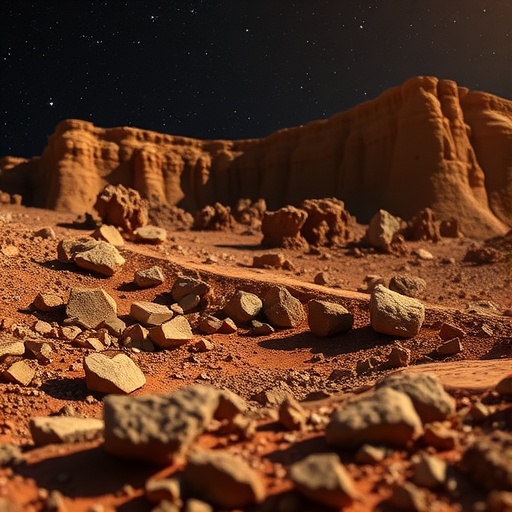
WASHINGTON, August 12, 2025 – NASA’s Mars rover Perseverance made headlines last year when it successfully gathered an unexpected rock sample known as Sapphire Canyon. This striking rock is distinguished by its unique structure, featuring white spots resembling a leopard’s skin, bordered by dark hues encased within a reddish mudstone matrix. Such a peculiar formation might not only tantalize curious scientists but could also provide invaluable insights into the origins of organic compounds on Mars, potentially reshaping our understanding of the planet’s history and its capacity for supporting life.
In an exciting development, researchers at the Jet Propulsion Laboratory (JPL) and the California Institute of Technology are capitalizing on a promising analytical technique known as optical photothermal infrared spectroscopy (O-PTIR) to investigate a rock sample that bears a visual resemblance to Sapphire Canyon. This innovative method utilizes dual lasers to extract detailed information about the chemical properties of materials. When the first laser heats the sample, it induces slight thermal vibrations that are wavelength-dependent. The second laser captures these changes, thereby creating a distinct chemical fingerprint that experts can analyze.
The JPL team embarked on using O-PTIR with a terrestrial basalt sample containing dark inclusions of similar dimension to those found in Sapphire Canyon’s unique rock formation. The researcher who spearheaded this work, Nicholas Heinz, serendipitously discovered this sample during a hiking trip in Sedona, Arizona. His keen eye for geology led him to pick up what appeared to be an out-of-place rock, later providing a valuable resource for scientific inquiry. “I stumbled upon this interesting specimen while walking in the stunning landscapes of Arizona,” he recounted. “It was clear to me that it was something out of the ordinary, almost as if it was calling for further analysis.”
The researchers set forth to determine if O-PTIR could effectively differentiate between the rock’s main material and the embedded dark inclusions. Their findings were promising. O-PTIR exhibited exceptional capability in distinguishing chemical variations, a direct result of its enhanced spatial resolution. Unlike traditional spectroscopic techniques, which may take longer to yield conclusive data, O-PTIR could deliver results in mere minutes. This quick turnaround not only enhances data collection efficiency but also allows scientists to zero in on areas of particular interest, possibly unveiling regions where organic molecules are present.
The implications of O-PTIR are significant, particularly concerning future planetary missions. Heinz expressed optimism that this technique will be integrated into workflows for analyzing materials returned from not just Mars, but also asteroids and other celestial bodies. Beyond its current application, the technology may prove invaluable in expanding our understanding of extraterrestrial geology and the potential for life beyond Earth. Its rapid analysis could set a new benchmark for how samples are studied by NASA and other space-faring organizations.
Additionally, the O-PTIR capabilities established at JPL are unparalleled in their sophistication. They have already been employed in other NASA projects, including a notable application for the Europa Clipper mission in 2024. In this context, the technique was crucial in confirming the cleanliness of instruments designed to explore Europa, one of Jupiter’s intriguing moons, before its launch. Thus, the adeptness of O-PTIR positions it as a multi-faceted tool that can address various challenges in planetary science.
Heinz and his colleagues are not resting on their laurels. They are collaborating closely with NASA’s Mars science team to apply O-PTIR to various geological analogs, including algal microfossils known to be used in Mars studies. This evolving partnership signifies the commitment to pushing the boundaries of scientific exploration. By marrying laboratory advancements with real-world applications, researchers are paving the way for a deeper understanding of not only Mars but of planetary processes as a whole.
The continuous refinement of techniques like O-PTIR is vital for addressing the myriad of questions that arise from planetary explorations. Each Martian rock sample carries with it a story, one that can reveal processes that have transpired over billions of years. Understanding these processes is crucial as we search for signs of past life and consider the potential for future human exploration. The ongoing work at JPL exemplifies the intersection of curiosity, technology, and the age-old quest to uncover the secrets of the universe.
As science marches forward, the forthcoming publication in Review of Scientific Instruments on August 12, 2025, titled “Application of Optical Photothermal Infrared Spectroscopy (O-PTIR) for Future Returned Mars Samples,” will delve deeper into the findings and implications of this research. Authored by Heinz, Mark S. Anderson, Jerami Mennella, and George R. Rossman, this paper stands to influence not just the fields of planetary science and geology, but also signal a potential shift in the methodologies we utilize to probe the cosmos.
The journey of exploring Mars and beyond is fraught with challenges yet filled with fascinating discoveries. As we await the return of significant Martian samples, the scientific community remains hopeful that techniques like O-PTIR will unlock new realms of knowledge. Researchers and enthusiasts alike are compelled to ask: what mysteries will the next piece of Martian rock unveil? Each sound piece of data ignites the imagination and takes us one step closer to comprehending our place in the cosmos.
As we look toward the horizon of space exploration, we owe it to the generations that came before and those yet to come to invest in the development of new tools and methodologies. By doing so, researchers can continue to engage with the universe at a deeper level, one that might ultimately reveal the presence of life beyond our planet. Science and exploration are inexorably linked, and the ongoing work at JPL and its collaborators showcases the vibrant spirit of inquiry that drives humanity’s quest for understanding.
Keywords
Mars, Perseverance rover, sapphire canyon, optical photothermal infrared spectroscopy, JPL, Caltech, geological analysis, extraterrestrial geology, O-PTIR, astrobiology, planetary science, organic molecules.
Cite Scienmag News
Grant Pearson. (August 12, 2025). Investigating Terrestrial Rocks to Develop Techniques for Mars Exploration. Scienmag. https://scienmag.com/investigating-terrestrial-rocks-to-develop-techniques-for-mars-exploration/
Grant Pearson. "Investigating Terrestrial Rocks to Develop Techniques for Mars Exploration." Scienmag, 12 August 2025, https://scienmag.com/investigating-terrestrial-rocks-to-develop-techniques-for-mars-exploration/. Accessed 5 September 2026.
Grant Pearson. "Investigating Terrestrial Rocks to Develop Techniques for Mars Exploration." Scienmag. August 12, 2025. https://scienmag.com/investigating-terrestrial-rocks-to-develop-techniques-for-mars-exploration/


