


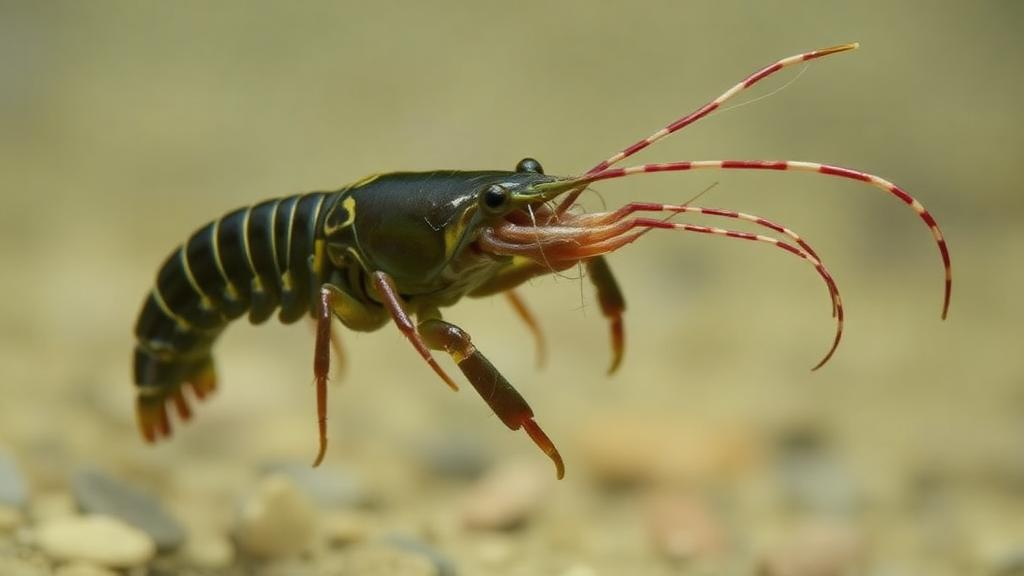
An invasive Australian crayfish sweeping through Malaysian waterways is carrying a hidden passenger: a small flatworm that clings to its body, lays egg capsules on its shell, and travels wherever the crayfish goes. The question that has worried freshwater ecologists is whether that passenger, the temnocephalid flatworm Diceratocephala boschmai, could leap across species lines and colonize native crustaceans. A new experimental study from Malaysia suggests the answer, at least for one important native species, is reassuringly no — but the findings also show how thoroughly the worm has made itself at home on its invading host.
Researchers led by N. Azri-Shah Norhan of Universiti Putra Malaysia Sarawak and Marina Hassan of Universiti Malaysia Terengganu set out to test the host compatibility of D. boschmai under controlled conditions. Their work, published in Acta Parasitologica, placed temnocephalid-infested redclaw crayfish, Cherax quadricarinatus, in tanks alongside two kinds of symbiont-free recipients: more of their own kind and the native giant freshwater prawn, Macrobrachium rosenbergii. The animals were held together for thirty days, long enough for any capable worm to disperse, attach, feed, and reproduce on a new host.
The result was strikingly one-sided. In 93.33 percent of the exposed crayfish, the flatworms successfully established themselves, and researchers detected both adult worms and the telltale egg capsules that signal a reproducing population. On the native prawns, however, not a single transmission occurred. Despite a month of direct contact with infested crayfish, the prawns emerged clean. Under these experimental conditions, D. boschmai appears to be a specialist locked onto its crayfish host, unable or unwilling to colonize even a large, abundant decapod sharing the same water.
That specificity matters because redclaw crayfish are one of the most widely traded and widely released freshwater crustaceans in the tropics. Native to northern Australia and Papua New Guinea, C. quadricarinatus has established invasive populations across Southeast Asia and Africa, including the Zambezi catchment, where its spread and ecology have been documented in detail. Wherever the crayfish goes, its entourage of symbionts may follow. Prior work by some of the same Malaysian team had already confirmed temnocephalid prevalence on cultured and wild redclaw in Malaysia, and studies elsewhere have flagged D. boschmai as a hitchhiker on ornamental crayfish in the aquarium trade. Co-transported pathogens and parasites are increasingly recognized as an underappreciated dimension of invasion biology, with the potential for spillover into vulnerable native species.
The redclaw’s flatworm entourage is not a trivial one. Temnocephalids are small platyhelminths that live as ectosymbionts on freshwater crustaceans, attaching to gill chambers, carapace, and limbs. Australia’s ancient spiny mountain crayfish host a rich, co-evolved community of them, and some of these associations are so old that conservationists worry about coextinction — the parasite dying out with its host. Diceratocephala boschmai itself was first described from New Guinea material collected in the Dutch expedition of 1939, and later work by Jones and Lester in the early 1990s established its life history on redclaw and examined its pathogenicity. On heavily infested hosts, the worms can cause measurable harm, which is precisely why aquaculturists and ecologists want to know whether the symbiont might expand its menu.
To probe what happened inside the exposed animals, the researchers turned to hemolymph, the crustacean equivalent of blood, and measured a standard panel of immune and physiological markers. These included the total hemocyte count, the differential hemocyte count, and the concentrations of glucose and total protein. Hemocytes are the circulating cells that carry out the crustacean immune response — engulfing invaders, encapsulating parasites, and mediating wound repair — so shifts in their numbers are a classic readout of immunological engagement. Glucose and protein levels, meanwhile, reflect metabolic mobilization and stress, both of which can be elevated when an animal is challenged.
The blood work told a nuanced story. Experimentally infested crayfish showed significantly higher total hemocyte counts than their non-infested counterparts, a difference the authors interpret as a cellular immune response to symbiont exposure — though they caution that the stress of the experimental handling itself may have contributed to the elevation. Differential hemocyte counts and glucose concentrations differed among the host populations examined, indicating that the physiological profile of each group carried its own signature. Total protein concentrations also varied significantly, with one notable outlier: the non-infested native prawns showed higher protein levels than any of the other groups, while the infested and non-infested crayfish were statistically indistinguishable from each other on that measure.
For the native prawns, the absence of both transmission and any alarming physiological disruption is the study’s most consequential finding. Macrobrachium rosenbergii is a species of major commercial and ecological importance in Malaysia and across Asia, supporting both capture fisheries and a substantial aquaculture industry, and it already contends with its own suite of symbionts and parasites, including bopyrid isopods documented in Malaysian rivers by overlapping research teams. Had D. boschmai proven capable of colonizing the prawn, the flatworm could have ridden the crayfish invasion straight into one of the region’s most valuable freshwater fisheries. Instead, the results suggest restricted host compatibility — a biological firewall that, for now, contains the symbiont within the crayfish.
Yet the researchers stop short of declaring the native fauna safe in perpetuity. Their conclusion frames redclaw as a reservoir for D. boschmai, an animal that allows the flatworm to persist and disseminate through freshwater ecosystems even if it does not immediately infect new species. Reservoir dynamics are a central concept in invasion biology precisely because they decouple a symbiont’s fate from any single host population: as long as invasive crayfish keep arriving through aquaculture shipments and aquarium releases, the worm has a fresh supply of vehicles. And host specificity in parasites is not always fixed; ecological opportunity, evolutionary time, and changes in host abundance can all erode the barriers that currently prevent host switching.
The study also carries practical implications for the trade that moves these animals. Ornamental crayfish have repeatedly been shown to carry D. boschmai across borders, and the worm’s egg capsules are durable enough to survive on traded animals. Simple biosecurity measures — inspection, quarantine, and treatment of crayfish before sale or pond stocking — could substantially reduce the further dispersal of this symbiont and others like it. For Malaysian authorities weighing the costs of regulating the live crayfish trade, the new data provide a concrete baseline: the flatworm is efficient at colonizing its invasive host and reproducing on it, but under controlled conditions it did not transmit to the giant freshwater prawn. That baseline, the authors suggest, will help refine risk assessments for symbiont spillover in the region’s freshwater systems, even as continued monitoring remains essential to catch any future breakdown of the compatibility barrier that currently protects native prawns.
Subject of Research: Experimental host specificity and transmission of the temnocephalid ectosymbiont Diceratocephala boschmai between invasive redclaw crayfish and native giant freshwater prawns in Malaysia
Article Title: Host Compatibility of the Temnocephalid Diceratocephala boschmai: Experimental Transmission Between Invasive Cherax quadricarinatus and Native Macrobrachium rosenbergii in Malaysia
Article References: Host Compatibility of the Temnocephalid Diceratocephala boschmai: Experimental Transmission Between Invasive Cherax quadricarinatus and Native Macrobrachium rosenbergii in Malaysia. (n.d.). https://doi.org/10.1007/s11686-026-01415-w
Image Credits: AI Generated
DOI: 10.1007/s11686-026-01415-w
Keywords: Diceratocephala boschmai, temnocephalid, Cherax quadricarinatus, Macrobrachium rosenbergii, invasive species, host specificity, symbiont spillover, hemocytes, Malaysia, freshwater ecosystems, parasitology, aquaculture
Cite Scienmag News
Gavin Prescott. (October 14, 2026). Invasive Crayfish Carry a Flatworm Passenger That Refuses to Jump to Native Prawns. Scienmag. https://scienmag.com/invasive-crayfish-carry-a-flatworm-passenger-that-refuses-to-jump-to-native-prawns/
Gavin Prescott. "Invasive Crayfish Carry a Flatworm Passenger That Refuses to Jump to Native Prawns." Scienmag, 14 October 2026, https://scienmag.com/invasive-crayfish-carry-a-flatworm-passenger-that-refuses-to-jump-to-native-prawns/. Accessed 14 October 2026.
Gavin Prescott. "Invasive Crayfish Carry a Flatworm Passenger That Refuses to Jump to Native Prawns." Scienmag. October 14, 2026. https://scienmag.com/invasive-crayfish-carry-a-flatworm-passenger-that-refuses-to-jump-to-native-prawns/


