

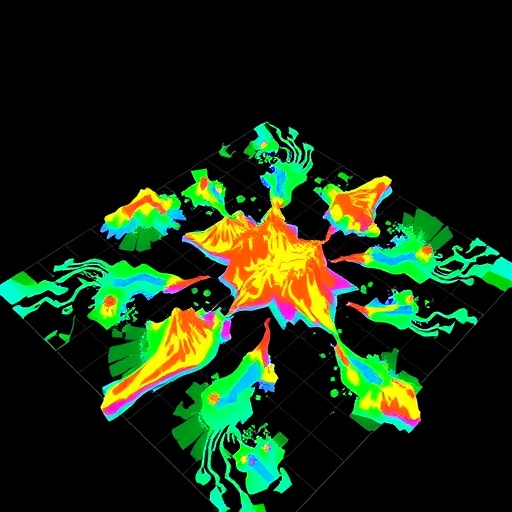
The detection of anomalies and defects on 3D surfaces holds immense value across industries ranging from manufacturing and infrastructure maintenance to robotics and autonomous systems. Despite its significance, the task remains challenging, primarily due to the scarcity of annotated defective samples—a costly and time-consuming resource to amass on a large scale. Traditional 3D anomaly detection approaches often rely on extensive template matching or computationally heavy inference, involving multiple passes or heuristic clustering methods that are brittle and difficult to generalize. These limitations have hindered the widespread adoption of automated 3D defect localization systems in practical settings.
In groundbreaking new research led by Associate Professor Phan Xuan Tan and a collaborative team from Japan and Vietnam, a novel framework named Vote3D-AD is introduced to revolutionize 3D anomaly localization. Published in the Alexandria Engineering Journal in early 2026, this innovative approach melds advanced deep learning architectures with sophisticated pseudo-anomaly synthesis techniques, forging a robust, single-pass method that operates effectively even when trained only on defect-free data. This marks a significant leap forward in the field, addressing longstanding bottlenecks in memory dependence, inference speed, and localization accuracy.
At the heart of Vote3D-AD lies a unique Varied Defect Synthesis (VDS) pseudo-anomaly generator, capable of simulating a diverse array of physically plausible surface abnormalities—such as dents, bulges, holes, cracks, and varying degrees of roughness. These synthetic defects are accompanied by realistic sensor noise and dropout artifacts, bridging the gap between idealized training environments and challenging real-world scenarios. By expanding the variety and fidelity of defect simulations, VDS empowers the model to generalize far beyond what conventional anomaly detection pipelines can achieve.
Complementing the synthesis engine is a transformer-based backbone tailored specifically for point cloud data—enabling the extraction of nuanced geometric features across sparse and noisy inputs. The Vote3D-AD framework employs an innovative voting network that aggregates learned feature representations into coherent “votes,” reflecting suspicious regions in the 3D scan. Unlike prior approaches relying on fixed heuristics for clustering, Vote3D-AD integrates a differentiable clustering module that learns to group these votes adaptively, producing precise and contiguous anomaly masks. This end-to-end trainable mechanism substantially reduces false positives and false negatives, giving rise to tighter and more meaningful defect localization.
Extensive experiments conducted on both synthetic and real industrial datasets underscore the framework’s superior performance. Quantitatively, Vote3D-AD surpasses the strongest existing baselines by approximately 6.7% in point-level Area Under the Receiver Operating Characteristic curve (AUROC) and exhibits gains of about 10.1% and 11.2% in Area Under the Precision-Recall curve (AUPR) and F1 scores, respectively. Importantly, these improvements extend to object-level metrics, validating its ability to localize entire defective regions rather than isolated outliers.
One of the critical strengths of Vote3D-AD lies not only in its accuracy but also in its practical applicability. The full pipeline achieves a remarkable inference speed of roughly 9.05 frames per second on contemporary RTX-3090 GPUs. This efficiency is vital for integration into real production lines where inspection throughput and rapid feedback are crucial. Furthermore, its single-pass architecture avoids costly multi-pass feature accumulation, while the elimination of hand-crafted clustering reduces engineering time and complexity—dramatically simplifying deployment across diverse manufacturing environments.
The system’s real-world utility is extensive. Automated quality inspections in industries such as sheet metal fabrication, precision machining, and plastic housing assembly stand to benefit immensely. Vote3D-AD excels in detecting subtle but consequential defects often invisible to 2D RGB imaging, including dents, missing components, holes, and surface texture anomalies. Beyond manufacturing, it offers promise for infrastructure health monitoring—spotting early indicators of structural degradation like cracks or corrosion on pipes, panels, and various connector parts where geometry-based defects presage failure.
Robotics and autonomous systems also stand to gain from this technology. By leveraging onboard depth sensors, robots can perform verification of assembly quality or detect damage during handling, even without prior examples of defective instances. The capacity to aggregate multi-view or streamed 3D point cloud data further enables detection tasks that extend into thermal or structural anomaly domains. Future directions envision multi-modal fusion, where vote clustering could synergize geometric, thermal, and other sensor inputs to bolster predictive maintenance decisions and asset management.
Dr. Tan emphasizes the value of precise and coherent anomaly mask generation made possible by Vote3D-AD’s learned clustering and boundary refinement components. These advances mitigate the incidence of false alarms and ambiguous detections that often plague existing inspection protocols. Reduced false positives translate directly into lower production downtime and minimized unnecessary rework—critical factors for maintaining efficiency and cost-effectiveness in modern manufacturing ecosystems. Moreover, the adaptability of the system to train solely on normal, defect-free data eliminates the burdensome requirement for large annotated defect datasets, enabling easier scalability across various products and manufacturers.
An especially innovative aspect of Vote3D-AD is its sophisticated pseudo-defect synthesis mechanism. The Varied Defect Synthesis module doesn’t merely create simplistic outlier shapes but fabricates complex, physically credible anomalies combined with simulated sensor artifacts such as noise and dropout. By closely mimicking real-world scanning imperfections, VDS substantially narrows the domain gap between training scenarios and operational deployments—greatly enhancing generalization and robustness.
Finally, Vote3D-AD outputs coherent region proposals rather than scattered anomaly points, laying the foundation for meaningful downstream actions. Automated rejection systems, targeted repair operations, and prioritization workflows for human inspectors can all leverage these refined spatial anomaly maps, ultimately fostering faster, safer, and more reliable inspection pipelines in production environments.
In summary, Vote3D-AD represents a major technological stride in unsupervised 3D anomaly localization. By combining cutting-edge defect synthesis, transformer-driven feature extraction, adaptive vote clustering, and real-time inference, it addresses multiple longstanding challenges facing industrial inspection, infrastructure monitoring, and robotic perception. As industries increasingly adopt advanced sensing modalities, Vote3D-AD’s balance of accuracy, speed, and scalability positions it to become a cornerstone technology for ensuring quality, safety, and operational excellence in the evolving era of intelligent automation.
Subject of Research: Not applicable
Article Title: Vote3D-AD: Unsupervised point cloud anomaly localization via varied defect synthesis and differentiable vote-clustering
News Publication Date: 1-Feb-2026
References: DOI: 10.1016/j.aej.2026.01.024 (http://dx.doi.org/10.1016/j.aej.2026.01.024)
Image Credits: Associate Professor Phan Xuan Tan from Shibaura Institute of Technology, Japan
Keywords: Applied sciences and engineering; Manufacturing; Manufacturing industry; Industrial production; Social sciences; Engineering


