


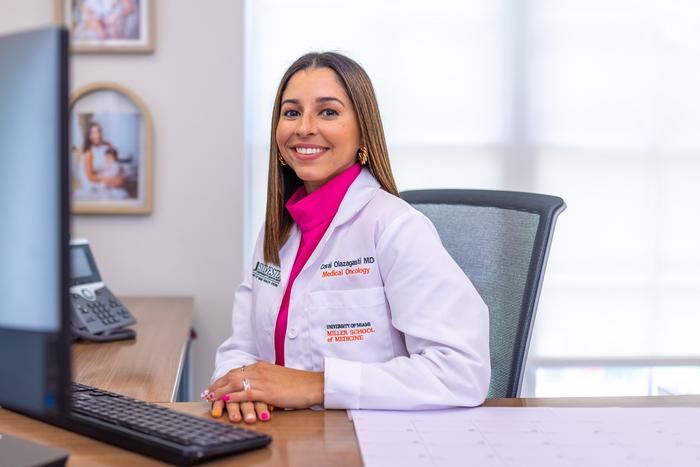
MIAMI, FLORIDA (May 23, 2024) – Coral Olazagasti expected a relatively smooth transition when she moved to New York to start her residency after graduating from medical school in her native Puerto Rico. But that proved wishful thinking.

Credit: Photo by Sylvester
MIAMI, FLORIDA (May 23, 2024) – Coral Olazagasti expected a relatively smooth transition when she moved to New York to start her residency after graduating from medical school in her native Puerto Rico. But that proved wishful thinking.
She not only experienced major culture shock, but also her superiors and colleagues often chastised her for speaking too loudly and joked about her accent.
“Puerto Rico is a U.S. territory so when I moved to New York, I thought it wasn’t going to be a big change,” said Olazagasti, now a thoracic medical oncologist at Sylvester Comprehensive Cancer Center at the University of Miami Miller School of Medicine. “But I went through a significant number of adjustments and challenges, and that was a really lonely time. Not many people in my situation were talking about experiencing these challenges.”
Olazagasti wondered if her adjustment struggles while dealing with biases against certain immigrants and ethnic minorities might be shared by other foreign-trained female physicians? So, she decided to explore further.
In a study to be presented June 3 at the American Society of Clinical Oncology’s annual meeting in Chicago, Olazagasti and collaborators from other top-tier cancer centers show female oncologists reported much higher levels of gender or race/ethnicity-based discrimination than their male counterparts.
Layers of discrimination
The researchers surveyed non-U.S. or Puerto Rican oncologists who were either training in a residency or fellowship program in the U.S. or who had completed training and were practicing as independent oncologists. Key findings included:
- More than 50% of female respondents reported gender discrimination during their training or practice, compared to less than 5% of male respondents.
- Nearly 70% of female respondents reported racism or ethnicity-based discrimination during their training, compared to only 38% of male respondents.
- Female oncologists reported more culture shock than did male oncologists, with 65% of women saying they had challenges adapting to American traditions versus 44% of men.
“It’s not surprising to me that women experienced more racial and ethnic discrimination, as well as more gender discrimination,” Olazagasti said. “Society still sees us as inferior to men and that translates beyond our gender to also include our race or ethnic background.”
Olazagasti, who’s also an assistant professor of medical oncology, noted that because the survey relied on self-reporting, some of the results could be due to differences in how men and women perceive discrimination and adapting to cultural differences. For example, women may more readily admit to their struggles than men, even in an anonymous survey, she explained.
Advocating for change
Olazagasti believes representation at all levels is important to overcome these issues. If universities and other employers want to attract and retain more women and racial and ethnic minorities as physicians, they need to ensure these candidates see diversity reflected and celebrated throughout their organizations.
“If you want to create a diverse community and attract people from different backgrounds, you have to have representation throughout all the tiers, up to leadership,” she said.
Olazagasti was looking for that representation when she considered different positions after her training. One of the reasons she chose Sylvester is because she saw many people like her in different leadership positions there.
“One of the big reasons I chose to move to Miami and work at Sylvester is because they’re very welcoming to different backgrounds and different cultures,” she said. “I feel like my identity is celebrated here. It’s important to find a place that celebrates you because they are out there.”
Read more about Sylvester research on the InventUM Blog and follow @SylvesterCancer on X for the latest news on its research and care.
# # #
ASCO SESSION TITLE: Assessing gender disparities in oncology: Less talk, more action.
ABSTRACT NUMBER: 9011
AUTHORS: A complete list of authors is available here.
Article Title
Assessing gender disparities in oncology: Less talk, more action.
Cite Scienmag News
Nathaniel Bowman. (May 24, 2024). Internationally trained female oncologists face many discrimination challenges in the U.S. Scienmag. https://scienmag.com/internationally-trained-female-oncologists-face-many-discrimination-challenges-in-the-u-s/
Nathaniel Bowman. "Internationally trained female oncologists face many discrimination challenges in the U.S." Scienmag, 24 May 2024, https://scienmag.com/internationally-trained-female-oncologists-face-many-discrimination-challenges-in-the-u-s/. Accessed 7 September 2026.
Nathaniel Bowman. "Internationally trained female oncologists face many discrimination challenges in the U.S." Scienmag. May 24, 2024. https://scienmag.com/internationally-trained-female-oncologists-face-many-discrimination-challenges-in-the-u-s/

