


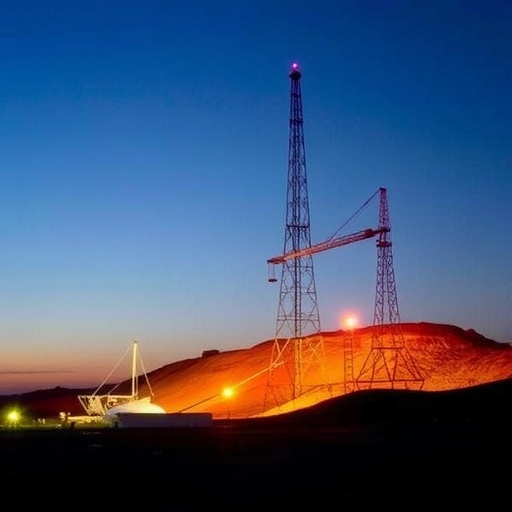
In the rapidly evolving field of environmental earth sciences, a groundbreaking study has emerged that promises to redefine how we understand and mitigate the effects of ground vibrations generated by blasting operations in open-pit mining. Spearheaded by researchers Ghosh, S., Himanshu V.K., and Behera, C., the investigation introduces an innovative approach that integrates the Geological Strength Index (GSI) of transmission strata directly into the established attenuation laws governing vibrations from bench blasting. This scientific advance, published in the acclaimed journal Environmental Earth Sciences, volume 84, article 282 (2025), addresses a longstanding challenge in geotechnical engineering and environmental management.
At the heart of this study lies the need to better quantify how mechanical energy propagates through rock masses disturbed by blasting. Open-pit mining, essential for extracting valuable minerals, unfortunately also subjects surrounding environments and infrastructure to significant ground vibrations. These vibrations, if unchecked, can compromise the structural integrity of nearby installations, trigger secondary hazards such as slope failures, and induce silent but damaging effects on local ecosystems. By focusing on the geological characteristics of transmission strata, namely their inherent strength and brittleness, the researchers have taken a pivotal step toward more precise predictive models.
The Geological Strength Index represents a semi-empirical measure that captures the condition and behavior of rock masses, accounting for variables such as fracturing, weathering, and intergranular cohesion. Traditionally, attenuation models—formulas describing how vibration intensity decreases over distance—have relied on simplified parameters that often overlook such nuanced geological features. This research integrates GSI values into these models, enhancing their sensitivity and accuracy in correlating the propagation of seismic energy with the specific nature of the surrounding rock layers.
Their methodology involved detailed field observations from multiple open-pit mines, alongside rigorous computational modeling. By synthesizing empirical vibration data with site-specific geological evaluations, the study proposes modified attenuation laws where GSI functions as a critical scaling factor. This enables predictions that reflect both the physical properties of the rock and the inherent energy dispersion pathways, which vary significantly with rock mass quality. This approach markedly contrasts earlier models that treated the rock medium as homogenous and isotropic, thereby oversimplifying the complexity of wave dispersion.
The scientific implications here are profound. For mine operators, this means having an advanced tool to predict ground vibrations more reliably, facilitating the design of blast parameters that minimize undesirable impacts. Moreover, environmental regulators can adopt such refined models to establish more scientifically grounded vibration thresholds that protect communities without unnecessarily constraining mining productivity. The inclusion of GSI thus bridges geological science and practical engineering safeguards, fostering sustainable resource extraction.
Interestingly, the researchers emphasize that understanding vibration attenuation through rock strata is not just a geotechnical problem but also an environmental imperative. Seismic waves displacing through transmission layers can affect groundwater flow, alter subsurface stress regimes, and indirectly impact surface vegetation and fauna. By customizing attenuation laws to local geology, this study allows environmental impact assessments to more accurately anticipate and mitigate ecological disruptions triggered by mining blasts.
The study also expands the theoretical framework underlying blast-induced vibrations. Leveraging advances in rock mechanics and wave propagation physics, the authors provide a robust analytical foundation for the modified attenuation laws. Their work highlights how dynamic stress transmission varies with rock mass condition, challenging longstanding assumptions of uniform wave attenuation functions. This deeper scientific insight paves the way for further research into tailoring vibration control technologies to specific geomechanical contexts.
From an engineering perspective, the incorporation of GSI into vibration attenuation models aids the optimization of bench geometry and explosive load distribution. By precisely calculating how vibration amplitudes decay with distance—modulated by the strength and fracturing characteristics of rocks—engineers can design blasts that achieve maximal fragmentation efficiency while minimizing extraneous vibration. This results in cost savings, improved safety margins, and reduced environmental footprint, aligning perfectly with modern principles of responsible mining.
The practical applications extend beyond mining alone. Any industry or infrastructure involving rock excavation or subsurface blasting can potentially benefit from these findings. For example, tunneling operations, civil construction projects in rocky terrains, and even seismic hazard evaluation in earthquake-prone regions stand to gain from improved models describing vibration transmission through complex geological media enhanced by rock mass indices like GSI.
Yet, as the authors note, this pioneering integration is not without challenges. Accurate estimation of GSI demands thorough geological mapping and rock mass characterization, including core logging and field surveys, which can be resource-intensive. Moreover, local geological heterogeneity introduces variability that must be carefully incorporated into model calibrations. The research therefore advocates for multidisciplinary collaboration combining geotechnical engineering, geophysics, and environmental science to refine and validate the proposed attenuation laws across diverse geological settings.
Another critical point addressed concerns the scalability of these improved models to different mining contexts, from small-scale quarry operations to vast metalliferous extraction sites. The study demonstrates that while fundamental relationships hold, parameter tuning is essential to tailor attenuation predictions to specific rock types, blast configurations, and regional geology. This adaptability enhances the global applicability and relevance of the research, making it a cornerstone contribution to both academic and industrial domains.
In light of these advances, future prospects look even more exciting. The authors envision integrating real-time monitoring systems, such as vibration sensors and geotechnical instrumentation, with their GSI-enhanced predictive models for dynamic blast management. This could enable immediate adjustments to blasting techniques in response to ground conditions and vibration feedback, enhancing precision and minimizing hazards. Such cyber-physical systems represent the cutting edge of smart mining technologies.
The study also opens avenues for coupling the enhanced attenuation laws with numerical simulations incorporating finite element or discrete element modeling of rock mass behavior. This integrated approach would allow comprehensive virtual testing of blasting scenarios, reducing reliance on empirical trial-and-error methods, and accelerating innovation in vibration control and mine safety engineering.
In conclusion, the innovative incorporation of the Geological Strength Index into ground vibration attenuation laws for open-pit bench blasting represents a significant leap forward in geotechnical and environmental sciences. By recognizing the critical role of rock mass conditions in seismic energy propagation, this research offers a scientifically robust, practically relevant framework to minimize the adverse impacts of mining-induced ground vibrations. Its potential to enhance operational efficiency, environmental protection, and infrastructural safety heralds a new era of informed, sustainable resource extraction.
As mining continues to evolve in complexity and scale, such integrative studies will be indispensable for balancing economic benefits with ecological stewardship. The work by Ghosh, Himanshu, Behera, and colleagues stands as a testament to the power of multidisciplinary research to solve real-world problems, bridging geology, engineering, and environmental science in a way that promises tangible benefits worldwide.
Cite Scienmag News
Violet Maxwell. (May 23, 2025). Integrating GSI into Ground Vibration Attenuation Models. Scienmag. https://scienmag.com/integrating-gsi-into-ground-vibration-attenuation-models/
Violet Maxwell. "Integrating GSI into Ground Vibration Attenuation Models." Scienmag, 23 May 2025, https://scienmag.com/integrating-gsi-into-ground-vibration-attenuation-models/. Accessed 6 September 2026.
Violet Maxwell. "Integrating GSI into Ground Vibration Attenuation Models." Scienmag. May 23, 2025. https://scienmag.com/integrating-gsi-into-ground-vibration-attenuation-models/


