


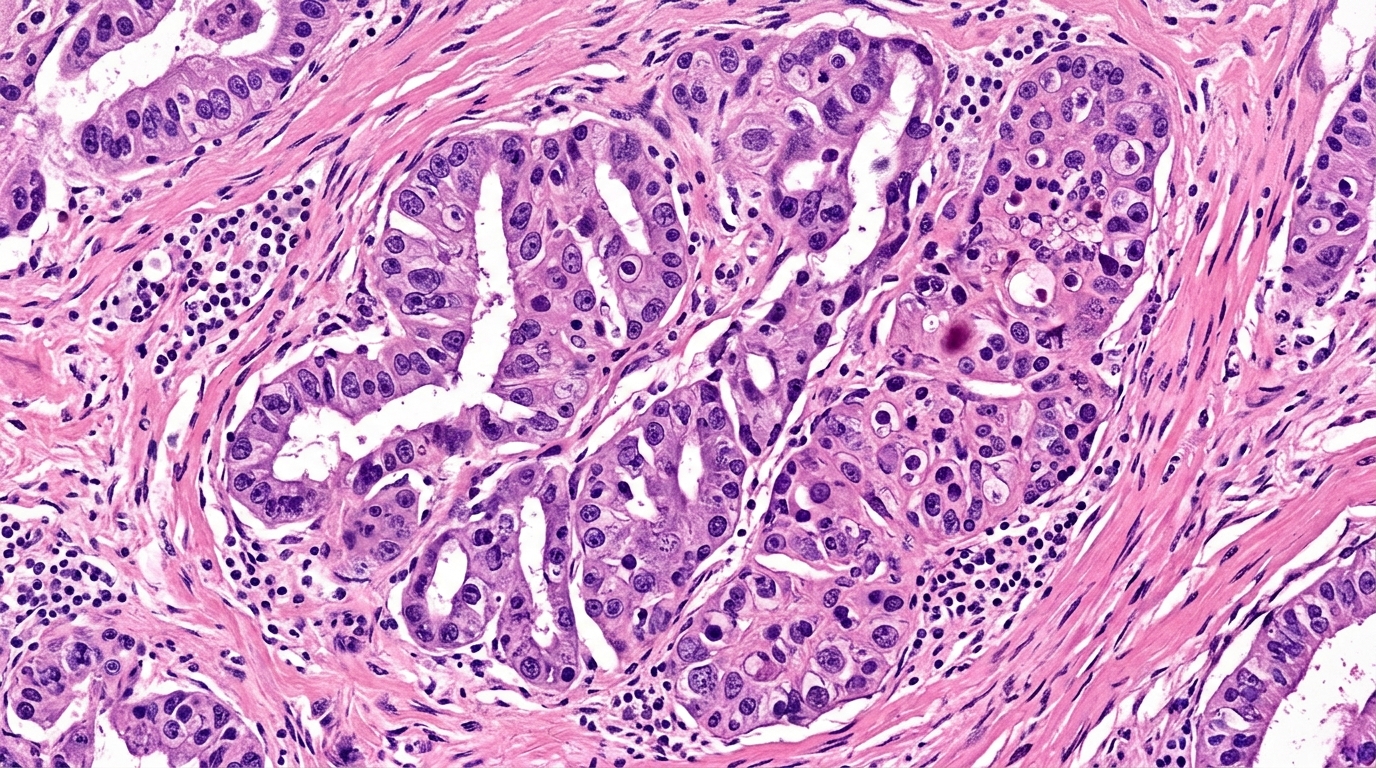
A recent study published in Diagnostic Pathology presents an integrated computational framework designed to enhance the accuracy and reliability of grading invasive ductal carcinoma (IDC). The research, led by Muna Alsallal and Bagher Farhood, combines traditional radiomic features with deep learning-derived features to classify histopathological images into four distinct grades. This approach aims to address current diagnostic challenges by leveraging both established radiomics methods and advanced deep learning models, thereby improving classification performance and potential clinical applicability for breast cancer assessment.
The study utilized a comprehensive dataset comprising 925 whole-slide images (WSIs) that were divided into over 356,000 image patches. These patches were categorized into four grades to facilitate multiclass classification. To extract radiomic features, the researchers employed the HistomicsTK platform, grouping the data into five categories that included shape, texture, and intensity-based features. Deep features were obtained from fine-tuned DenseNet169 and EfficientNet models.
The methodology involved two distinct approaches to evaluate the efficacy of feature integration. In the first approach, deep features were extracted and combined with radiomic features to serve as input for machine learning classifiers, including XGBoost, LightGBM, CatBoost, and Random Forest. In the second approach, an end-to-end framework directly utilized convolutional neural networks for multiclass classification without separate feature extraction steps. Advanced feature selection techniques such as LASSO, ANOVA, and RFE were used to identify the most predictive features.
The results demonstrated that the integration of radiomic and deep learning features outperformed all standalone approaches. Specifically, the combination of RFE and XGBoost achieved a test Area Under the Curve (AUC-ROC) of 95.9%, an accuracy of 94.1%, and a sensitivity of 93.9%. The study also evaluated ensemble models that combined the outputs of DenseNet169 and EfficientNet, which further improved performance, achieving a test AUC-ROC of 95.2% and an accuracy of 94.44%.
The researchers conducted SHAP analysis. This analysis identified key features such as Intensity.Min, Shape.EquivalentDiameter, and Haralick.Entropy.Mean as critical for the classification process. Additionally, t-SNE visualization confirmed the discriminative power of selected features.
The study concludes that integrating radiomic and deep learning features offers a robust and clinically interpretable framework for IDC grading.
Despite the promising results, the study acknowledges the need for further development to enhance predictive accuracy. Future work could incorporate molecular data to further enhance predictive accuracy.
Subject of Research: Innovative pathomics approach: integrating radiomic and CNN features for breast cancer classification using histopathological images
Article Title: Innovative pathomics approach: integrating radiomic and CNN features for breast cancer classification using histopathological images
Article References: Alsallal, M., Habeeb, M. S., Shareef, A., Jyothi, S. R., Nayak, P. P., Chauhan, A. S., Singla, S., Sameer, H. N., Yaseen, A., Athab, Z. H., Adil, M., & Farhood, B. (2026). Innovative pathomics approach: integrating radiomic and CNN features for breast cancer classification using histopathological images. Diagnostic Pathology. https://doi.org/10.1186/s13000-026-01828-1
Image Credits: AI Generated
DOI: 10.1186/s13000-026-01828-1
Keywords: Innovative, pathomics, approach, integrating, radiomic, features, breast, cancer, classification, histopathological, images, scientific research
Cite Scienmag News
Nathaniel Bowman. (November 8, 2026). Integrated Pathomics Framework Improves Breast Cancer Grading Accuracy. Scienmag. https://scienmag.com/integrated-pathomics-framework-improves-breast-cancer-grading-accuracy/
Nathaniel Bowman. "Integrated Pathomics Framework Improves Breast Cancer Grading Accuracy." Scienmag, 8 November 2026, https://scienmag.com/integrated-pathomics-framework-improves-breast-cancer-grading-accuracy/. Accessed 8 November 2026.
Nathaniel Bowman. "Integrated Pathomics Framework Improves Breast Cancer Grading Accuracy." Scienmag. November 8, 2026. https://scienmag.com/integrated-pathomics-framework-improves-breast-cancer-grading-accuracy/




