

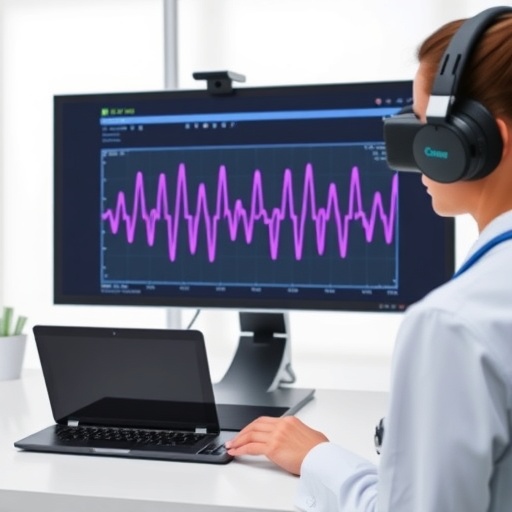
As healthcare simulation technology evolves, the integration of virtual reality (VR) in educational settings has captured significant attention. In particular, immersive VR simulations offer unique opportunities for students and professionals in nursing and allied health fields to enhance their learning experiences. A recent study conducted by Ping-Ju Chen examines the learning experiences and usability perceptions of an immersive virtual reality simulation designed specifically for cardiotocography interpretation education. This pioneering investigation adds valuable insights into the effectiveness of innovative teaching methodologies within nursing education.
At the heart of Chen’s study is the recognition of the complexities involved in cardiotocography—a monitoring technique for fetal heart and uterine contractions during labor. Effective interpretation of cardiotocography data is critical for ensuring optimal outcomes in both maternal and fetal health. Traditional educational methods often fall short in providing nursing students with accurate, hands-on experiences necessary for mastering this skill. Virtual reality simulations, however, propose a transformative solution by immersing students in a realistic environment that closely mimics clinical scenarios.
The study employs a qualitative-dominant mixed methods approach, highlighting the importance of both qualitative feedback and quantitative analysis. By combining these methodologies, Chen aims to create a comprehensive understanding of how immersive VR simulations can impact learning outcomes. This multifaceted approach enables researchers to explore not only the efficacy of the simulation but also the subjective experiences of its users. Such insights are invaluable for identifying potential enhancements and addressing barriers to effective learning in nursing education.
During the research, participants engaged with a VR simulation that allowed them to practice interpreting cardiotocography in a realistic setting. Unlike traditional methods, where students often rely on textbooks and static imagery, the immersive VR experience provides a dynamic interface. Users can interact with various elements within the virtual environment, fostering a sense of presence and engagement that is difficult to achieve through conventional teaching techniques. This interactivity is essential for promoting active learning, encouraging students to think critically about the data presented to them.
The study highlights a variety of participant experiences, revealing a spectrum of perceptions regarding usability and educational value. Many learners reported increased confidence in their ability to interpret cardiotocography data after engaging with the VR simulation. This newfound sense of self-efficacy is crucial for nursing students as they prepare to enter fast-paced clinical environments, where quick and accurate decision-making is paramount. Additionally, participants noted that the immersive nature of the simulation helped to enhance retention and recall of critical information related to fetal monitoring.
Yet, while many users expressed enthusiasm for the technology, some identified challenges in interfacing with the VR system. Technical difficulties such as glitches or limitations in the VR hardware can detract from the overall learning experience. Observations made during the study indicate that user experience must be a key consideration in the development of such educational tools. As educational institutions consider integrating VR into their curricula, addressing these technical challenges becomes integral to ensuring a seamless learning experience.
Further analysis within the study reveals a correlation between immersive learning experiences and improved engagement levels among students. Participants consistently reported that the VR simulation captured their attention, making them more likely to absorb and apply the information presented. This aspect speaks volumes about the potential of VR technology in transforming educational paradigms, particularly in nursing education, where retention of complex concepts can be pivotal for professional success.
Chen’s findings resonate beyond the constraints of the nursing discipline; they provide a useful framework for broader applications within healthcare education. The successful implementation of VR simulations in teaching cardiotocography interpretation can serve as a model for other specialized skills training across medical fields. As technologies continue to evolve, the adaptability of VR tools could revolutionize the way educational institutions approach hands-on training.
In addition to pedagogical implications, the study also raises important considerations regarding accessibility and inclusivity in healthcare education. All students should have equal access to innovative learning tools, regardless of their resources or institutional support. Future research should address measures to improve accessibility, ensuring that all nursing students can benefit from immersive technologies, which may ultimately contribute to more equitable healthcare education.
As academic and clinical institutions grapple with the challenges posed by an ever-evolving healthcare landscape, the integration of immersive VR technologies may offer a promising avenue for preparing the next generation of healthcare professionals. Chen’s insights provide a necessary foundation for understanding the nuances of employing virtual reality in education, underscoring both the successes and challenges encountered in the transition from traditional to innovative modalities.
The potential impact of immersive VR simulations extends further into the realm of lifelong learning for healthcare professionals. As technology continues to advance at an unprecedented pace, ongoing professional development is essential for nurses and healthcare providers. By facilitating the continuous evolution of training methodologies through immersive experiences, the health sector can enhance the quality of care delivered to patients, ensuring that practitioners remain at the forefront of evidence-based practice.
Ultimately, Chen’s study is emblematic of a broader shift in education—one that prioritizes adaptability, innovation, and learner engagement. As educational researchers and institutions continue to explore the applications of virtual reality in healthcare education, the findings from this study will indubitably contribute to the ongoing conversation surrounding effective pedagogical strategies that foster the development of competent and confident nursing professionals.
In conclusion, the rapid advancement of technologies indicates a future where immersive learning experiences become standard within healthcare education. By leveraging the potential of VR simulations, educational institutions can empower nursing students with the tools needed for effective decision-making in clinical environments. As evidenced by the insights provided in Chen’s research, the road ahead is filled with possibilities for enhancing educational practices and ultimately improving healthcare outcomes for mothers and infants alike.
Subject of Research: Immersive Virtual Reality Simulation for Cardiotocography Education
Article Title: Learning experiences and usability perceptions of an immersive virtual reality simulation for cardiotocography interpretation education: a qualitative-dominant mixed methods inquiry.
Article References: Chen, PJ. Learning experiences and usability perceptions of an immersive virtual reality simulation for cardiotocography interpretation education: a qualitative-dominant mixed methods inquiry. BMC Nurs (2026). https://doi.org/10.1186/s12912-025-04126-1
Image Credits: AI Generated
DOI: 10.1186/s12912-025-04126-1
Keywords: Virtual Reality, Nursing Education, Cardiotocography, Immersive Learning, Usability Perception, Healthcare Simulation, Mixed Methods.


