

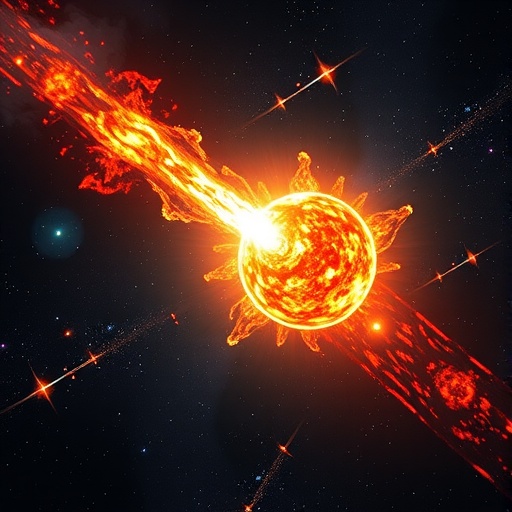
In a remarkable discovery shaking the foundation of our understanding of stellar interactions, astronomers have unveiled that a white dwarf star, located approximately 10,000 light years from Earth, is engaged in an unprecedented consumption spree with its larger companion star. This double star system, identified as V Sagittae, has been igniting curiosity and bewilderment among astrophysicists for over a century, as its unusual luminosity and behavior have long defied current theories.
Recent observations from the powerful European Southern Observatory’s Very Large Telescope in Chile have provided enlightening insights into the dynamics of V Sagittae. Astronomers have documented how the super-dense white dwarf is siphoning mass from its larger twin, generating an extraordinary brightness that sets it apart from other star systems. The white dwarf, a remnant of a star that has exhausted its nuclear fuel, displays a voracious appetite, consuming material from its companion star at an alarming rate. This interaction produces a brilliant glow, illuminating the night sky as the white dwarf transitions into a thermonuclear state.
As the two stars orbit one another every 12.3 hours in a gravitational ballet, they are gradually spiraling closer together. This intimate dance could culminate in a spectacular astrophysical event—a supernova explosion so radiant that it might be viewable from Earth during the day. Such a powerful eruption would not only release an immense amount of energy but also challenge existing models of stellar evolution and the life cycles of stars.
The lead author of the study, Dr. Pasi Hakala from the University of Turku, emphasizes the significance of these findings, explaining that they solve a century-old enigma surrounding the V Sagittae pair. The intense brightness is attributed to the white dwarf drawing mass from its companion, a process that transforms the accreted matter into energy, resulting in the star shining like a beacon. The team, which includes Professor Phil Charles from the University of Southampton and Dr. Pablo Rodríguez Gil from Spain’s Instituto de Astrofisica de Canarias, is excited about how their research reshapes our understanding of binary star systems.
Moreover, one of the standout discoveries involves a ring of gas encircling the double star system—a striking halo resulting from the energetic interactions at play. This unexpected presence of a gas ring highlights the chaotic environment surrounding the stars, offering important clues into the physical processes governing stellar lifecycles. The increased mass transfer escalates the likelihood of eruptive events such as nova outbursts, where the white dwarf sporadically brightens, captivating skywatchers and scientists alike.
The accumulation of mass on the white dwarf suggests that it is nearing a critical threshold, likely leading to a nova explosion within the next few years. If this eruption occurs, V Sagittae is predicted to reach brightness levels accessible to the naked eye, presenting an extraordinary opportunity for both amateur and professional astronomers. This spectacle signifies not just a tantalizing astronomical event but an opening to study the properties of white dwarfs and their explosive behaviors in greater depth.
This discovery bears implications extending beyond the immediate observation. It raises questions regarding the destiny of massive star systems and the intricate ballet they perform throughout their lifetimes. Understanding these dynamics enhances our knowledge of the underlying mechanisms that dictate stellar evolution, particularly in binary systems where interactions can lead to dramatic transformations.
As researchers continue to study V Sagittae, they are unlocking secrets about the universe that have remained hidden for far too long. The researchers stress the need for ongoing observations to document these developments in real-time, as they anticipate watching a stellar drama unfold that could redefine our comprehension of fundamental astrophysical concepts. With V Sagittae poised for significant changes, the scholarly community is abuzz with excitement about the potential discoveries that lie ahead.
In summary, the feeding frenzy of V Sagittae offers breathtaking insights into the universe’s most enigmatic phenomena. This system presents a unique laboratory for studying astrophysical processes such as mass transfer, stellar fusion, and eventual stellar explosions. As scientists reveal more about V Sagittae and its extravagant interactions, we are reminded of the vibrant and violent processes that govern the cosmos and shape the stars we glimpse in our night sky. The captivating narrative woven by this star system not only intrigues us but reminds us of the grandeur of our universe, full of mysteries waiting to be uncovered.
Subject of Research: Stellar interactions and mass transfer in binary star systems
Article Title: V Sagittae: A Study of Extravagant Stellar Consumption
News Publication Date: October 2023
Web References: N/A
References: N/A
Image Credits: University of Southampton
Keywords
Stellar evolution, binary stars, V Sagittae, white dwarfs, nova explosions, astrophysics, mass transfer, cosmic phenomena, luminous stars, stellar dynamics.


