


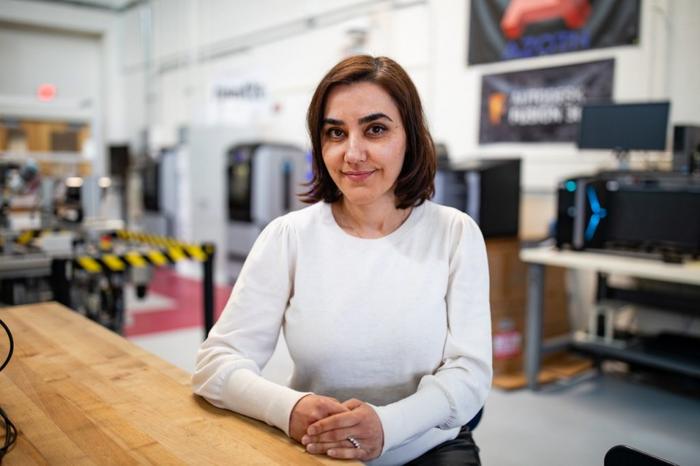
Drunken driving claims 37 lives daily in the U.S. with teen and young adult drivers disproportionately involved. Niyousha Hosseinichimeh in the College of Engineering has partnered with researchers across the U.S. to create a simulation model — the first of its kind in adolescent drunken driving prevention — that examines how numerous public health interventions affect fatalities.

Credit: Photo by Peter Means for Virginia Tech.
Drunken driving claims 37 lives daily in the U.S. with teen and young adult drivers disproportionately involved. Niyousha Hosseinichimeh in the College of Engineering has partnered with researchers across the U.S. to create a simulation model — the first of its kind in adolescent drunken driving prevention — that examines how numerous public health interventions affect fatalities.
Utilizing the simulation model, the team tested single intervention factors, such as increasing alternative transportation through both public or ride sharing services, enacting new restrictive laws across the U.S., and higher law enforcement presence. The model identified that the best way to reduce alcohol-related crashes among teens and young adults is not through a single measure, but a combined intervention strategy with three tenants:
- Enactment of a new restrictive law in 50 states, such as lowering the legal limits for blood alcohol content (BAC) while driving
- Providing more alternative transportation
- Higher enforcement, such as increased police presence or checkpoints on roadways
The team’s findings were recently published in the journal of Social Science & Medicine and underscores the importance of Hosseinichimeh’s unique mathematical modeling, which allows researchers to test multiple interventions and evaluate outcomes in real time to better address the complex public health and societal issue.
Why it matters
Alcohol-impaired driving is influenced by numerous interconnected factors and long delays between actions and outcomes, complicating policymaking and increasing the risk of unintended consequences. Understanding these dynamics is crucial for crafting effective interventions.
“The system is very complex, and not a single discipline can provide an effective solution to reduce impaired driving,” Hosseinichimeh said. “We aim to provide policymakers with a better understanding of the potential impacts of their decisions.”
Hosseinichimeh, assistant professor in the Grado Department of Industrial and Systems Engineering, has partnered with Federico Vaca, a physician with the University of California, Irvine. Utilizing funding from the National Institutes of Health (NIH), Hosseinichimeh, Vaca, and a team of researchers across disciplines set forth with the goal to understand why teens drink and drive. In their prior research published in 2022, they mapped out how factors such as peer influence, parental monitoring and alcohol advertising connect. They found prevention needed a multifactor approach, so Hosseinichimeh got to work on building a mathematical model. Research related to drunk driving prevention is abound, but utilzing modeling and systems engineering provides new perspectives.
“While there is extensive research related to alcohol impaired driving, using modeling and systems thinking offers a robust approach to understand the complex and often overlooked factors that influence this issue and can lead to negative outcomes,” Vaca said.
Key insights
- Innovative modeling: The team developed a system dynamics simulation model using group modeling sessions with input from various health and safety experts.
- Prior research: Previous research from this study mapped complex causal outcomes and identified key feedback mechanisms that affect alcohol-impaired driving among adolescents and young adults. This mapping highlighted the systemic complexity contributing to the persistence of the problem, and researchers realized a more complex model was needed to test interventions and see the results in real time.
- Data-driven analysis: The simulation model, calibrated with data such as FBI arrests, interviews from adolescent drivers, and national fatality information, accurately replicated historical trends for people ages 15 to 24.
- Effective interventions: The research found that the most impactful solution was three pronged: implement new restrictive laws, increase police presence, and provide more alternative transportation.
- Future directions: Despite the success of combined interventions, fatalities plateau over time, highlighting the need for new strategies to ensure a sustained decline in alcohol-related deaths. The research team submitted a new proposal to NIH focusing on reducing BAC levels for selected individuals. Future projects will refine the models and test new interventions, aiming for a comprehensive solution to teen drinking and driving.
The bottom line
The highest percentage of alcohol-impaired drivers in fatal crashes was the 21- to 24-year-old age group, totaling 27 percent of all fatal crashes in 2021. By integrating diverse knowledge and expertise, Hosseinichimeh and her team are pioneering a systems engineering approach to address the complex issue of teen drinking and driving. Her mathematical model allows researchers to easily quantify a complex problem and understand potential outcomes related to policy decisions. The combination of the work not only highlights the importance of interdisciplinary collaboration, but also provides actionable insights for policymakers striving to make the roads, and young drivers, safer.
Journal
Social Science & Medicine
Article Title
Modeling of drinking and driving behaviors among adolescents and young adults in the United States: Complexities and Intervention outcomes
Article Publication Date
22-Jul-2024
Cite Scienmag News
Courtney Benton. (July 22, 2024). Innovative modeling aims to curb teen drunken driving fatalities. Scienmag. https://scienmag.com/innovative-modeling-aims-to-curb-teen-drunken-driving-fatalities/
Courtney Benton. "Innovative modeling aims to curb teen drunken driving fatalities." Scienmag, 22 July 2024, https://scienmag.com/innovative-modeling-aims-to-curb-teen-drunken-driving-fatalities/. Accessed 5 September 2026.
Courtney Benton. "Innovative modeling aims to curb teen drunken driving fatalities." Scienmag. July 22, 2024. https://scienmag.com/innovative-modeling-aims-to-curb-teen-drunken-driving-fatalities/

