

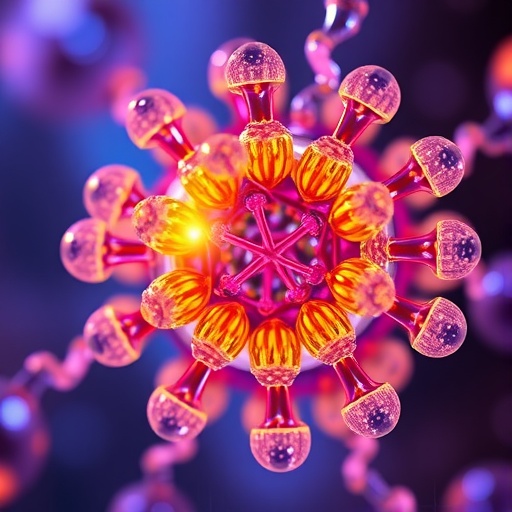
In the relentless pursuit of precision in cancer therapy, a groundbreaking chemistry-based strategy emerges from the laboratories of Syracuse University, promising to revolutionize how toxic cancer drugs are delivered and activated. The central challenge with many existing cancer treatments lies in their inherent toxicity not just to cancer cells but also to healthy tissues, leading to devastating side effects and severely limiting therapeutic efficacy. Addressing this, assistant professor of chemistry Xiaoran Hu and his team have pioneered a novel “lock-and-key” molecular system that ensures cancer drugs remain inert during circulation and become activated only at tumor sites, thereby minimizing collateral damage.
At the heart of this innovation is the principle of biorthogonal chemistry, a discipline devoted to designing chemical reactions so selective that they can occur inside living organisms without interfering with the host’s native biochemical processes. Hu’s research leverages this precise control to cage therapeutic molecules, holding them in a chemically inert, masked state as they traverse the body. The “lock,” formed through supramolecular host-guest chemistry, acts as a molecular cage, while the “key” is a complementary chemical trigger introduced specifically at the tumor site. Upon encountering this trigger, the drug is swiftly released, unleashing its cytotoxic potential exactly where it is needed, thus redefining spatial and temporal control in drug delivery.
The biological milieu is an exceptionally complex and reactive environment, which poses formidable challenges to conventional chemistry techniques. Hu’s approach circumvents these challenges by designing molecular interactions that are “invisible” to biological processes yet robust enough to maintain drug inactivity. This exquisite selectivity is achieved by exploiting supramolecular host molecules that recognize and tightly bind their guest counterparts. Unlike covalent bonds, these non-covalent interactions allow reversible and tunable binding, essential for maintaining drug stability before targeted release. This chemistry affords an unprecedented level of control, enabling therapeutic activation with surgical precision inside living cells and tissues.
Cancer chemotherapy’s Achilles heel lies in its nonspecific action—drugs circulate systemically and indiscriminately attack replicating cells, healthy or malignant. Hu’s platform ingeniously circumvents this by ensuring that these potent agents are locked in a “cage,” chemically inert and incapable of triggering toxicity during their journey through the body. Only upon reaching a designated tumor microenvironment, where the “key” chemical trigger is applied, does the cage open, initiating precise drug activation. This specificity not only promises to reduce systemic side effects but also paves the way for dosage refinement and improved patient outcomes.
Despite the innovative strides, the system is not without its challenges. One critical hurdle lies in the stability of the host-guest complex under physiological conditions, particularly regarding temperature and pH. At normal body temperature (approximately 37°C), supramolecular interactions naturally weaken, leading to the premature “leakage” of free drug molecules from their cages. Such unintended release undermines therapeutic precision and raises potential safety concerns. Hu acknowledges this limitation and underscores the ongoing efforts to enhance host-guest binding affinity, striving for a system that remains locked firmly until externally triggered.
The implications of this research extend beyond oncology. Given that the platform operates independently of specific biological receptors or pathways, it holds vast potential to be adapted to a diverse array of therapeutic agents. From antimicrobials to neurological drugs, this versatile method of programmable drug activation could reshape treatments across the medical spectrum. The fundamental notion shifts from administering drugs as simple chemical entities to delivering them as sophisticated, encoded systems whose effects are spatially and temporally orchestrated by chemists.
In vitro experiments further demonstrate the system’s capacity for dynamic control. Hu’s team was able to modulate cytotoxicity levels in cancer cells by precisely regulating the release kinetics of different therapeutic agents. This nuanced control suggests future avenues in personalized medicine, where drug activation can be custom-tailored to individual patient needs or tumor heterogeneity. Such advancements could significantly mitigate the trial-and-error challenges common in contemporary chemotherapy regimens.
The platform’s modularity is another hallmark feature, enabling the “lock-and-key” concept to be fine-tuned for multiple classes of drugs. By altering the host molecules or trigger chemicals, researchers can potentially orchestrate multi-drug release sequences or respond to complex biological cues within tumors. This opens exciting prospects for combinational therapies, where synergistic drugs are activated in concert, maximizing efficacy while minimizing toxicity—a paradigm shift toward smarter, more effective treatments.
The research also underscores the importance of supramolecular chemistry’s subtleties. Unlike traditional covalent drug conjugates, the reversible nature of non-covalent host-guest complexes allows for more nuanced regulation of drug availability. However, this same reversibility demands meticulous chemical engineering to optimize interaction strength and stability in the bloodstream. Incorporating next-generation molecular designs that enhance binding affinity, such as multivalent hosts or novel synthetic hosts, constitutes the forefront of ongoing investigations aimed at overcoming premature drug release.
This pioneering study was published in the prestigious journal Angewandte Chemie International Edition—a testament to its scientific significance and potential impact. Funded in part by the Syracuse University Office of Undergraduate Research and Creative Engagement, the work heralds a new chapter in medicinal chemistry by merging sophisticated chemical strategies with pressing clinical challenges. The research team envisions that continued refinement of this technology may eventually bring these concepts from the bench to bedside, offering safer, smarter cancer therapies in the years to come.
Ultimately, Xiaoran Hu’s “lock-and-key” drug delivery system exemplifies a transformative approach to cancer treatment—a programmable chemistry that liberates therapeutics precisely where and when they are needed, sparing patients from the ravages of systemic toxicity. It epitomizes the intersection of molecular innovation and clinical necessity, promising a future where cancer is combated not only by powerful drugs but by the intelligent control of their chemical activity within the human body.
Subject of Research: Programmable drug activation through biorthogonal supramolecular chemistry for targeted cancer therapy
Article Title: Chemistry-Based “Lock-and-Key” System Enables Targeted Drug Activation in Cancer Treatment
Web References:
References:
Hu, X., et al. “Biorthogonal Supramolecular Chemistry for Controlled Drug Release.” Angewandte Chemie International Edition, 2024.
Image Credits: Syracuse University
Keywords: Chemistry, Biorthogonal Chemistry, Supramolecular Chemistry, Drug Delivery, Cancer Therapy, Chemical Compounds, Chemical Physics, Molecular Physics, Physical Chemistry


