


In the realm of additive manufacturing, the pursuit of melding intricate design with mechanical robustness has long been a formidable challenge, especially when it comes to fabricating metals and ceramics with high precision. Traditional vat photopolymerization, a cornerstone 3D printing technique, excels in crafting complex polymer structures by selectively curing light-sensitive resins within a vat using lasers or ultraviolet light. However, while this approach facilitates exquisite architectural control, its applications have historically been tethered to polymers, limiting its utility where durable metals or ceramics are indispensable.
Recent advances have attempted to bridge this divide by embedding metal precursors within photo-curable resins, followed by post-processing to transform these polymers into metals or ceramics. Unfortunately, this pathway often culminates in problematic porosity and significant material shrinkage during conversion. These defects compromise the structural integrity and dimensional fidelity of the final product, rendering the process unsuitable for applications demanding high strength and precision.
Addressing these persistent impediments, a team led by Daryl Yee at EPFL’s Laboratory for the Chemistry of Materials and Manufacturing has pioneered a transformative approach that redefines the paradigm of metal and ceramic 3D printing. Their innovative method circumvents the pre-mixing of metal salts into the resin, instead leveraging an initially inert hydrogel scaffold as a foundational blank template. This hydrogel, a water-rich polymer matrix, is first meticulously shaped into complex geometries using vat photopolymerization, capitalizing on the technique’s unrivaled spatial control and resolution.
Crucially, the metal salts are introduced only after the hydrogel framework has been fabricated, via a repeated infusion process. This post-fabrication doping involves soaking the hydrogel scaffold in solutions containing various metal ions such as iron, silver, or copper. Subsequent chemical treatments convert these ions into nanoscale metal-containing particles that propagate throughout the polymer network. By iteratively repeating these infusion-precipitation cycles five to ten times, the team achieves exceptionally high metal loadings within the composite structure, while maintaining the original complex form.
The culmination of this transformative process is a baking step, during which the hydrogel is volatilized and removed through controlled heating. This calcination leaves behind a dense, self-supporting metallic or ceramic lattice that faithfully replicates the original designed architecture. By separating the shape-fabrication and material-infusion stages, this approach endows unparalleled flexibility, allowing the same hydrogel blueprint to be converted into a diverse array of materials depending on the metal salts chosen for infusion.
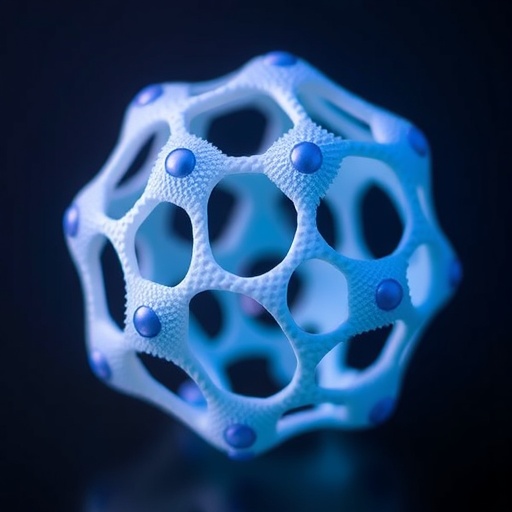
For practical validation, Yee and colleagues fabricated gyroidal structures—mathematically defined triply periodic minimal surfaces known for their high surface-to-volume ratios and mechanical efficiency—and infused them with iron, silver, and copper. These lattice architectures are notoriously challenging to produce with metals using conventional 3D printing due to their complexity and fragile nature when improperly consolidated. In rigorous mechanical tests conducted with universal testing machines, the resulting metal gyroids demonstrated remarkable strength, withstanding pressures twenty times greater than those formed by existing polymer-to-metal conversion methods. Furthermore, the process exhibited minimal volumetric shrinkage—around 20%—a dramatic improvement compared to the 60 to 90% shrinkage typically observed.
Such enhancements pave the way for manufacturing complex, lightweight, yet ultra-strong metal components with precision and reliability previously unattainable. The implications are profound for sectors where performance hinges on balancing weight, strength, and intricacy, including aerospace, biomedical implants, energy conversion technologies, and catalysis. High-surface-area metallic structures, for example, are pivotal for catalytic converters that transform chemical energy efficiently or for heat dissipation elements in cutting-edge cooling systems.
Despite its promise, the method currently suffers from time constraints due to multiple infusion cycles required to build up metal content, posing a challenge for scalability and industrial adoption. Recognizing this, the EPFL team is actively developing automation strategies to accelerate processing, including robotic handling that can streamline infusion and washing steps. Enhancements in cycle speed and further densification of the final materials remain research priorities.
This breakthrough also signifies a conceptual shift in additive manufacturing workflows. Traditionally, material selection is an initial, fixed decision prior to printing, binding design to a specific medium early on. The EPFL technique decouples form from material identity, enabling a single printed hydrogel structure to serve as a universal canvas that can be ‘painted’ post-printing with various metal or ceramic chemistries. This late-stage material customization holds tremendous potential for rapid prototyping, tailored functional materials, and recycling pathways.
Underlying this innovation is the adept utilization of hydrogels, substances traditionally valued for biomedical scaffolding and drug delivery, now harnessed as versatile 3D printing intermediates for high-performance inorganic materials. The capacity of hydrogels to imbibe metal ions and facilitate their in-situ nanoparticle formation inside a polymer matrix before conversion lends this method exceptional tunability and control.
Looking forward, the integration of this hydrogel-based vat photopolymerization with advanced chemical infusion opens new frontiers for engineering next-generation materials. By marrying precision architecture with robust material properties at scale and speed, the technique promises to reshape how metals and ceramics are fabricated, bringing futuristic devices and structures within practical reach. As such, it marks a pivotal stride toward overcoming longstanding limitations in additive manufacturing of dense, strong, and intricate functional components.
News Publication Date: 24-Sep-2025.
Web References: Not provided.
References: DOI 10.1002/adma.202504951.
Cite Scienmag News
Denise Maddox. (October 8, 2025). Innovative 3D Printing Technique ‘Grows’ Ultra-Strong Materials. Scienmag. https://scienmag.com/innovative-3d-printing-technique-grows-ultra-strong-materials/
Denise Maddox. "Innovative 3D Printing Technique ‘Grows’ Ultra-Strong Materials." Scienmag, 8 October 2025, https://scienmag.com/innovative-3d-printing-technique-grows-ultra-strong-materials/. Accessed 4 September 2026.
Denise Maddox. "Innovative 3D Printing Technique ‘Grows’ Ultra-Strong Materials." Scienmag. October 8, 2025. https://scienmag.com/innovative-3d-printing-technique-grows-ultra-strong-materials/


