


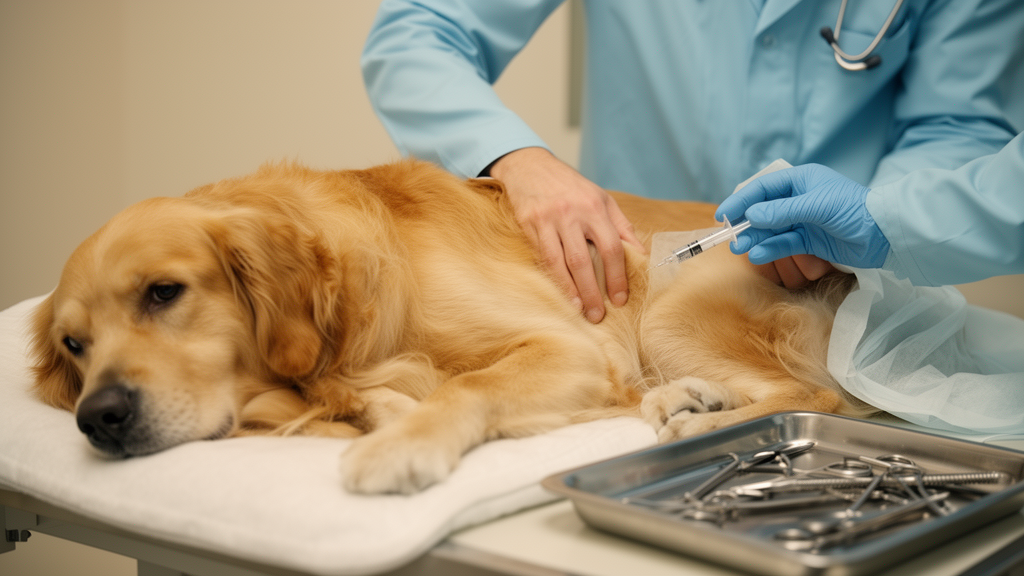
Dogs with aching hips may get more relief when regenerative serum is delivered straight into the joint rather than only through a vein. A retrospective study of 16 active police working dogs with naturally occurring bilateral hip osteoarthritis, published in Frontiers in Pain Research, compared two treatment protocols based on autologous conditioned serum (ACS), a preparation made from each dog’s own blood that is enriched with anti-inflammatory cytokines, growth factors, exosomes and lipid mediators. Both protocols were associated with improvements in pain, stiffness and function over a 120-day follow-up, but the group that received an initial intra-articular injection followed by a later intravenous dose showed significantly greater and longer-lasting gains than the group treated intravenously only.
Osteoarthritis is a common chronic joint disorder in dogs, estimated to affect roughly 20 percent of dogs over one year of age in North America and the United Kingdom. Risk factors include breed-related characteristics, reproductive status, body weight and age, with animals older than eight years at particular risk. Rising life expectancy and increasing obesity may push prevalence higher in the future. Because clinical signs are appearing at younger ages, prolonged pharmacological treatment with first-line drugs such as non-steroidal anti-inflammatory drugs raises concerns about long-term adverse effects, fueling interest in regenerative strategies that target the mechanisms of joint inflammation rather than only controlling symptoms.
ACS is one such strategy. It is produced by drawing about 15 milliliters of a dog’s venous blood into a preparation device, incubating it at 37 degrees Celsius for 4.5 hours to induce coagulation and activate blood cells, and then centrifuging the sample. The resulting serum contains a secretome of bioactive components, including the interleukin-1 receptor antagonist, which competitively blocks the IL-1 receptor and dampens inflammatory signaling within the joint. Intra-articular administration has previously shown anti-inflammatory and regenerative potential, while intravenous delivery, which avoids procedures requiring sedation and anesthesia, has also been reported to improve clinical signs.
The new analysis was conducted retrospectively at the Canine Veterinary Center of the Guarda Nacional Republicana, the Portuguese gendarmerie, using records from routine clinical care. Eight dogs received 6 milliliters of ACS intravenously on days 0 and 60, forming the intravenous group, and eight received 6 milliliters injected directly into the hip joints on day 0, split as 3 milliliters per hip, followed by 6 milliliters intravenously on day 60, forming the intra-articular group. All dogs rested for three days after each administration. Dogs were included only if they weighed at least 15 kilograms, were older than two years, had radiographic findings consistent with bilateral hip osteoarthritis graded on the Orthopedic Foundation for Animals scheme, had no other concurrent disease, and had received no joint treatments or other concomitant therapy.
Treatment response was tracked with three translated, validated owner-completed questionnaires: the Canine Brief Pain Inventory, which yields a pain severity score and a pain interference score; the Liverpool Osteoarthritis in Dogs instrument; and the Canine Orthopedic Index, which covers stiffness, gait, function and quality of life. Handlers assessed their dogs at baseline and at 15, 30, 60, 90 and 120 days. The intra-articular injections were performed aseptically under sedation, with correct needle placement confirmed by aspiration of synovial fluid. Because the study reviewed existing records, handlers were not blinded to which protocol their dog had received, and the choice of protocol had been made by the attending clinician rather than randomized.
The 16 dogs, nine males and seven females, had a mean age of 10.4 years and a mean body weight of 26.0 kilograms, and included German Shepherds, Labrador Retrievers, Belgian Malinois Shepherds and Dutch Shepherds. Thirteen had moderate osteoarthritis and three severe disease at the initial evaluation, and the two groups were comparable at baseline in questionnaire scores, age, weight, breed, sex and radiographic grade. Both groups improved on pain severity from the first to the last evaluation, but the trajectory of improvement diverged sharply between protocols.
From day 15 onward, the intra-articular group scored significantly better on pain severity, pain interference and the Liverpool Osteoarthritis in Dogs measure, with between-group effect sizes growing from small to large as follow-up progressed. In that group, pain severity fell by 5.0 points within 15 days and stayed about 3.9 points below baseline through day 120, whereas the intravenous-only group declined by only 1.6 to 1.7 points and then plateaued. On the Liverpool measure, only the combined protocol crossed the pre-defined threshold for clinically significant improvement, reaching a reduction of 15.0 points at day 30 and holding around 12.5 points, while reductions in the intravenous group of 0.8 to 1.8 points never reached clinical significance. Overall Canine Orthopedic Index scores and stiffness also favored the combined protocol at every time point, with moderate to large effect sizes, while function differed from day 30, gait at all time points except day 60, and quality of life only from day 90.
Kaplan-Meier time-to-event analysis reinforced the pattern, measuring how long dogs maintained a clinically important improvement, defined by thresholds such as a one-point drop in pain severity, a two-point drop in pain interference, a four-point drop on the Liverpool measure, or a 14-point drop in the overall orthopedic index. The combined-protocol dogs kept their pain severity improvements for a mean of 124.4 days against 26.3 days in the intravenous-only group, and the differences were statistically significant for pain severity, pain interference, the Liverpool measure, stiffness and the overall orthopedic score. The authors caution that because assessments occurred only at scheduled visits, the exact timing of responses could not be observed precisely, and these estimates should be interpreted accordingly. The authors also note that because both groups received intravenous ACS by day 60, the comparison reflects two distinct treatment protocols rather than a pure comparison of administration routes, a distinction that matters especially for interpreting differences after day 60.
Safety signals were reassuring within the limits of the study. Hematological and biochemical parameters, including complete blood counts, liver and kidney markers, albumin, globulins and C-reactive protein, remained within reference ranges throughout, with no differences between groups at any point, and no side effects were recorded in either group. The authors suggest that direct exposure of joint tissues to the serum may explain the faster local response, possibly reflecting local retention of bioactive mediators after joint injection versus more rapid systemic clearance after intravenous dosing, and that an initial joint injection might prime tissues for the later intravenous dose. Because the study did not quantify specific ACS components, these remain hypotheses for future work. Function and gait showed less consistent differences, plausibly because chronic musculoskeletal adaptations, muscle mass and established gait-compensation strategies resolve slowly regardless of inflammation, and mild baseline impairment left limited room for detectable improvement.
The findings come with important caveats. The sample was small at eight dogs per group, limiting statistical power for variable measures such as function, gait and quality of life; allocation was retrospective and non-randomized, creating potential selection bias; owner-reported outcomes were unblinded; and the absence of a control group means natural fluctuations in disease cannot be excluded. All subjects were active police working dogs, so extrapolation to pet dogs should be cautious, and a 120-day window cannot address longer-term durability. Still, the authors argue the intravenous route retains practical appeal, being simpler and less invasive, usable without sedation, and potentially administable at shorter intervals without repeated joint punctures, though that possibility was not tested. Future studies with randomization, blinding, objective gait and imaging measures, synovial biomarker quantification and longer follow-up will be needed to confirm which patients benefit most from each protocol.
Subject of Research: Comparison of intra-articular-plus-intravenous versus intravenous-only protocols of autologous conditioned serum in dogs with hip osteoarthritis
Article Title: A comparison of intravenous-only and intra-articular-plus-intravenous protocols of autologous conditioned serum in dogs with hip osteoarthritis—a retrospective study
Article References: Constantino, M., & Alves, J. C. (2026). A comparison of intravenous-only and intra-articular-plus-intravenous protocols of autologous conditioned serum in dogs with hip osteoarthritis—a retrospective study. Frontiers in Pain Research, 7, Article 1981364. https://doi.org/10.3389/fpain.2026.1981364
Image Credits: AI Generated
DOI: 10.3389/fpain.2026.1981364
Keywords: autologous conditioned serum, dogs, hip osteoarthritis, veterinary medicine, regenerative medicine, intra-articular injection, intravenous therapy, canine pain, retrospective study, working dogs, interleukin-1 receptor antagonist, client-reported outcomes
Cite Scienmag News
William Thompson. (October 23, 2026). Injecting Joint Serum Directly Into Arthritic Hips Eases Dogs’ Pain Faster Than Drips Alone. Scienmag. https://scienmag.com/injecting-joint-serum-directly-into-arthritic-hips-eases-dogs-pain-faster-than-drips-alone/
William Thompson. "Injecting Joint Serum Directly Into Arthritic Hips Eases Dogs’ Pain Faster Than Drips Alone." Scienmag, 23 October 2026, https://scienmag.com/injecting-joint-serum-directly-into-arthritic-hips-eases-dogs-pain-faster-than-drips-alone/. Accessed 23 October 2026.
William Thompson. "Injecting Joint Serum Directly Into Arthritic Hips Eases Dogs’ Pain Faster Than Drips Alone." Scienmag. October 23, 2026. https://scienmag.com/injecting-joint-serum-directly-into-arthritic-hips-eases-dogs-pain-faster-than-drips-alone/


