Thursday, October 29, 2026
Science
No Result
View All Result
  • Login
  • HOME
  • SCIENCE NEWS
  • CONTACT US
  • HOME
  • SCIENCE NEWS
  • CONTACT US
No Result
View All Result
Scienmag
No Result
View All Result
Home Science News

Induction self-heating insert for mold temperature control evaluated with experiments, simulation, and neural network model

October 27, 2026
in Science News
Cassandra Pierce
By Cassandra Pierce Scienmag Editorial Profile - Systems Neuroscience
Reading Time: 3 mins read
0
Induction self-heating insert for mold temperature control evaluated with experiments, simulation, and neural network model

Induction self-heating insert for mold temperature control evaluated with experiments, simulation, and neural network model

65
SHARES
587
VIEWS
Share on FacebookShare on Twitter
ADVERTISEMENT

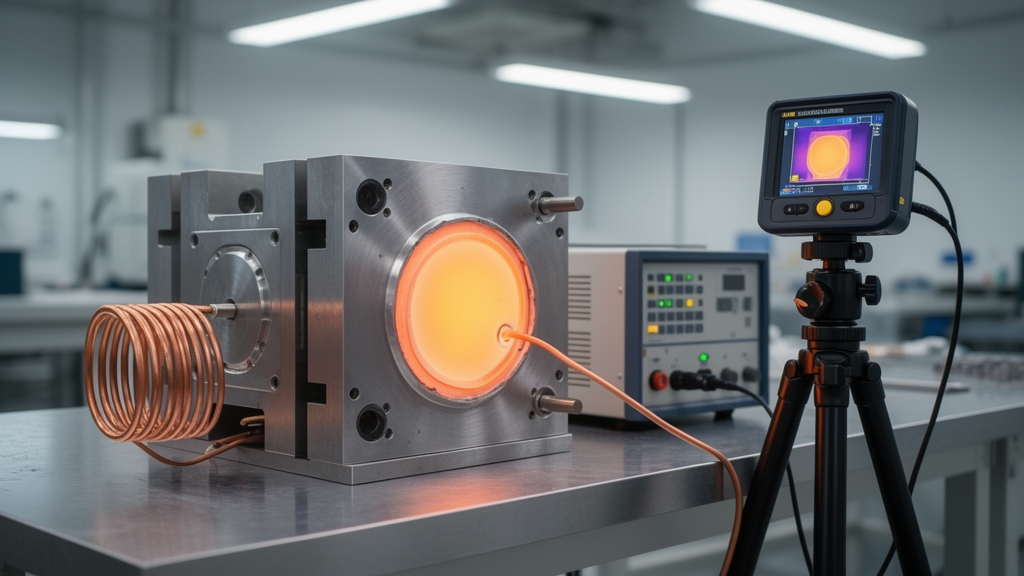
Injection molding of thin-walled parts lives or dies by how fast the mold cavity surface can be heated and cooled. A new study in PLOS One reports an experimental and computational evaluation of an induction self-heating insert that couples a thin heating zone directly to a cooling layer, combining laboratory measurements, a sequentially coupled electromagnetic-thermal simulation, and an Artificial Neural Network (ANN) surrogate model.

The research team, led by Thanh Trung Do, Tran Minh The Uyen, and Pham Son Minh, built a design space of 25 Taguchi L25 geometries defined by three parameters: T, W, and L. They then added X and Y coordinates so that the ANN could predict not just a single temperature value but the entire surface temperature field of the insert.

Three cooling states were tested: no water (NW), stagnant water (SW), and flowing water (FW). Experimental targets for the neural network were taken as the mean of five repeated tests at each condition, a step intended to reduce measurement noise in the training data.

The multiphysics simulation reproduced the location of the hot zone on the insert surface. Among the four cases with reported quantitative differences, three differed from experiment by no more than about 10 degrees Celsius, while one case showed a peak difference of about 20 degrees Celsius, indicating generally good but not perfect agreement.

To prevent data leakage during model validation, the researchers kept all 846 data points from each geometry together in a geometry-wise validation scheme, so that the network was never trained and tested on points from the same insert design.

The ANN’s predictive accuracy varied with cooling state. The coefficient of determination (R²) was 0.746 for the no-water case, 0.653 for stagnant water, and 0.493 for flowing water, with root mean square errors of 17.03, 12.97, and 12.62 degrees Celsius, respectively.

Interestingly, the effects of the three geometric parameters T, W, and L depended on which cooling state was active and were not consistently monotonic. This means that an insert geometry optimized for one cooling configuration may not perform best under another, underscoring the value of a surrogate model that can explore the combined geometry-cooling design space quickly.

As a proof of concept, the team ran a molding test with low-density polyethylene using a Chip 2 part. The insert achieved complete filling, with a mean feature spacing of 28.6 micrometers against a nominal 30 micrometers, and a mean feature height of 106.6 micrometers against a nominal 100 micrometers.

The authors conclude that combining insert geometry, cooling-water state, and a neural network surrogate can support local thermal design in injection molding, with the potential to delay frozen-layer formation and improve filling in thin-wall parts. The work remains at the proof-of-concept stage, and the moderate ANN accuracy under flowing-water cooling suggests room for further model refinement before industrial deployment.

Subject of Research: Induction self-heating mold inserts and neural network modeling for rapid temperature control in injection molding

Article Title: Geometry and cooling effects on an induction self-heating insert for rapid mold temperature control: Experimental, Multiphysics, and artificial neural network-based analysis

Article References: Do, T. T., Uyen, T. M. T., & Son Minh, P. (2026). Geometry and cooling effects on an induction self-heating insert for rapid mold temperature control: Experimental, Multiphysics, and artificial neural network-based analysis. PLOS One, 21(10), e0359849. https://doi.org/10.1371/journal.pone.0359849

Image Credits: AI Generated

DOI: 10.1371/journal.pone.0359849

Keywords: injection molding, induction heating, mold temperature control, artificial neural network, multiphysics simulation, Taguchi design, thin-wall molding, frozen layer, cooling water, surrogate modeling, LDPE, PLOS One

Cite Scienmag News

Cassandra Pierce. (October 27, 2026). Induction self-heating insert for mold temperature control evaluated with experiments, simulation, and neural network model. Scienmag. https://scienmag.com/induction-self-heating-insert-for-mold-temperature-control-evaluated-with-experiments-simulation-and-neural-network-model/


Cassandra Pierce. "Induction self-heating insert for mold temperature control evaluated with experiments, simulation, and neural network model." Scienmag, 27 October 2026, https://scienmag.com/induction-self-heating-insert-for-mold-temperature-control-evaluated-with-experiments-simulation-and-neural-network-model/. Accessed 29 October 2026.

Cassandra Pierce. "Induction self-heating insert for mold temperature control evaluated with experiments, simulation, and neural network model." Scienmag. October 27, 2026. https://scienmag.com/induction-self-heating-insert-for-mold-temperature-control-evaluated-with-experiments-simulation-and-neural-network-model/

Tags: artificial neural networkartificial neural networks for thermal field modelingcooling watereffects of cooling water states on mold temperature regulationelectromagnetic-thermal coupled simulation in mold heatingexperimental and computational evaluation of mold heatingfrozen layerinduction heatinginduction self-heating insert for mold temperature controlinjection moldingLDPEmold temperature controlmultiphysics simulationmultiphysics simulation of induction heating in moldsneural network surrogate model for mold temperature predictionPLOS Onerapid heating and cooling in injection molding processessurface temperature field prediction in injection moldssurrogate modelingTaguchi designTaguchi design of experiments for mold heating optimizationthin-wall moldingthin-walled injection molding temperature management
Share26Tweet16
Previous Post

Ozone Raises Allergic Rhinitis Outpatient Visits, Stronger in Warmer Weather

Next Post

How the Brain Weighs Melody Against Meaning When Songs Turn Emotionally Ambiguous

Related Posts

Two Milligrams of Dotinurad Beat Standard Febuxostat in Real-World Chinese Gout Patients
Medicine

Two Milligrams of Dotinurad Beat Standard Febuxostat in Real-World Chinese Gout Patients

October 29, 2026
Gene Therapy Halves Key DNA Repair Signal in Primate Brains, Model Predicts Slower Huntington’s Progression
Medicine

Gene Therapy Halves Key DNA Repair Signal in Primate Brains, Model Predicts Slower Huntington’s Progression

October 29, 2026
Depression and cardiometabolic syndrome together triple frailty risk in older Chinese adults
Medicine

Depression and cardiometabolic syndrome together triple frailty risk in older Chinese adults

October 29, 2026
Real-World Psoriasis Study Finds Patients Treated Below Clinical Trial Severity Thresholds
Medicine

Real-World Psoriasis Study Finds Patients Treated Below Clinical Trial Severity Thresholds

October 29, 2026
MBSR Homework Practice Linked to Mindfulness Gains and Workplace Outcomes in Dutch Government Employees
Psychology & Psychiatry

MBSR Homework Practice Linked to Mindfulness Gains and Workplace Outcomes in Dutch Government Employees

October 29, 2026
Only About One in Ten Girls and Young Women Return for Ovarian Tissue Transplantation, Meta-Analysis Finds
Medicine

Only About One in Ten Girls and Young Women Return for Ovarian Tissue Transplantation, Meta-Analysis Finds

October 29, 2026
Next Post
How the Brain Weighs Melody Against Meaning When Songs Turn Emotionally Ambiguous

How the Brain Weighs Melody Against Meaning When Songs Turn Emotionally Ambiguous

  • Mothers who receive childcare support from maternal grandparents show more optimized

    Mothers who receive childcare support from maternal grandparents show more parental warmth, finds NTU Singapore study

    27656 shares
    Share 11059 Tweet 6912
  • University of Seville Breaks 120-Year-Old Mystery, Revises a Key Einstein Concept

    1061 shares
    Share 424 Tweet 265
  • Bee body mass, pathogens and local climate influence heat tolerance

    682 shares
    Share 273 Tweet 171
  • Researchers record first-ever images and data of a shark experiencing a boat strike

    546 shares
    Share 218 Tweet 137
  • Groundbreaking Clinical Trial Reveals Lubiprostone Enhances Kidney Function

    531 shares
    Share 212 Tweet 133
Science

Embark on a thrilling journey of discovery with Scienmag.com—your ultimate source for cutting-edge breakthroughs. Immerse yourself in a world where curiosity knows no limits and tomorrow’s possibilities become today’s reality!

RECENT NEWS

  • Two Milligrams of Dotinurad Beat Standard Febuxostat in Real-World Chinese Gout Patients
  • Gene Therapy Halves Key DNA Repair Signal in Primate Brains, Model Predicts Slower Huntington’s Progression
  • Depression and cardiometabolic syndrome together triple frailty risk in older Chinese adults
  • Real-World Psoriasis Study Finds Patients Treated Below Clinical Trial Severity Thresholds

Categories

  • Agriculture
  • Anthropology
  • Archaeology
  • Athmospheric
  • Biology
  • Biotechnology
  • Blog
  • Bussines
  • Cancer
  • Chemistry
  • Climate
  • Earth Science
  • Editorial Policy
  • Marine
  • Mathematics
  • Medicine
  • Pediatry
  • Policy
  • Psychology & Psychiatry
  • Science Education
  • Science News
  • Social Science
  • Space
  • Technology and Engineering

Subscribe to Blog via Email

Enter your email address to subscribe to this blog and receive notifications of new posts by email.

Join 5,150 other subscribers

© 2025 Scienmag - Science Magazine

Welcome Back!

Login to your account below

Forgotten Password?

Retrieve your password

Please enter your username or email address to reset your password.

Log In
No Result
View All Result
  • HOME
  • SCIENCE NEWS
  • CONTACT US

© 2025 Scienmag - Science Magazine

Discover more from Science

Subscribe now to keep reading and get access to the full archive.

Continue reading