


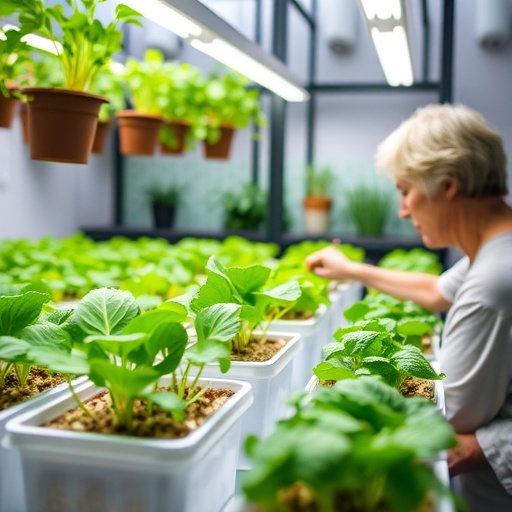
In a groundbreaking pilot study published in Frontiers in Public Health, researchers from Texas A&M University School of Public Health have demonstrated the promising potential of indoor hydroponic gardening to enhance mental health, dietary habits, and overall quality of life among cancer patients. This innovative approach shuns traditional soil-based gardening in favor of nutrient-rich water culture systems, marking an important stride toward accessible nature-based interventions for patients often limited by physical constraints or lack of outdoor green spaces.
Cancer patients frequently face profound psychological challenges that impact their emotional well-being and daily life functioning. Conventional research has extensively documented the mental health benefits of outdoor exposure and gardening activities, linking green space interaction with reduced pain, diminished reliance on analgesics, and lowered cancer recurrence rates. However, many patients lack access to outdoor gardens or are physically unable to engage in traditional horticultural practices, prompting the need for adaptable alternatives. This newly published study addresses this gap by employing AeroGarden systems — compact hydroponic kits equipped with LED grow lights and nutrient solutions that enable cultivation of heirloom salad greens indoors over an eight-week period.
The study cohort comprised 30 cancer patients receiving care at Houston Methodist Cancer Center, with diverse demographics including an average age of 57 years, nearly equal gender distribution, and significant representation from White and Hispanic populations. Most participants had tertiary education and adequate private health insurance, but surprisingly, despite having yard space, more than 90% reported not engaging in gardening prior to the study. This underscores the potential utility of an accessible indoor gardening system suited to urban or constrained living environments.
Participants were provided with AeroGarden kits containing grow containers, hydroponic nutrient solutions, and seed pods specifically chosen for their suitability in indoor growth. Over the course of the trial, subjects managed their gardens, overseeing germination, cultivation, and harvest cycles while researchers conducted repeated assessments of mental health parameters, psychological distress, pain levels, and dietary intake. The methodology relied on validated psychometric surveys administered at baseline, four weeks, and eight weeks, ensuring reliability and reproducibility in measuring nuanced shifts in well-being.
Quantitative findings revealed statistically significant improvements across multiple mental health domains. Mental well-being scores escalated steadily, while depression indices experienced a marked decline. Concurrently, participants reported enhanced emotional and social functioning, with overall quality of life metrics improving as early as week four and peaking by the trial’s conclusion. Notably, there was a positive shift in appetite regulation and self-reported consumption of fruits and vegetables, indicating concurrent behavioral changes aligned with nutritional benefits.
The researchers propose several physiological and psychosocial mechanisms to explain these effects. Hydroponic gardening likely provides sensory engagement that activates neural pathways associated with reward and stress reduction. The act of nurturing living plants may modulate the autonomic nervous system, lowering cortisol levels and promoting parasympathetic responses. Furthermore, cultivating responsibility over a small ecosystem can instill a sense of control and accomplishment, mitigating feelings of helplessness common among patients undergoing intensive cancer treatments.
Despite its encouraging outcomes, the investigation acknowledges limitations inherent to pilot studies, notably the small sample size, short duration, and absence of a control group, all of which constrain generalizability. The authors advocate for larger, randomized controlled trials to verify efficacy and explore longitudinal impacts. Future research could also extend to other patient populations and chronic disease groups who face barriers to outdoor gardening or lack access to green infrastructure.
This study simultaneously addresses critical public health concerns related to nutrition, mental health, and chronic disease management while exemplifying innovative intersections between technology and nature-based therapy. As hydroponic systems like AeroGarden become more affordable and compact, the feasibility of integrating them into hospital settings, rehabilitation centers, and home care increases. This could revolutionize supportive cancer care by transforming sterile indoor environments into therapeutic green spaces that foster physical and psychological healing.
Moreover, the findings invite broader societal implications regarding urban planning and health equity. In metropolitan areas where green space is scarce or inaccessible, indoor hydroponic gardening could democratize the benefits of horticultural engagement. It offers a scalable solution to reconnect vulnerable populations with the biophilic stimuli necessary for sustained mental health. This aligns with emerging perspectives that view nature not merely as leisure but as an integral component of holistic medical care.
Texas A&M’s collaborative initiative, supported by the Center for Health and Nature—a partnership between Houston Methodist Hospital, Texan by Nature, and Texas A&M Health—exemplifies the growing emphasis on interdisciplinary approaches that unite public health, clinical medicine, and environmental sciences. Graduate students and faculty with expertise spanning epidemiology, biostatistics, and floriculture contributed to the rigorous design and execution of this pilot, enhancing its methodological robustness.
In summary, this pioneering research spotlights indoor hydroponic gardening as a viable, user-friendly intervention capable of delivering measurable mental health and nutritional benefits to cancer patients. It simultaneously opens avenues for integrative therapeutic strategies that leverage technology, environmental psychology, and patient-centered care. Such innovations promise not only to improve individual outcomes but also to transform health systems by embedding natural elements into clinical practice, ultimately enriching the human experience of healing.
News Publication Date: 14-Oct-2025
Web References:
https://doi.org/10.3389/fpubh.2025.1670698
https://pmc.ncbi.nlm.nih.gov/articles/PMC9978680/
References:
- Taehyun Roh et al., Frontiers in Public Health, 2025.
- Texas A&M University School of Public Health
Cite Scienmag News
Nathaniel Bowman. (November 3, 2025). Indoor Hydroponic Gardening Enhances Mental Well-Being and Quality of Life in Cancer Patients. Scienmag. https://scienmag.com/indoor-hydroponic-gardening-enhances-mental-well-being-and-quality-of-life-in-cancer-patients/
Nathaniel Bowman. "Indoor Hydroponic Gardening Enhances Mental Well-Being and Quality of Life in Cancer Patients." Scienmag, 3 November 2025, https://scienmag.com/indoor-hydroponic-gardening-enhances-mental-well-being-and-quality-of-life-in-cancer-patients/. Accessed 3 September 2026.
Nathaniel Bowman. "Indoor Hydroponic Gardening Enhances Mental Well-Being and Quality of Life in Cancer Patients." Scienmag. November 3, 2025. https://scienmag.com/indoor-hydroponic-gardening-enhances-mental-well-being-and-quality-of-life-in-cancer-patients/


