

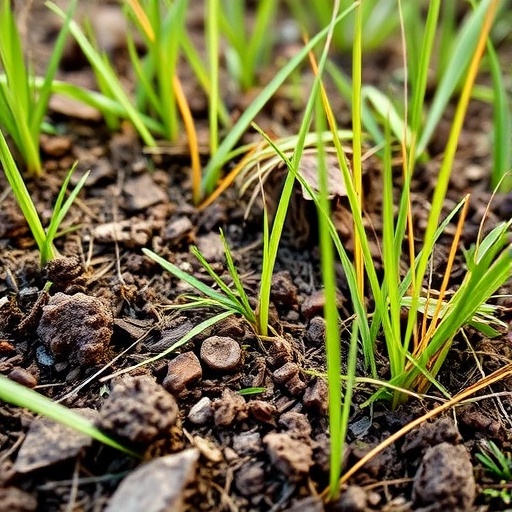
In an era marked by unprecedented climatic fluctuations, the resilience of terrestrial ecosystems continuously faces new challenges. Recent research led by Li, L., Radujković, D., Nijs, I., and colleagues delves deeply into the intricate dynamics of soil microbial communities in grasslands subjected to the increasingly persistent alternating patterns of drought and rainfall. Their findings, published in Communications Earth & Environment in 2026, reveal that the impact of these oscillating moisture conditions on soil microbes not only persists but intensifies over time, highlighting the looming threat to ecosystem stability and function under future climate scenarios.
Grasslands are critical ecosystems that support biodiversity, regulate carbon cycling, and maintain soil health. Central to these functions are the vast populations of soil microorganisms—bacteria, fungi, archaea, and other microbial life forms—that govern nutrient transformations and organic matter decomposition. When rainfall and drought alternate with increasing persistence, the soil environment experiences frequent disruptions, leading to profound effects on the microbial consortia essential for ecosystem resilience.
At the heart of this study is an investigation into how changing precipitation patterns affect microbial community structure, function, and overall soil biochemical processes. Unlike prior research focusing purely on singular extreme events, this study uniquely emphasizes the cumulative effects of repeated drought and rewetting cycles, capturing the escalating stress imposed on belowground microbial assemblages over extended temporal scales.
The researchers implemented controlled field experiments in diverse grassland ecosystems, monitoring soil moisture variations, microbial biomass, enzymatic activity, and nutrient fluxes. Employing high-throughput sequencing and advanced bioinformatics allowed them to detect shifts in microbial diversity and functional gene expression. What emerged was a complex picture: persistent alternations in moisture conditions act as chronic environmental stressors, selectively favoring drought-tolerant taxa but reducing overall microbial evenness and richness.
One of the study’s most striking revelations is that the microbial community exhibited increased susceptibility with time, even as some taxa appeared to adapt temporarily. This phenomenon contradicts earlier assumptions that microbial populations might stabilize after initial disturbances. Instead, with every successive drought-rainfall cycle, the biochemical functionality—such as nitrogen cycling and organic matter breakdown—became progressively impaired, jeopardizing soil fertility and carbon sequestration potential.
This degradation likely arises from altered microbial metabolic strategies in response to fluctuating moisture. Under drought, microbes enter dormant states or shift towards pathways minimizing water loss and oxidative stress. Upon rewetting, a sudden nutrient flush stimulates rapid microbial growth and activity, frequently leading to pulses of greenhouse gas emissions such as carbon dioxide and nitrous oxide. The intensified cycling of drought and rainfall exacerbates these boom-and-bust microbial dynamics, with implications for broader atmospheric feedback mechanisms.
Crucially, the study elucidates that grassland ecosystems with a history of variable precipitation show less microbial resilience than previously thought. The cumulative damage from repeated environmental stressors affects key functional guilds, including mycorrhizal fungi, nitrogen fixers, and decomposers. Losses or functional impairment in these groups can cascade to affect plant productivity and soil carbon storage, undermining the grassland’s capacity to act as a carbon sink amidst climate change.
The authors highlight the importance of temporal scale in understanding climate-microbe interactions. Short-term experiments may underestimate the long-term consequences of climate extremes due to microbial lag responses and progressive community restructuring. Their multi-year dataset provides compelling evidence that ongoing climate variability will likely reshape soil microbial landscapes with consequences extending to ecosystem services, agricultural productivity, and global biogeochemical cycles.
Furthermore, this research underscores the necessity of integrating soil microbial dynamics into climate models and environmental policy frameworks. As the persistence of alternating drought and rainfall events intensifies under a warming climate, reliable predictions and mitigation strategies hinge on incorporating belowground microbial feedbacks. Such insights could guide grassland management practices tailored to bolster ecosystem resilience through microbial conservation and soil health enhancement.
The findings also raise urgent questions regarding the adaptability and threshold limits of microbial communities. Could microbial inoculants or soil amendments mitigate the deleterious effects of fluctuating moisture regimes? How might shifts in plant root exudates under stress influence microbial functionality? Future interdisciplinary research bridging microbial ecology, hydrology, and ecosystem modeling is poised to resolve these pivotal issues, driving innovation in climate adaptation strategies.
As climate projections forecast an increase in the frequency, intensity, and persistence of precipitation extremes, this study offers a prescient warning. The subtle yet potent interplay between alternating drought and rainfall imparts cumulative stress on the foundation of terrestrial生命 — the soil microbiome — threatening the very processes that underpin global ecosystem stability. In decoding this hidden narrative, Li and colleagues crystallize the urgency to address microbial vulnerabilities amid an accelerating climate crisis.
The comprehensive approach combining molecular, biochemical, and ecological measurements serves as a blueprint for future empirical investigations. By revealing the mechanistic underpinnings behind microbial responses to perturbation persistence, this research paves the way for transformative understanding of ecosystem resilience. Its implications reverberate beyond grasslands, inviting reevaluation of microbial roles in forest soils, agricultural systems, and natural habitats facing similar climatic stochasticity.
In conclusion, as the planet’s hydrological patterns grow more unpredictable and extreme, the persistent swings between drought and rainfall emerge not as isolated events but as a series of compounded stressors intensifying over time. Soil microbial communities, central to nutrient cycling and ecosystem productivity, are caught in the crossfire of these oscillations. The groundbreaking work of Li, Radujković, Nijs, and their team brings into sharp focus the escalating vulnerabilities of these microbial engines, underscoring the critical need for inclusive climate strategies that consider fundamental microbial processes in safeguarding Earth’s ecological future.
Subject of Research: The impact of increasing persistence of alternating drought and rainfall events on soil microbial communities in grassland ecosystems over time.
Article Title: Effect of increasing persistence of alternating drought and rainfall events on grassland soil microbes intensifies over time.
Article References:
Li, L., Radujković, D., Nijs, I. et al. Effect of increasing persistence of alternating drought and rainfall events on grassland soil microbes intensifies over time. Commun Earth Environ (2026). https://doi.org/10.1038/s43247-026-03355-9
Image Credits: AI Generated


