
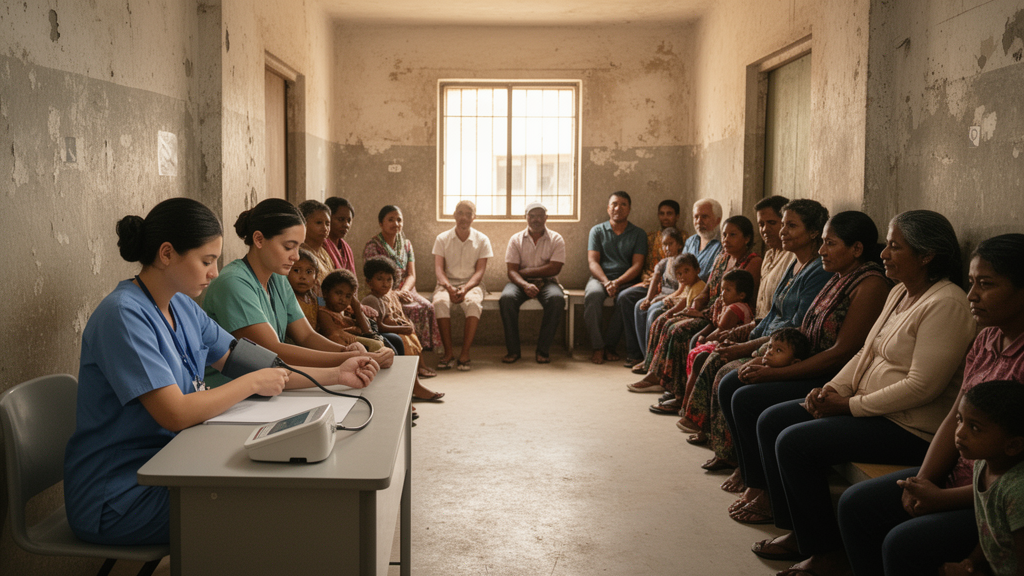
Higher levels of human development are associated with better universal health coverage worldwide, and disparities in coverage between income groups are generally larger than disparities between world regions. Those are the two central conclusions of a new study published this week in the open-access journal PLOS Global Public Health by Akira Hayasaka of Yokohama City University, Japan, Yasuhiro Nakanishi of the National Institute of Public Health, Japan, and colleagues.
Universal health coverage (UHC) is a core target of the Sustainable Development Goals, and progress toward it is tracked using the UHC Service Coverage Index (SCI), a composite score built from four domains: reproductive, maternal, newborn, and child health; infectious diseases; noncommunicable diseases; and service capacity and access. UHC and human development are closely linked because greater access to health care leads to better health outcomes in general, through preventative care, screenings, vaccinations and related services. However, how this relationship varies across coverage domains, income groups, and world regions over time had not been systematically examined until now.
In the new study, the researchers conducted a retrospective, country-level longitudinal analysis using seven different years of publicly available World Health Organization and United Nations data spanning 2000 to 2021. The dataset allowed them to compare the UHC Service Coverage Index and its four sub-indices with the Human Development Index (HDI) and its components across World Bank income groups and WHO regions. Because the analysis was observational and measured countries rather than individuals, the authors caution that the findings describe associations at the national level, not causal effects operating within populations.
The results showed a consistent pattern after adjustment for other variables. Low-income countries had significantly lower UHC coverage than high-income countries, with overall coverage 21 percent lower, and the largest gaps appeared in the infectious disease domain, where coverage was 31 percent lower. These income-group disparities were generally larger than the differences observed between WHO regions, suggesting that a country’s economic level is a stronger correlate of health service coverage than its geographic location.
The strength of the association between development and coverage also varied by domain. A 0.1-unit increase in HDI was associated with a 6.8-point higher overall UHC score (95% CI 5.6–8.1). The strongest association was for service capacity and access, at 11.7 points per 0.1-unit HDI increase, while the weakest was for noncommunicable diseases, at 2.2 points. This gradient indicates that broader development is most tightly linked to the infrastructure and access components of health systems, and less tightly linked to coverage of noncommunicable disease services.
The authors note important limitations. The study measured countries, not individuals, so it could not capture inequalities in coverage within countries. In addition, changes to the index’s underlying indicators over time limit comparisons across different report editions. Despite these constraints, the researchers concluded that higher levels of human development were associated with better UHC coverage, and that persistent disparities exist across income groups.
“These findings may help policymakers interpret the UHC SCI and its sub-indices in the context of their country’s broader development trajectory,” the authors say.
The authors add: “Higher levels of human development were associated with better health service coverage, although the strength of this relationship differed across domains. We believe that our findings, which demonstrate that development in sectors beyond healthcare is associated with access to healthcare services, can provide valuable insights into strategies for creating a healthier world.”
The work was supported by the Health Science and Labour Research Grants of the Ministry of Health, Labour, and Welfare, Japan, and the authors declared no competing interests. The full article is freely available in PLOS Global Public Health.
Subject of Research: Associations between the universal health coverage service coverage index and the human development index across countries
Article Title: Health coverage more strongly associated with income than world region
Article References: Health coverage more strongly associated with income than world region. Original publication (Bibliographic details unavailable.)
Image Credits: AI Generated
DOI: Not provided
Keywords: universal health coverage, human development index, service coverage index, income groups, WHO regions, PLOS Global Public Health, global health, health policy, longitudinal analysis, health disparities, Health, coverage
Cite Scienmag News
Tiffany Hanley. (October 28, 2026). Income Gaps Outweigh Regional Differences in Global Health Coverage. Scienmag. https://scienmag.com/income-gaps-outweigh-regional-differences-in-global-health-coverage/
Tiffany Hanley. "Income Gaps Outweigh Regional Differences in Global Health Coverage." Scienmag, 28 October 2026, https://scienmag.com/income-gaps-outweigh-regional-differences-in-global-health-coverage/. Accessed 28 October 2026.
Tiffany Hanley. "Income Gaps Outweigh Regional Differences in Global Health Coverage." Scienmag. October 28, 2026. https://scienmag.com/income-gaps-outweigh-regional-differences-in-global-health-coverage/