

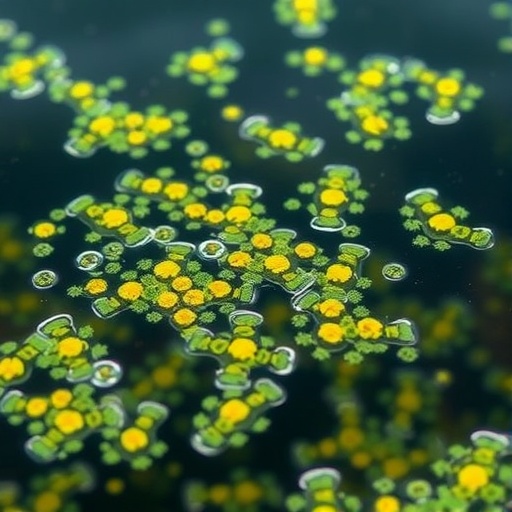
In a groundbreaking study published in the November 2025 issue of Harmful Algae, scientists from Incheon National University have uncovered a stealthy mechanism by which the toxic potential of the benthic dinoflagellate Prorocentrum lima dramatically intensifies, even in the absence of visible bloom proliferation. This algae is notorious for producing diarrhetic shellfish poisoning (DSP) toxins such as okadaic acid (OA) and dinophysistoxin 1 (DTX1), which have significant implications for seafood safety and coastal ecosystem health globally. The new research led by Professor Jang K. Kim reveals that protracted nutrient deprivation—not just short-term stress—can substantially elevate cellular toxin levels without a corresponding increase in algal numbers, posing a covert yet serious risk to public health.
Previous investigations primarily explored the immediate physiological responses of P. lima to transient nutrient stress, frequently linking low nutrient levels to transient boosts in toxin synthesis. However, these studies fell short of illuminating the long-term dynamics of toxin production during extended periods of nutrient scarcity. Addressing this gap, the team maintained P. lima cultures under nutrient-replete conditions until the cultures plateaued at stationary growth phase, then halted nutrient input entirely, monitoring the cultures meticulously over a month-long nutrient depletion phase.
Throughout this period, the algae demonstrated a remarkable capacity to sustain modest growth despite the absence of external nutrients, indicative of internally stored reserves enabling continued metabolic activity. Initial measurements revealed that within mere hours, more than 90% of nitrate and nitrite nutrients were assimilated from the medium, swiftly followed by precipitous phosphate depletion. This rapid nutrient uptake underlined P. lima’s efficiency in resource utilization, but it was the physiological aftermath that told a more complex story. Cellular density increased only slightly during the nutrient starvation phase, without obvious signs of bloom expansion, challenging conventional assumptions about toxicity being tightly coupled with visible algal proliferation.
Detailed assessments of photosynthetic performance painted a stark contrast to cell stability. Although key pigments like chlorophyll a and carotenoids maintained relatively steady concentrations, indicating pigment synthesis was not immediately compromised, the functional parameters of photosynthesis deteriorated substantially. Variables such as the maximum electron transport rate (ETRmax), light saturation thresholds, and relative electron transport rates (rETR) all exhibited significant declines after 30 days. This reduced photosynthetic efficiency reflects profound metabolic stress, likely curtailing energy production necessary for cellular maintenance and division.
Most notably, toxin quantification demonstrated dramatic increases in intracellular OA and DTX1 content. Okadaic acid levels per cell surged more than threefold over the nutrient deprivation interval, while dinophysistoxin 1 concentrations doubled by the experiment’s conclusion. These elevated toxin burdens far exceeded those observed in prior research focused on short-term or moderate nutrient limitation, underscoring how prolonged starvation intensifies toxin accumulation rather than merely sustaining it.
The team’s insights illuminate a crucial physiological mechanism: as cell division diminishes during stationary phase under nutrient stress, the dilution effect that typically moderates intracellular toxin concentrations is minimized. Consequently, the sustained biosynthesis of DST toxins coupled with reduced cellular replication results in heightened toxin concentrations within individual cells. This uncoupling of toxin concentration from population growth signals a perilous undercurrent where the apparent calm of stable algal biomass can mask dangerous elevations in toxicity.
Such findings have immediate ramifications for monitoring and managing harmful algal blooms (HABs). Traditional risk assessments often prioritize bloom density and rapid population expansion as toxicity indicators. The present evidence cautions that nutrient-poor but stable algal communities may harbor unexpected toxic hazards, complicating detection and mitigation strategies for DSP outbreaks. Implicitly, this demands an evolution in surveillance programs to integrate chemical toxin analysis alongside quantification of cell abundance.
Professor Kim emphasizes this paradigm shift by stating, “Our work provides a foundation for refining predictive models of DSP-related HABs, emphasizing the need to consider nutrient dynamics and long-term physiological responses when evaluating seafood contamination risks.” This enhanced understanding will better equip regulatory agencies and public health authorities to anticipate toxin fluctuations and institute timely advisories or closures of shellfish harvesting regions.
From a mechanistic viewpoint, the study’s experimental approach combining nutrient assays, pigment quantification, photosynthetic efficiency measurements, and toxin analyses offers a comprehensive view of P. lima physiology under extended stress. It elucidates how metabolic reallocation and energy constraints influence secondary metabolite synthesis, possibly as a protective or stress mitigation strategy, though the exact biochemical pathways governing increased DSP toxin biosynthesis warrant further molecular investigation.
Beyond environmental ramifications, this research also carries implications for aquaculture industries reliant on shellfish harvesting, where unrecognized toxin accumulation could imperil food safety and trade. The persistence of toxin-rich P. lima cells under nutrient-limiting conditions may result in prolonged contamination episodes even without conspicuous bloom events, challenging existing seafood monitoring protocols and necessitating enhanced vigilance.
Looking forward, the researchers advocate for integration of molecular tools to dissect gene expression pathways responsible for toxin biosynthesis, alongside field validations to map nutrient-toxicity correlations in natural marine settings. Such multidisciplinary efforts would deepen comprehension of how nutrient fluxes modulate harmful algal physiology and enhance the precision of bloom risk forecasts.
In sum, this study punctuates the complexity of harmful algal bloom dynamics by revealing that silent toxin amplification can occur under stealthy nutrient deprivation conditions. As global coastal environments grapple with shifting nutrient regimes due to anthropogenic activities and climate change, understanding these cryptic processes becomes pivotal for safeguarding ecosystem integrity and seafood safety.
Subject of Research: Cells
Article Title: Effects of nutrient depletion duration on growth, photosynthesis and toxins (OA and DTX) in the dinoflagellate Prorocentrum lima
News Publication Date: 1 November 2025
Web References: https://doi.org/10.1016/j.hal.2025.102932
References:
Jeong Hwa Hwang, Ji-Sook Park, Young-Seok Han, Youn-Jung Kim, Mungi Kim, Seongjin Hong, Jang K. Kim. “Effects of nutrient depletion duration on growth, photosynthesis and toxins (OA and DTX) in the dinoflagellate Prorocentrum lima.” Harmful Algae, Volume 149, November 2025.
Image Credits: Cybergerac from Openverse
Keywords: Prorocentrum lima, harmful algal blooms, diarrhetic shellfish poisoning, okadaic acid, dinophysistoxin 1, nutrient depletion, toxin bioaccumulation, photosynthetic efficiency, coastal ecosystems, seafood safety


