


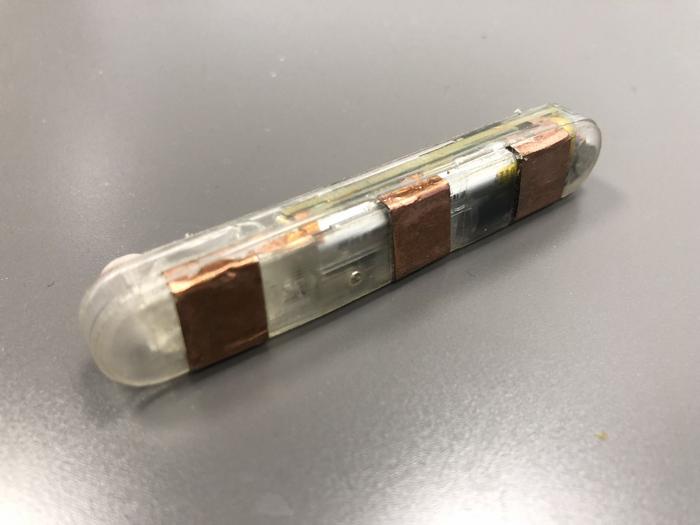
Naloxone is an effective treatment for opioid overdose, but it usually requires a bystander to step in and administer it. Now, researchers have developed an implantable device that can independently detect overdose and automatically administer naloxone. The device, which the researchers call “iSOS,” includes multiple sensors that allow it to continuously monitor the user’s heart and respiratory systems and a pump that rapidly administers naloxone when needed. It’s yet to be tested in humans, but in animal trials, iSOS successfully revived 24 out of 25 overdosed pigs within 3.2 minutes. The study is published August 14 in the journal Device.

Credit: Hen-Wei Huang
Naloxone is an effective treatment for opioid overdose, but it usually requires a bystander to step in and administer it. Now, researchers have developed an implantable device that can independently detect overdose and automatically administer naloxone. The device, which the researchers call “iSOS,” includes multiple sensors that allow it to continuously monitor the user’s heart and respiratory systems and a pump that rapidly administers naloxone when needed. It’s yet to be tested in humans, but in animal trials, iSOS successfully revived 24 out of 25 overdosed pigs within 3.2 minutes. The study is published August 14 in the journal Device.
“Having an automated robotic system that is able to sense and reverse opiate overdose could be transformational, particularly for high-risk populations,” says senior author Giovanni Traverso (@cgtraverso), a clinician and biomedical engineer at MIT, Brigham and Women’s Hospital, and the Broad Institute. “Substance use is a fundamental disorder, and individuals who have had overdoses are at higher risk of overdosing again. To help support this population and those at the greatest risk of overdosing, we wanted to develop an automated way of providing early detection of those events, and then couple that signal with the quick release of naloxone.”
Opioid overdose from both prescription and illicit drugs can cause permanent brain damage within 3 minutes and death within 4 to 6 minutes, so rapid administration of naloxone is critical. However, because opioid use often results in a loss of consciousness, self-administration of naloxone is not usually an option, and bystanders need to be able to recognize the symptoms and respond quickly.
“The most challenging aspects of developing an engineering solution to prevent overdose mortality are addressing patient adherence and willingness to adopt new technology, minimizing false positive detections, and ensuring the rapid delivery of antidotes,” says co-first author and roboticist Hen-Wei Huang of Brigham and Women’s Hospital, Harvard Medical School, and Massachusetts Institute of Technology. “Our proposed solution tackles these unmet needs by developing a miniaturized robotic implant equipped with multi-sensing modalities, continuous monitoring capabilities, on-board decision-making, and an innovative micro-pumping mechanism.”
The team engineered a subcutaneously implantable device with multiple sensors that allow it to continuously monitor the user’s respiratory rate, heart rate, body temperature, and blood oxygen saturation. These sensors are connected to a decision-making algorithm that integrates the various vital signs to decide whether an overdose is occurring.
The device contains a refillable drug reservoir and an active pump that can quickly release a jet of naloxone directly into the user’s muscle if an overdose is detected. When it detects a suspected overdose event, the device begins buzzing and simultaneously sends an alert to the user’s smartphone that allows them to override the decision for naloxone administration in case they are not actually experiencing an overdose. Though the system is designed to be a “closed loop”—meaning it both detects and delivers the drug—it also incorporates an alarm system that could alert loved ones or health care workers to the user’s side.
In preliminary tests in pigs, the device proved effective at detecting and reversing opioid overdose. Going forward, the researchers plan to continue to optimize and miniaturize the device, which currently measures 8 mm x 12 mm x 78 mm (approximately 0.3 x 0.5 x 3 inches).
“This is only the first generation of this device, and so there’s certainly room for further miniaturization and more testing in large mammals like pigs, but we’re looking to begin testing in humans in the next few years,” says Traverso.
The team also plans to begin researching and collecting data on the preferences of the people who would actually be using the device.
“Understanding the end-user preference and acceptability is a critical element,” says Traverso. “Part of our future work will be to really inform the general perception and acceptability of this type of device, which will help inform some of the engineering as we continue to develop this technology.”
###
This research was supported by Novo Nordisk, the McGraw Family Foundation, Brigham and Women’s Hospital, and MIT.
Device, Huang et al., “An implantable system for opioid safety (iSOS)”
Device (@Device_CP) is a physical science journal from Cell Press along with Chem, Joule, and Matter. Device aims to be the breakthrough journal to support device- and application-oriented research from all disciplines, including applied physics, applied materials, nanotechnology, robotics, energy research, chemistry, and biotechnology, under a single title that focuses on the integration of these diverse disciplines in the creation of the cutting-edge technology of tomorrow. Visit https://www.cell.com/device/home. To receive Cell Press media alerts, contact press@cell.com.
Journal
Device
Method of Research
Experimental study
Subject of Research
Animals
Article Title
An Implantable System for Opioid Safety (iSOS)
Article Publication Date
14-Aug-2024
Cite Scienmag News
Denise Maddox. (August 14, 2024). Implantable device detects opioid overdose and automatically administers naloxone in animal trials. Scienmag. https://scienmag.com/implantable-device-detects-opioid-overdose-and-automatically-administers-naloxone-in-animal-trials/
Denise Maddox. "Implantable device detects opioid overdose and automatically administers naloxone in animal trials." Scienmag, 14 August 2024, https://scienmag.com/implantable-device-detects-opioid-overdose-and-automatically-administers-naloxone-in-animal-trials/. Accessed 5 September 2026.
Denise Maddox. "Implantable device detects opioid overdose and automatically administers naloxone in animal trials." Scienmag. August 14, 2024. https://scienmag.com/implantable-device-detects-opioid-overdose-and-automatically-administers-naloxone-in-animal-trials/

