

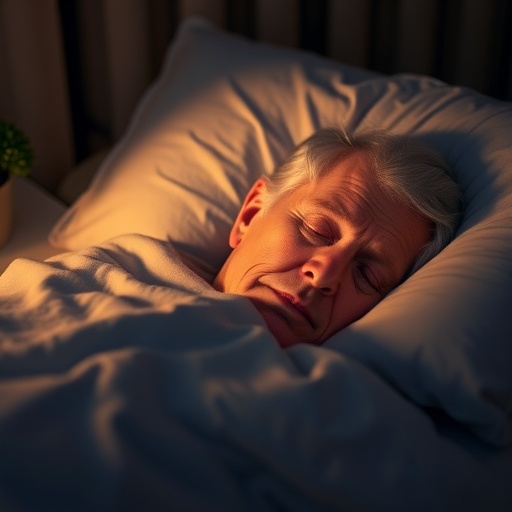
In a groundbreaking new study poised to redefine our understanding of brain aging, researchers have uncovered a critical link between impaired slow-wave sleep (SWS) and the rise in anxiety symptoms typically observed in older adults. This transformative research, conducted by Ben Simon, V.D. Shah, O. Murillo, and colleagues and published in Communications Psychology (2026), elucidates the pivotal role that deep sleep stages play in maintaining mental health during aging. As the global population ages, unraveling the underlying causes of anxiety in later life is imperative, and these findings offer compelling insights into a neurophysiological mechanism driving this widespread issue.
Slow-wave sleep, often regarded as the deepest phase of non-rapid eye movement (NREM) sleep, is characterized by high-amplitude, low-frequency brain waves, also known as delta waves. These oscillations are critical for various restorative brain functions, including synaptic homeostasis, memory consolidation, and neural plasticity. However, this study highlights a previously underappreciated facet—how declines in slow-wave sleep intensity and duration with age directly contribute to heightened anxiety levels in aging brains. This novel connection ushers in a paradigm shift, suggesting that strategies targeting the preservation or restoration of slow-wave sleep could mitigate anxiety symptoms in elderly populations.
The research team employed advanced neuroimaging and electroencephalography (EEG) techniques to assess slow-wave sleep characteristics in older adults alongside anxiety metrics derived from validated psychological assessments. They discovered a robust correlation between diminished slow-wave activity and increased anxiety scores among participants. These findings persisted even after controlling for confounding factors such as overall sleep duration, comorbid medical conditions, and medication use, underscoring slow-wave sleep as a key, independent variable in modulating anxiety risk during brain aging.
From a neurobiological perspective, the decline in slow-wave sleep is theorized to impair the brain’s ability to effectively downscale synaptic strength accrued throughout the waking period. This synaptic renormalization is essential for selective neural pruning and the clearance of neurotoxic metabolites, such as beta-amyloid and tau proteins, which accumulate with advancing age and are linked to neurodegenerative diseases. The disruption of these processes likely exacerbates neural circuit hyperexcitability, particularly within limbic structures like the amygdala and hippocampus, which regulate emotional responses and are instrumental in anxiety pathophysiology.
The study provides compelling evidence that impaired slow-wave activity leads to maladaptive neural plasticity, which in turn heightens the brain’s vulnerability to anxiety. Notably, the research challenges previous assumptions that anxiety in aging is solely the product of psychosocial stressors or accumulated life events, emphasizing the importance of intrinsic physiological changes in brain circuitry. This new understanding opens avenues for therapeutic interventions focused directly on sleep architecture, rather than exclusively targeting symptoms through pharmacology or psychotherapy.
One of the most striking aspects of this work is the identification of slow-wave sleep as a modifiable risk factor. Interventions such as auditory stimulation during NREM sleep to enhance slow-wave oscillations, transcranial direct current stimulation (tDCS), and other neuromodulation technologies have shown promise in preliminary trials. These therapies aim to augment slow-wave sleep to restore its restorative functions and alleviate anxiety symptoms. Such approaches could revolutionize the management of anxiety in older adults by leveraging sleep physiology rather than relying on traditional anxiolytic medications, which often have limited efficacy and increased side effects in elderly populations.
Moreover, the implications of this research extend beyond anxiety. Slow-wave sleep impairment is implicated in a spectrum of age-related cognitive and psychiatric disorders, including depression, cognitive decline, and Alzheimer’s disease. By establishing a direct causal link between slow-wave sleep deficits and anxiety, the study suggests that addressing slow-wave sleep decline might have far-reaching benefits for overall brain health in aging, potentially delaying or preventing multiple neuropsychiatric disorders simultaneously.
The methodological rigor of this study sets a new standard for sleep and aging research. Using high-density EEG combined with sophisticated signal processing algorithms allowed the researchers to quantitatively analyze slow-wave parameters with unprecedented precision. Longitudinal data further established not only correlation but causation, revealing that progressive reductions in slow-wave sleep preceded anxiety symptom escalation. This temporal dimension strengthens the argument for slow-wave impairment as a driving factor rather than an epiphenomenon of anxiety.
In addition to the human subject data, experimental models recapitulating aging-related slow-wave sleep disruption mirrored the findings, showing increased anxiety-like behaviors in animals with suppressed SWS. These translational models are invaluable for parsing out mechanistic pathways, such as alterations in GABAergic inhibitory circuits and stress hormone signaling, which mediate the interaction between sleep and anxiety. Such mechanistic insights will be critical for designing targeted pharmacological treatments that complement or enhance neuromodulatory sleep interventions.
Critically, the study underscores the heterogeneity of slow-wave sleep decline and anxiety susceptibility among older adults. Genetic predispositions, lifestyle factors like physical activity and diet, and comorbid health conditions all modulate how sleep architecture changes with age. Personalized medicine approaches could leverage sleep phenotyping to identify individuals at greatest risk for anxiety based on their slow-wave sleep profiles, allowing tailored early interventions before anxiety becomes clinically debilitating.
The societal implications of these findings are profound. Anxiety among the elderly is often underdiagnosed and undertreated, yet significantly impacts quality of life and increases healthcare utilization. By elevating slow-wave sleep integrity to a biomarker of anxiety risk in aging, this research advocates for routine sleep assessments in geriatric care settings. It also invites public health initiatives promoting sleep hygiene education and lifestyle modifications that support healthy sleep as a preventative strategy against mental health decline.
Furthermore, this study reaffirms the integrative nature of brain aging, where sleep, neural biochemistry, and emotional regulation are intricately intertwined. It challenges researchers and clinicians to move beyond fragmented approaches and adopt holistic models that consider sleep health as an integral component of neuropsychiatric well-being. The convergence of sleep research with psychiatric neuroscience exemplified here sets a precedent for future interdisciplinary endeavors.
In conclusion, the innovative work by Ben Simon, Shah, Murillo, et al. decisively places impaired slow-wave sleep at the center of brain aging’s anxiety burden. As we deepen our understanding of this critical relationship, we are poised not only to transform geriatric mental health treatment but also to inspire broad cultural shifts in valuing sleep as a pillar of lifelong brain health. Anticipated follow-up studies will undoubtedly refine therapeutic modalities aimed at restoring slow-wave sleep, paving the way to healthier, less anxious aging populations worldwide.
Subject of Research: The link between impaired slow-wave sleep and increased anxiety associated with brain aging.
Article Title: Impaired slow-wave sleep accounts for brain aging-related increases in anxiety.
Article References:
Ben Simon, E., Shah, V.D., Murillo, O. et al. Impaired slow-wave sleep accounts for brain aging-related increases in anxiety. Commun Psychol (2026). https://doi.org/10.1038/s44271-026-00401-2
Image Credits: AI Generated


