

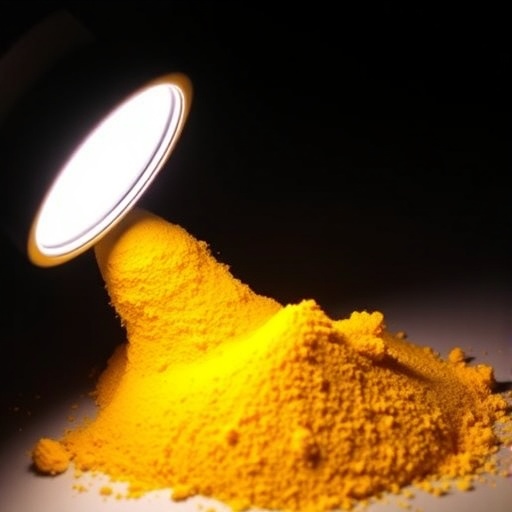
In a groundbreaking study poised to shake the foundations of household lighting awareness, researchers have unveiled critical insights into the effects of white light-emitting diode (LED) illumination on the photostability and bioactivity of turmeric pigment. This revelation, detailed in the recent publication by Oh and Hong, uncovers the intricate interplay between everyday LED exposure and the chemical integrity of curcumin, the vibrant yellow compound responsible for turmeric’s famed health benefits and culinary allure. As white LEDs become ubiquitous in modern homes, their unintended influence on natural pigments raises urgent questions about both consumer safety and food quality.
Turmeric, long celebrated for its antioxidant, anti-inflammatory, and therapeutic properties, owes much of its efficacy to curcumin. However, curcumin is chemically sensitive and prone to degradation when exposed to light, an issue that until now had not been fully explored under the specific conditions imposed by white LED lighting common in household environments. The study conducted by Oh and Hong methodically investigated this phenomenon, focusing on how the spectral characteristics of white LEDs impact the molecular stability and subsequent biological activities of turmeric pigment.
The methodology involved exposing turmeric extracts to varying intensities and durations of white LED light, closely mimicking the lighting conditions found in typical residential settings. Advanced spectrophotometric and chromatographic techniques were employed to monitor photodegradation kinetics and identify structural modifications in curcumin molecules. Results revealed a significant reduction in pigment stability upon prolonged LED exposure, correlating with diminished antioxidant capacity and altered photosensitivity profiles.
This finding is particularly alarming given the escalating replacement of traditional incandescent and fluorescent bulbs by LEDs, widely praised for their energy efficiency and longevity. While LEDs bring clear environmental and economic benefits, the discovery that they may compromise the beneficial properties of turmeric suggests a heretofore overlooked trade-off. The photodegradation not only reduces turmeric’s health-promoting potential but may also generate unknown degradation products whose biological effects remain to be elucidated.
One of the pivotal aspects of the research was the demonstration that photostability loss follows a nonlinear progression relative to light intensity and exposure time. Specifically, curcumin degradation accelerated markedly beyond a certain threshold of LED irradiance, indicating the existence of critical exposure parameters. The spectral composition of the white LEDs, rich in high-energy blue light components, was implicated as a key factor in triggering oxidative breakdown of the pigment, underscoring the influence of light quality rather than mere intensity.
Furthermore, the study probed the alterations in bioactivity post-irradiation through in vitro assays measuring antioxidant activity and enzymatic modulation. A consistent decline in free radical scavenging efficiency was observed, signaling a compromised therapeutic potency of turmeric exposed to white LED light. This bioactivity attenuation was linked mechanistically to the fragmentation of the curcumin molecule and the reduction of conjugated double bonds essential for its radical neutralization capability.
In a novel extension, the investigation also explored photosensitivity changes, revealing that curcumin’s response to subsequent light exposure was altered due to modifications in its molecular structure. These changes could influence the pigment’s behavior in photo-mediated biological processes, raising concerns about both safety and efficacy when used in dietary supplements or topical applications subjected to LED illumination.
The implications of these results resonate beyond the laboratory, suggesting immediate reconsideration of LED lighting design in environments where turmeric and similar bioactive compounds are stored or used. The findings advocate for incorporating photoprotective strategies, including tinted packaging, controlled lighting spectra, or adjunct stabilizers, to preserve the functional integrity of light-sensitive nutraceuticals. This research opens new avenues for interdisciplinary collaboration straddling photophysics, food science, and consumer health.
Moreover, these insights could push regulatory bodies to reassess guidelines concerning lighting standards in food handling, storage, and display environments. Given the global prevalence of turmeric in culinary and medicinal contexts, ensuring its bioactive preservation under modern lighting conditions emerges as a public health priority. The study prompts manufacturers to innovate in formulation and packaging technologies to safeguard product quality against photodegradation under prevalent LED lighting regimes.
The broader scientific community stands to gain as well from this investigation, offering a template for systematically evaluating the effects of artificial lighting on diverse phytochemicals and their stability profiles. As LEDs extend into more nuanced applications including horticulture, medical devices, and biopharmaceutical settings, understanding light-driven chemical interactions at a molecular level becomes indispensable.
Importantly, the study’s meticulous dissection of photodegradation pathways also contributes to the foundational photochemistry of natural compounds. By delineating the susceptibility patterns to specific LED spectra, the research charts a course for tailoring light sources that minimize detrimental effects while harnessing beneficial photoactivation when desirable. This balance between protection and activation could revolutionize the way light-based technologies interact with bioactive molecules in both consumer and industrial contexts.
Analytically, the deployment of cutting-edge spectral and chromatographic analyses sets a benchmark for future studies in this field. The precision in capturing transient degradation intermediates and correlating them with functional bioactivity changes equips researchers with crucial tools to devise mitigation strategies. This holistic approach addressing both chemical and biological endpoints exemplifies the modern paradigm in food science research.
Intriguingly, the study also raises novel questions about the potential long-term effects of LED exposure on other dietary pigments and the cumulative impact within complex food matrices. The relative vulnerabilities and synergistic degradation phenomena in multi-component systems invite comprehensive future investigations. Addressing these complexities is paramount to preserving nutritional and functional quality across the food supply chain in an LED-driven lighting era.
As society embraces energy-efficient lighting, this research serves as a timely reminder that technological advancements, while beneficial, demand rigorous assessment of unintended consequences. The revelation that household white LED lighting can compromise the photostability and bioactivity of turmeric pigment is a clarion call to integrate photobiological considerations into product development, regulation, and consumer education. Ultimately, shielding nature’s most valuable compounds from light-induced deterioration aligns sustainability with health and innovation.
The illustrious work of Oh and Hong thus not only guides immediate practical interventions but also inspires a new research frontier at the interface of photonics and food biotechnology. Their findings will undoubtedly catalyze a reevaluation of lighting practices in the home and industry to uphold the integrity of turmeric and perhaps myriad other substances integral to human well-being.
Subject of Research: Effects of household white light-emitting diode (LED) light exposure on the photostability, bioactivities, and photosensitivity of turmeric pigment.
Article Title: Effects of exposure to household white light-emitting diode lights on the photostability, bioactivities, and photosensitivity of turmeric pigment.
Article References:
Oh, J., Hong, J. Effects of exposure to household white light-emitting diode lights on the photostability, bioactivities, and photosensitivity of turmeric pigment. Food Sci Biotechnol (2025). https://doi.org/10.1007/s10068-025-02072-x
Image Credits: AI Generated
DOI: 13 December 2025


