

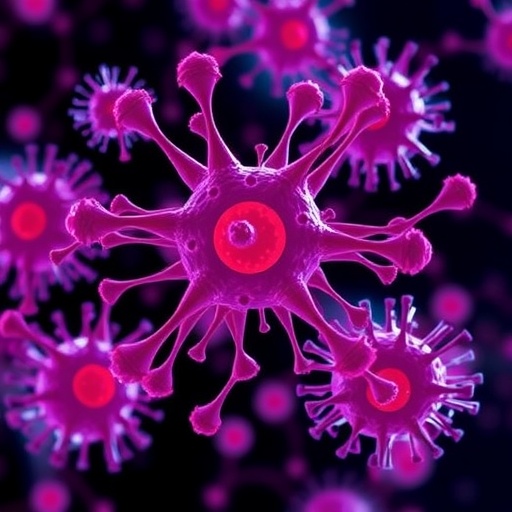
In a groundbreaking advance that unravels a critical enigma of cancer progression, researchers from the University of Geneva (UNIGE) and the Ludwig Institute for Cancer Research have unveiled a novel mechanism by which neutrophils—traditionally defenders against infection—become unwitting architects of tumor growth. Their findings, published in the illustrious journal Cancer Cell, identify the chemokine CCL3 as a pivotal mediator secreted by reprogrammed neutrophils within tumors, fundamentally shifting our understanding of immune cell roles in the tumor microenvironment.
The tumor microenvironment is a complex and dynamic ecosystem, where cancer cells coexist with diverse populations of immune and stromal cells, each influencing — and sometimes hijacking — one another’s functions. While the focus for years has been on understanding how tumor cells proliferate, an increasing body of evidence highlights the critical influence of non-cancerous cells in dictating tumor fate. Neutrophils, the most abundant white blood cells and principal responders in acute infection, have emerged as enigmatic players in this intricate milieu, often associated with poor patient prognosis in solid cancers.
This latest study spearheaded by Mikaël Pittet, professor and expert in pathology and immunology at UNIGE, and his team, revealed that neutrophils infiltrating tumors undergo a functional transformation that subverts their canonical anti-microbial roles. When exposed to the tumor ecosystem, these neutrophils begin producing elevated levels of CCL3, a chemokine traditionally implicated in leukocyte recruitment and inflammation, which paradoxically promotes tumor progression rather than inhibiting it.
Neutrophils are notoriously challenging to study given their short lifespan and delicate nature, compounded by technical hurdles in manipulating their gene expression. Evangelia Bolli, co-lead author responsible for the experimental work, described the sophisticated genetic approaches developed to selectively modulate CCL3 expression in neutrophils, without affecting other cells. This precise targeting revealed the indispensable role of neutrophil-derived CCL3 in fostering a pro-tumor microenvironment. Strikingly, neutrophils devoid of CCL3 retained their circulatory functions and were still recruited to tumors but failed to facilitate tumor growth, marking this chemokine as a critical switch in their deleterious reprogramming.
Complementing the experimental data, bioinformatics expertise by Pratyaksha Wirapati forged innovative analysis tools to identify neutrophils more reliably across broad cancer datasets. Due to their inherently low transcriptional activity, neutrophils had long evaded detection in conventional genomic analyses. This breakthrough methodology enabled the detection of a consistent pattern: across multiple cancers, aged neutrophils become CCL3-overexpressing agents closely linked with aggressive tumor phenotypes, underscoring the universality of this mechanism.
The implications for clinical oncology are profound. Historically, biomarkers capable of accurately predicting tumor progression have been limited and often insufficiently precise. The team’s parallel earlier work involving two macrophage genes correlated with clinical outcomes highlighted the multifactorial nature of tumor evolution. Adding neutrophil-derived CCL3 as a second key variable refines the emerging concept of a ‘tumor identity card’—a composite molecular signature that encapsulates the tumor’s intrinsic biology and trajectory.
Armed with this knowledge, future diagnostic approaches could leverage neutrophil CCL3 expression as a prognostic indicator, guiding therapeutic decisions and potentially enabling timely interventions tailored to a patient’s tumor ecosystem. Moreover, therapeutics that target neutrophil reprogramming or specifically inhibit CCL3 signaling pathways might unlock novel avenues for cancer treatment, transforming immune cells from facilitators of malignancy back to allies in immune surveillance.
This research also emphasizes the dual-edged nature of immune responses in cancer biology. While neutrophils conventionally provide frontline defense against pathogens, their plasticity within the tumor microenvironment allows malignant cells to co-opt these cells, turning an erstwhile protector into a promoter of disease. Understanding these contextual functional switches is critical for designing immunotherapies that can effectively recalibrate the immune landscape towards tumor eradication.
The study’s interdisciplinary approach—marrying experimental genetics, in vivo tumor models, and advanced computational methods—epitomizes the modern scientific modus operandi necessary to decode cancer’s complexity. Each layer of analysis reinforces the conclusion: neutrophil-mediated secretion of CCL3 is a determinant factor in tumor pathogenesis, representing both a biological insight and a therapeutic vulnerability.
Looking ahead, deciphering how neutrophils transition into this CCL3-producing state and identifying the molecular cues from the tumor microenvironment that drive this process remain imperative next steps. Such knowledge could reveal upstream regulators amenable to pharmacological inhibition, further expanding the arsenal against tumor progression.
In sum, these findings herald a paradigm shift in oncology, spotlighting the nuanced roles immune cells play beyond simplistic anti- or pro-tumor categorizations. As research continues to peel back the layers of tumor ecology, variables like neutrophil-derived CCL3 will be instrumental in building predictive models that translate into real-world patient benefits, ultimately advancing the era of personalized cancer medicine.
Subject of Research: Immune cell reprogramming in cancer; neutrophil function and chemokine CCL3 in tumor progression
Article Title: “CCL3 is produced by aged neutrophils across cancers and promotes tumor growth”
News Publication Date: 5-Feb-2026
Web References:
- DOI: 10.1016/j.ccell.2026.01.006
- University of Geneva media release on related gene expression study: https://www.unige.ch/medias/en/2023/une-paire-de-genes-pourrait-predire-levolution-du-cancer
Image Credits: © Mikaël Pittet – UNIGE
Keywords: tumor microenvironment, neutrophils, CCL3 chemokine, immune reprogramming, cancer progression, bioinformatics, immune biomarkers, personalized oncology, tumor ecology


