

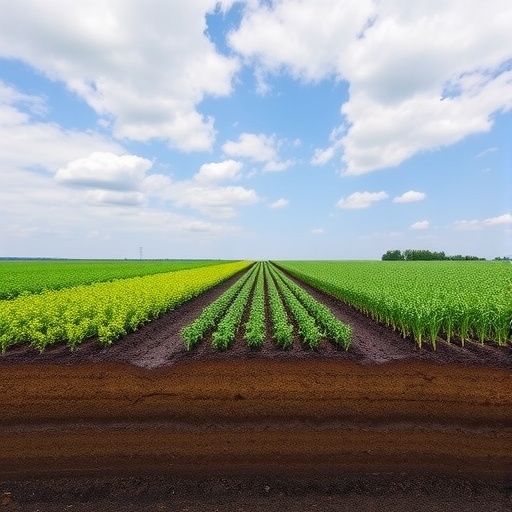
The intricate dance of carbon within soil ecosystems has long fascinated scientists, particularly as it relates to the global carbon cycle and climate change. One fundamental aspect of soil carbon dynamics involves understanding the age of soil organic carbon (SOC) as indicated by its radiocarbon content. Traditionally, scientists have assumed that older radiocarbon ages of SOC imply a slower biological reactivity, suggesting that older carbon pools are more resistant to decomposition and hence, less responsive to environmental changes such as warming. However, a groundbreaking study led by Amundson, Sanderman, Yoo, and colleagues, recently published in Nature Geoscience, challenges this prevailing paradigm, revealing that the processes governing SOC age and reactivity are far more complex than previously believed.
Radiocarbon dating has been a cornerstone method in assessing soil carbon turnover, offering a window into how long carbon has been sequestered below the surface. The radiocarbon content effectively acts as a clock, informing scientists about carbon’s “age” or the time elapsed since it was last part of the atmospheric carbon pool. For decades, this approach has been harnessed to infer the biological availability and decomposition rates of SOC. The assumption goes: younger carbon, rich in radiocarbon, is more reactive and decomposes rapidly, whereas older carbon buried deeper within soil profiles is more stable and decomposes more slowly. This notion has deeply influenced Earth system models, shaping predictions about soil carbon feedbacks in a warming climate.
In an innovative departure, Amundson and colleagues introduce the critical role of vertical advective transport in shaping soil radiocarbon profiles. Vertical advection refers to the physical downward movement of soil carbon, driven by water percolation and bioturbation, carrying carbon molecules from surface layers to greater depths, irrespective of their decomposition rates. This transport mechanism, the researchers argue, inherently increases the radiocarbon age of carbon with soil depth, complicating the simplistic narrative that older SOC is inherently less reactive. Even if decomposition rates remained uniform throughout the soil profile, the mere physical relocation of carbon downward would cause the observed increase in radiocarbon age with depth.
The research team developed a robust theoretical framework incorporating vertical transport processes alongside decomposition kinetics. They applied this model to extensive databases of over 3,000 soil profiles across the United States, employing a first-principles approach to simulate the expected radiocarbon distribution under varying scenarios. Remarkably, their theoretical predictions exhibited a high degree of coherence with empirical radiocarbon measurements taken from diverse soil environments. This congruence underscores the pivotal influence of vertical transport, suggesting it is a dominant driver of soil carbon age distributions rather than varying decomposition rates alone.
These findings carry profound implications for how soil carbon dynamics are conceptualized and modeled. Earth system models, which currently often neglect or oversimplify vertical transport processes, may be systematically misestimating the vulnerability and turnover of soil carbon stocks. Specifically, if vertical transport is not adequately accounted for, models may underestimate the responsiveness of deep soil carbon to environmental changes, thereby biasing climate projections. The study advocates for integrating these transport processes into predictive frameworks to better capture the vertical heterogeneity of soil carbon cycling.
Furthermore, the recognition that decomposition rate constants potentially remain near constant with depth challenges long-held assumptions about soil carbon stabilization mechanisms. Researchers have traditionally posited lower microbial activity and reduced substrate availability as key reasons for slower decomposition at greater depths. However, the new findings imply that the apparent increase in carbon age with depth does not necessarily translate to diminished reactivity. Instead, physical transport reshuffles carbon ages without substantially altering intrinsic reactivity properties across soil layers.
This idea also invites reconsideration of strategies aimed at carbon sequestration through soil management. If deep soil carbon is more reactive than assumed, interventions targeting carbon stabilization need to be evaluated in light of transport-driven aging patterns. It opens the possibility that some carbon thought to be sequestered long-term may, under certain disturbances or changes in soil hydrology, become more actively decomposed and released back into the atmosphere, influencing greenhouse gas dynamics.
Incorporating vertical advective transport into soil carbon frameworks highlights the complex interplay between physical and biological processes governing ecosystem carbon stocks. Soil is not a static repository but a dynamic medium where carbon fluxes respond sensitively to hydrological movements, microbial activity, and environmental variability. Recognizing these interactions enriches our understanding of soil biogeochemistry and its role in the Earth’s climate system.
This breakthrough not only has scientific ramifications but also opens avenues for improving carbon cycle modeling at regional and global scales. Models enriched with transport-informed dynamics could yield more accurate predictions of soil carbon responses to global warming and land-use changes, thereby enhancing the reliability of climate mitigation strategies.
The approach adopted in this study combines rigorous theoretical modeling with extensive empirical validation, setting a new standard for integrating observational and process-based insights in Earth system science. The expansive dataset of soil radiocarbon profiles across varied climatic and soil contexts strengthens confidence in the universality of the observed patterns, suggesting that vertical transport is a fundamental process shaping soil carbon dynamics globally.
Intriguingly, the study also prompts renewed focus on bioturbation and water fluxes as crucial modulators of soil carbon fate. Biological organisms like earthworms and soil fauna, alongside hydrological cycles, are active agents in the vertical redistribution of organic carbon, underscoring the interconnectedness of biological, physical, and chemical soil processes.
While the study clarifies central mechanisms in soil carbon aging, it also leaves open questions about how other factors such as mineral interactions, soil texture, and microclimate gradients modulate the balance of transport and decomposition. Continued research integrating these variables will be essential for a holistic understanding of soil carbon stocks under future environmental shifts.
The elegant synthesis provided by Amundson et al. encourages a paradigm shift from viewing soil carbon reactivity purely through the lens of age toward embracing transport dynamics as a core determinant of radiocarbon profiles. This conceptual advancement is poised to reshape soil carbon research and foster more nuanced ecosystem management practices.
In sum, the findings expose a critical oversight in traditional soil carbon models: neglecting vertical transport processes leads to underestimations of soil carbon turnover and misinterpretations of radiocarbon measurements. The enhanced comprehension of soil carbon dynamics afforded by this study represents a significant stride toward more accurate predictions of carbon-climate feedbacks, reinforcing the urgency of integrating physical transport processes in Earth system modeling.
As climate change accelerates, understanding the controls on soil carbon stability and decomposition remains paramount. This study’s insights offer a transformative lens through which to interpret soil radiocarbon data, guiding improved stewardship of soil carbon reservoirs and their roles in mitigating global climate change.
Subject of Research: Soil carbon dynamics, radiocarbon dating, vertical transport processes, soil organic carbon decomposition rates.
Article Title: Neglecting vertical transport leads to underestimated soil carbon dynamics.
Article References:
Amundson, R., Sanderman, J., Yoo, K. et al. Neglecting vertical transport leads to underestimated soil carbon dynamics. Nat. Geosci. 18, 1239–1244 (2025). https://doi.org/10.1038/s41561-025-01846-6
Image Credits: AI Generated
DOI: 10.1038/s41561-025-01846-6 (December 2025)


