

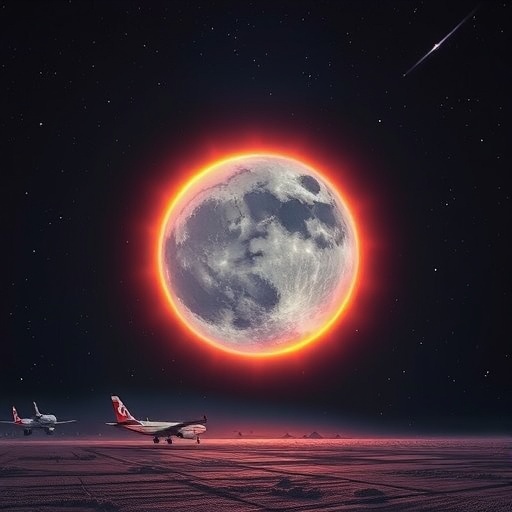
Earth’s magnetic field functions as a critical shield, safeguarding our planet from high-energy radiation emanating from cosmic sources and solar activity. This protective barrier, however, is not static. It undergoes continuous change and, at times in Earth’s history, has even reversed polarity—swapping magnetic north and south poles. A recent international study led by researchers at the University of Oulu, Finland, has delved into the consequences of such geomagnetic fluctuations, particularly examining the implications if a historic event known as the Laschamps excursion were to reoccur in the present day. This detailed investigation highlights potential risks for modern aviation routes subjected to varying cosmic radiation exposures driven by changes in Earth’s magnetic field.
The Earth’s magnetic field, generated by the geodynamo effects within its liquid outer core, is a complex and dynamic entity. It acts by deflecting charged particles from cosmic rays and solar winds, preventing them from reaching the atmosphere in harmful quantities. Despite its robustness, the magnetic field’s intensity varies with time, weakening and strengthening across centuries to millennia. Among the most significant past anomalies was the Laschamps excursion approximately 41,000 years ago, when the geomagnetic field’s strength plummeted to roughly five percent of current levels. This event, characterized not only by substantial weakening but also by a multipolar magnetic structure, lasted several millennia—an initial weakening phase lasting around two thousand years, followed by a gradual recovery over five thousand years.
This recent groundbreaking study employs advanced simulation tools to reconstruct the geomagnetic environment and atmospheric radiation conditions during the Laschamps excursion, integrating updated paleomagnetic field models and cosmic radiation transport algorithms. Utilizing the OTSO tool alongside the LSMOD.2 paleomagnetic field reconstruction model, the researchers were able to accurately depict the spatial and temporal variations of Earth’s magnetic field during this tumultuous period. In concert, the CRAC:DOMO model helped calculate resultant cosmic ray flux and radiation doses imparted to the atmosphere and the biosphere, crucially advancing our understanding of cosmic radiation’s impact under altered geomagnetic shielding conditions.
One of the fundamental findings reveals that during the Laschamps event, the threshold energy for cosmic rays to penetrate Earth’s magnetic shield dropped drastically from the present-day ~17 gigavolts (GV) to around 4 GV. This significant reduction allowed an unprecedented influx of energetic particles into the atmosphere, effectively tripling the atmospheric volume exposed to intense cosmic radiation. This alteration in radiation exposure was not homogenous; instead, the geomagnetic field’s multipolar nature created irregular protective zones and “shielding pockets” that defied traditional assumptions based on present geomagnetic configurations.
For modern aviation, which depends on navigating designated air corridors often monitored for radiation risk, these findings suggest a radical shift in radiation exposure patterns during such geomagnetic excursions. Conventional wisdom posits that flights traversing high-latitude, polar routes endure elevated radiation levels, due to the weaker magnetic protection near the poles, while equatorial routes are generally safer. However, simulations of aviation routes like Helsinki–New York and Helsinki–Dubai during the Laschamps event demonstrated counterintuitive results. Specifically, the Helsinki–New York route, lying in a high-latitude region, could have experienced intermittent shielding owing to the complex multipolar magnetic fields, thereby receiving lower-than-expected radiation doses. Conversely, the more southern Helsinki–Dubai route, generally presumed safer, would have been subjected to significantly amplified radiation exposure due to the diminished magnetic shielding in that sector.
These revelations carry profound implications for aviation safety and space weather resilience. The enhanced cosmic radiation pose not only biological hazards to aircrew and passengers but also threaten the integrity of avionics and satellite communication systems. Increased exposure can escalate the likelihood of radiation-induced single event upsets in electronic systems, potentially impairing navigation and operational control. In light of modern society’s reliance on complex technological infrastructure both in the skies and on the ground, understanding these variable risk landscapes associated with geomagnetic fluctuations is indispensable for air traffic management and aerospace engineering.
Beyond aviation, the multipolar geomagnetic field configuration during excursions like Laschamps could also influence atmospheric phenomena such as auroral displays. Unlike the standard dipolar field that localizes auroras near the polar regions, a multipolar structure can induce auroras at unusual latitudes, broadening their geographic footprint. These manifestations are indicative of altered particle precipitation patterns forced by the disordered geomagnetic topology, raising intriguing questions about climate and atmospheric chemistry changes induced by episodic increases in ionizing radiation.
Although the notion of a geomagnetic excursion occurring imminently remains remote—current scientific consensus suggests that such major polarity shifts transpire over millennia—the study points to ongoing secular variation trends. Notably, Earth’s magnetic field has decreased in strength by approximately nine percent over the last two hundred years, paralleled by the expansion of the South Atlantic Anomaly, a region notable for its markedly weakened magnetic intensity. These observations underscore the importance of continuous geomagnetic monitoring and research to anticipate and mitigate risks associated with future magnetic field variations and their space weather consequences.
The study, published in the Journal of Geophysical Research: Space Physics, exemplifies interdisciplinary collaboration combining geophysics, atmospheric science, and space physics. By leveraging paleomagnetic data records, sophisticated modeling frameworks, and radiation transport calculations, researchers have crafted a comprehensive picture of a past geomagnetic crisis with direct relevance to contemporary technological challenges. This work not only advances scientific understanding of Earth’s magnetic field dynamics but also provides a vital tool for forecasting and preparing for analogous scenarios in our increasingly technology-dependent society.
These findings resonate within the broader framework of ongoing research initiatives, such as the ERC-funded GERACLE project and the Research Council of Finland’s GERACLIS program. Both efforts focus on unraveling the complex interplay between cosmic radiation, geomagnetic variability, and their multifaceted impacts on Earth’s environment and human systems. Moreover, this research aligns with objectives pursued by the SafeEarth program, which investigates natural and anthropogenic risk factors associated with space-related phenomena and their societal implications. Such integrated research approaches are essential for developing robust mitigation strategies to enhance resilience against the subtle yet substantial threats posed by Earth’s dynamic magnetic shield.
Professor Ilya Usoskin and his colleagues at the University of Oulu have significantly contributed to this evolving field by refining tools like the OTSO model, which enables precise paleomagnetic reconstructions, and the CRAC:DOMO framework, which quantifies cosmic radiation effects on the atmosphere. Their pioneering work sets a new standard for assessing radiation exposure under varying geomagnetic conditions, offering critical insights essential for aviation safety policy, space weather forecasting, and long-term planning of technological infrastructure both within and beyond Earth’s atmosphere.
In summary, this landmark study reveals that a geomagnetic event akin to the Laschamps excursion would result in a radically altered radiation environment, impacting aviation routes in unforeseen ways. It challenges long-standing paradigms about cosmic radiation distribution and geomagnetic protection, painting a complex portrait of Earth’s magnetic shield’s vulnerabilities. As our planet’s magnetic field continues its slow but inexorable transformation, these insights serve as a sobering reminder of the intricate, sometimes precarious relationship between Earth’s ancient geophysical processes and the demands of our modern, technologically interconnected existence.
Subject of Research:
Impact of geomagnetic field weakening during the Laschamps excursion on cosmic radiation exposure and aviation safety.
Article Title:
Reduced geomagnetic shielding during the Laschamps excursion and its impact on cosmic-ray-induced atmospheric radiation.
News Publication Date:
24 February 2026.
Web References:
https://doi.org/10.1029/2025JA034820
https://cosmicrays.oulu.fi/geraclis/
https://www.oulu.fi/en/news/if-laschamps-geomagnetic-excursion-happened-today-aviation-radiation-exposure-would-be-radically
Image Credits:
Mikko Törmänen / University of Oulu.
Keywords
Earth’s magnetic field, geomagnetic excursion, Laschamps event, cosmic radiation, aviation safety, magnetic field reversal, paleomagnetic modeling, cosmic ray exposure, multipolar magnetic field, space weather, atmospheric radiation, South Atlantic Anomaly.


