

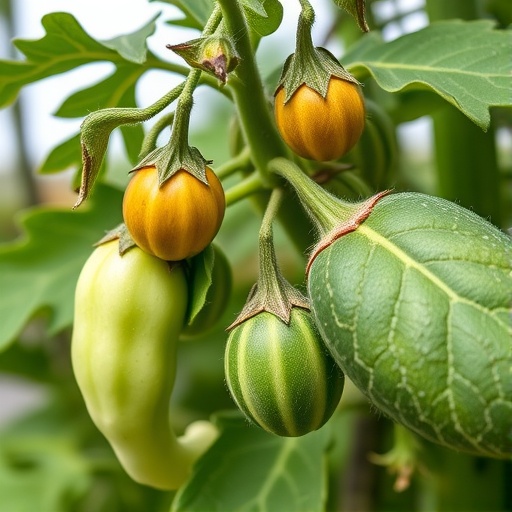
In a groundbreaking study published in BMC Genomics, researchers led by Gao and his team have provided a comprehensive analysis of the GATA transcription factor family across ten different species of the Cucurbitaceae family, which includes well-known plants such as cucumbers, melons, and squash. This research not only highlights the genetic diversity present within these species but also significantly contributes to our understanding of how these plants respond to environmental stress. The study focuses particularly on the role of GATA transcription factors, which are crucial in regulating various biological processes such as cell differentiation, growth, and stress responses.
Transcription factors are proteins that help turn specific genes on or off by binding to nearby DNA. The GATA family is especially interesting because its members are involved in many essential plant functions. The identification and characterization of GATA transcription factors in Cucurbitaceae species are a major step towards unraveling the complexities of plant adaptation to challenging environmental conditions, especially in the face of global climate change. The implications of this research could be monumental for agricultural practices, particularly in enhancing crop resilience.
The study began with a systematic approach involving genome-wide identification techniques. Researchers utilized advanced bioinformatics tools to locate and annotate GATA genes in the genomes of ten selected Cucurbitaceae species. This involved detailed gene mapping and phylogenetic analysis, which placed each identified GATA gene into a broader evolutionary context. As a result, the findings illuminated not only the structural diversity of GATA genes but also their evolutionary relationships among different species.
One of the standout revelations from this research was the sheer number of GATA transcription factors identified in each species, highlighting the rich genetic reservoir within the Cucurbitaceae family. Understanding the number and types of these transcription factors opens new avenues for genetic research and breeding programs aimed at improving crop traits and stress resistance. This vast array of GATA factors suggests a fine-tuned evolution, enabling these plants to thrive in various ecological niches.
Following the identification of GATA genes, the researchers turned their focus towards expression analysis, specifically examining how these genes respond to different stressors in watermelon, a prominent member of the Cucurbitaceae family. Watermelon plants were subjected to various stress conditions, including drought and salinity, which serve as significant challenges to agricultural productivity. Using quantitative PCR, the team was able to measure the expression levels of ClGATA genes, uncovering their roles in mediating stress responses effectively.
Results revealed a dynamic expression pattern for ClGATA genes under stress conditions, indicating their pivotal role in enhancing stress tolerance in watermelon. This includes genes that showed significant upregulation in response to drought, providing insights into how plants modulate gene expression to combat adverse environmental conditions. Such knowledge is crucial in creating watermelon varieties that are better equipped to withstand fluctuations in climate.
Moreover, the expression profiles identified in this study are expected to guide future research and breeding programs, aiming for the development of crops that can maintain high yields under stress conditions. This study’s findings might also extend beyond watermelon, influencing practices in managing other crops to ensure food security in rapidly changing environments.
Gao and his colleagues emphasized the importance of GATA transcription factors in plant biology, likening them to a regulatory orchestra that orchestrates gene expression in response to internal and external stimuli. The findings could lead to innovative genetic engineering approaches that enhance the resilience of not just watermelon, but a host of other economically important crops. By targeting specific GATA genes, breeders could develop varieties that maintain productivity even when faced with adverse conditions.
The research also highlights the potential for leveraging the synergistic relationship between GATA factors and other stress-responsive pathways. Such an integrative approach could open new avenues in plant biotechnology, paving the way for developing molecular tools that enable enhanced stress tolerance in various crops across the board.
Furthermore, the study’s interdisciplinary approach, combining genomics, transcriptomics, and field experimentation, sets a precedent for future research in plant sciences. This comprehensive methodology ensures that the findings are not only scientifically robust but also practically applicable in agriculture. As the world grapples with the effects of climate change, research like this could become increasingly vital in devising strategies to ensure sustainable food production.
The implications of this research extend beyond the academic sphere, impacting agricultural policy and practice. With food security becoming an increasingly pressing global issue, studies that explore and harness the genetic diversity of crops are paramount. The integration of this knowledge into breeding programs can lead to more resilient varieties that can thrive in the face of climate unpredictability.
In conclusion, this research constitutes a significant contribution to the field of plant genomics and stress biology. The identification of GATA transcription factors in Cucurbitaceae species, combined with expression analysis in watermelon, presents a roadmap for future studies aimed at enhancing crop resilience. It demonstrates the power of advanced genomic tools in unraveling the complexities of plant adaptation, ultimately aiding in the fight against food insecurity in a changing world. The potential avenues for innovation in agricultural practices can be seen as a beacon of hope for sustainable agriculture.
This innovative work by Gao, Jia, Cui, and colleagues encapsulates the essence of modern genomics research and its necessary role in reshaping our agricultural landscape, empowering us to meet the challenges that lie ahead.
Subject of Research: GATA transcription factor family in Cucurbitaceae species
Article Title: Genome-wide identification of the GATA transcription factor family in ten Cucurbitaceae species and expression analysis of ClGATA genes in watermelon stress responses
Article References:
Gao, J., Jia, L., Cui, R. et al. Genome-wide identification of the GATA transcription factor family in ten Cucurbitaceae species and expression analysis of ClGATA genes in watermelon stress responses.
BMC Genomics (2026). https://doi.org/10.1186/s12864-026-12576-3
Image Credits: AI Generated
DOI: 10.1186/s12864-026-12576-3
Keywords: GATA transcription factors, Cucurbitaceae, genomic analysis, stress response, watermelon, bioinformatics, crop resilience, climate change.


