


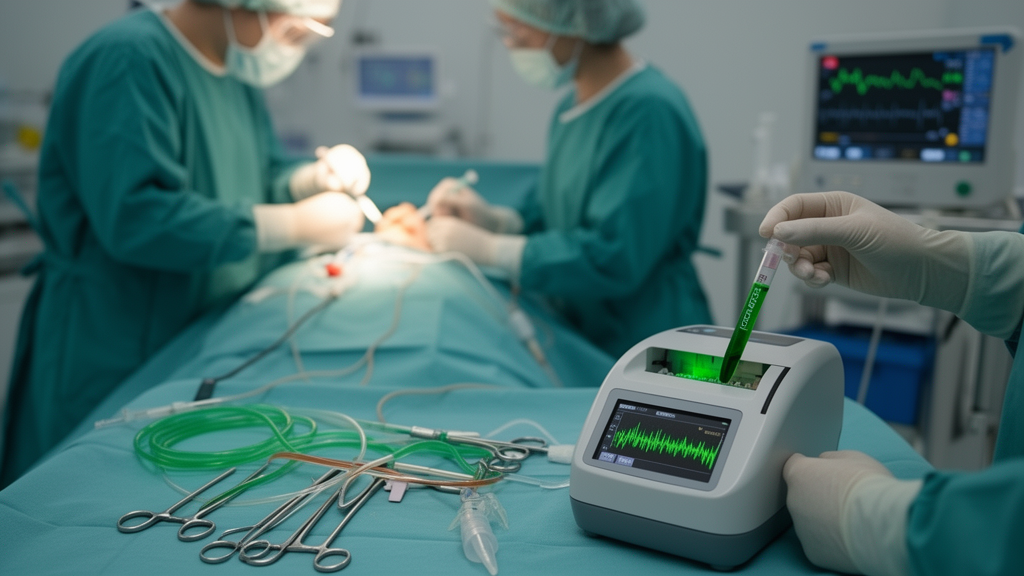
Intravenous indocyanine green (ICG), a fluorescent dye used to visualize blood flow and parathyroid glands during thyroid surgery, can produce large but temporary false elevations in intraoperative parathyroid hormone (ioPTH) measurements, according to a small prospective study conducted at a regional teaching hospital in Taiwan. In six patients undergoing thyroidectomy, measured PTH concentrations peaked three minutes after ICG injection and approached baseline over approximately 20 to 30 minutes. The study also found that adding ICG directly to blood samples distorted results from two generations of PTH immunoassays, supporting an analytical interference effect rather than a change caused solely by surgery.
The finding matters because ioPTH monitoring is used during thyroid and parathyroid operations to assess whether parathyroid function is likely to remain adequate after tissue removal. Surgeons may use declining hormone levels, absolute thresholds or kinetic criteria to guide decisions about parathyroid autotransplantation, calcium supplementation, postoperative monitoring and discharge planning. PTH has a circulating half-life typically estimated at three to five minutes, making rapid intraoperative measurements particularly useful in these settings. If a dye used in the same operative workflow falsely raises a PTH result, a surgeon could overestimate remaining parathyroid function or be misled about the likelihood of postoperative hypocalcemia.
Researchers divided the prospective experimental and observational study into paired in vitro spiking experiments involving six patient samples and an in vivo thyroidectomy cohort involving six patients. They also conducted limited exploratory testing on additional analytical platforms. The principal in vivo measurements were made with a Roche Cobas e601 electrochemiluminescence immunoassay platform for second-generation intact PTH, or i-PTH, and third-generation whole PTH (1–84). Before beginning the main experiments, the team validated sample handling: differences between standard and internal centrifugation protocols ranged from -2.79% to +4.69% across 10 samples, while storage and temperature tests remained within a predefined acceptance limit of plus or minus 25%.
For the in vitro experiment, blood from each of six patients was divided into paired aliquots. One aliquot served as a baseline control, and the other was spiked with 0.5 mL of ICG solution at 2.5 mg/mL to evaluate assay behavior under saturation conditions. The median third-generation PTH (1–84) concentration rose from 40.19 pg/mL to 235.10 pg/mL, corresponding to a median 5.98-fold increase among individual samples. The median second-generation i-PTH concentration increased from 36.26 pg/mL to 120.45 pg/mL, a median 3.34-fold increase. Both changes were statistically significant at p = 0.031 under the Wilcoxon signed-rank analysis.
The third-generation assay was affected more strongly. In every ICG-spiked specimen, the ratio of PTH (1–84) to i-PTH, which is normally not greater than 1.0, inverted to above 1.0. This reversal indicates that ICG exposure did not simply add the same proportional bias to both assays. Rather, the assay intended to detect biologically active, intact PTH registered a disproportionately larger response under the tested conditions. The controlled addition of ICG also showed that the interference could occur without neck dissection, tissue manipulation or a systemic physiological response to surgery.
For the in vivo component, investigators enrolled six patients undergoing elective total or near-total thyroidectomy. All six had normal liver-function test results and no history or diagnosis of liver cirrhosis. A baseline arterial blood sample was collected immediately before ICG was administered through a peripheral venous catheter in the contralateral arm. Additional arterial samples were taken 3, 6, 9, 15, 20, 25 and 30 minutes after injection. Surgical dissection and manipulation of the neck were paused throughout the sampling period to reduce biological fluctuations unrelated to ICG exposure, while separate vascular access sites were intended to minimize direct contamination of the sampling line or local venous retention of concentrated dye.
The in vivo results reproduced the direction seen in the laboratory experiments. At three minutes, third-generation PTH (1–84) reached 234.8% of baseline, a median increase of 50.25 pg/mL, while second-generation i-PTH reached 146.1% of baseline, a median increase of 13.53 pg/mL. Both peak changes were significant at p = 0.031. Positive interference remained substantial at six and nine minutes. By 15 minutes, i-PTH was close to baseline at 98.3%, although PTH (1–84) remained slightly elevated at 122.9%. Between 20 and 30 minutes, both assays approached baseline: at 30 minutes, i-PTH was at 96.6% of baseline and PTH (1–84) was at 103.1%, with neither difference statistically significant.
Exploratory comparisons suggested that the problem may not be confined to one assay system, but the evidence was limited. In paired serum samples from one surgery patient, i-PTH rose from 28.06 to 370.5 pg/mL on the Roche electrochemiluminescence system and from 29.6 to 382.0 pg/mL on Abbott’s Alinity i chemiluminescent microparticle immunoassay. That single-patient agreement cannot establish platform independence. A separate experiment using three whole-blood specimens produced inconsistent responses among systems: measurements increased on Roche, failed to report on Abbott because of an activated read error that persisted after dilution, and decreased on Siemens Atellica IM. These findings show that the direction and magnitude of interference may vary with the analytical method and specimen conditions rather than supporting one uniform response across platforms.
The mechanism remains unresolved. ICG is an amphiphilic dye that binds extensively to plasma proteins, particularly albumin and lipoproteins, forming large circulating complexes. Because ICG fluorescence near 800 to 830 nm does not overlap directly with the 620 nm ruthenium emission used by the Roche electrochemiluminescence system, simple optical cross-talk was considered less likely. The researchers proposed that ICG-protein complexes might instead interfere nonspecifically with antibody binding or signal generation, but they did not directly test this mechanism. The paired in vitro experiments support a direct analytical contribution from ICG exposure, although they do not establish the molecular pathway responsible. The study evaluated PTH only, so its findings cannot be extended to interference with other blood analytes.
Several limitations constrain interpretation. The operative cohort contained only six patients and had no contemporaneous control group receiving thyroidectomy without ICG. The cross-platform work involved one patient and a small number of additional specimens, and the observed return toward baseline over 20 to 30 minutes was not independently validated. The proposal that the effect reflects a washout period linked to hepatic clearance is also preliminary; the study measured the timing of assay interference but did not directly test that proposed explanation. Nevertheless, the agreement between controlled sample-spiking experiments and serial intraoperative measurements, together with the use of contralateral sampling sites and the pause in surgical manipulation, strengthens the evidence that ICG can transiently distort ioPTH assays.
The authors’ practical conclusion is limited but clear: when feasible, baseline ioPTH should be collected before ICG is administered, and subsequent results should be interpreted with the timing of the injection in mind. The data show that measurements can be falsely elevated soon after exposure, with the largest distortion occurring early and values tending back toward baseline later in the 30-minute observation period. They do not yet establish a universal waiting period, biological washout interval or post-ICG sampling schedule. For the six-patient operative cohort, the 20-to-30-minute return toward baseline is an observed preliminary pattern that requires validation in a larger cohort with an appropriate control group before it can guide routine timing decisions.
Subject of Research: Analytical interference between indocyanine green and intraoperative parathyroid hormone immunoassays
Article Title: Indocyanine green alters intraoperative parathyroid hormone measurements: a timing-dependent effect
Article References: Sung, C.-H., Huang, S.-M., Ye, R.-J., & Shih, P.-J. (2026). Indocyanine green alters intraoperative parathyroid hormone measurements: a timing-dependent effect. Frontiers in Endocrinology, 17, 1981095. https://doi.org/10.3389/fendo.2026.1981095
Image Credits: AI Generated
DOI: 10.3389/fendo.2026.1981095
Keywords: indocyanine green, parathyroid hormone, thyroidectomy, immunoassay interference, analytical bias, intraoperative monitoring, near-infrared fluorescence, postoperative hypocalcemia, Indocyanine, green, alters, intraoperative
Cite Scienmag News
Ophelia Keating. (October 21, 2026). ICG temporarily distorts intraoperative PTH measurements after thyroid surgery. Scienmag. https://scienmag.com/icg-temporarily-distorts-intraoperative-pth-measurements-after-thyroid-surgery/
Ophelia Keating. "ICG temporarily distorts intraoperative PTH measurements after thyroid surgery." Scienmag, 21 October 2026, https://scienmag.com/icg-temporarily-distorts-intraoperative-pth-measurements-after-thyroid-surgery/. Accessed 21 October 2026.
Ophelia Keating. "ICG temporarily distorts intraoperative PTH measurements after thyroid surgery." Scienmag. October 21, 2026. https://scienmag.com/icg-temporarily-distorts-intraoperative-pth-measurements-after-thyroid-surgery/


