


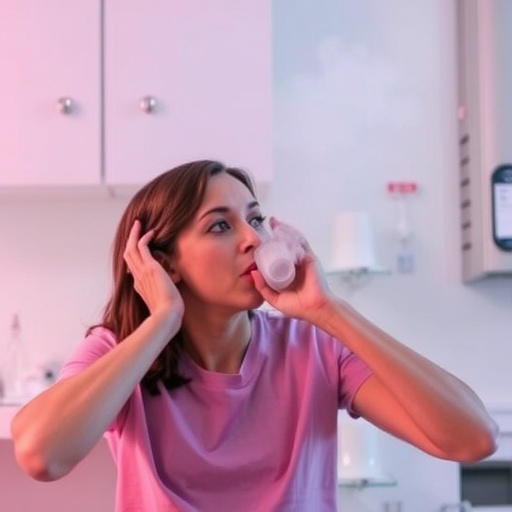
Electroconvulsive therapy (ECT) remains one of the most effective interventions for severe psychiatric illnesses, particularly treatment-resistant depression and certain psychotic disorders. Despite its long-standing clinical use, optimizing the parameters that influence the therapeutic efficacy of ECT continues to be a pressing concern in psychiatric research. Recently, a comprehensive systematic review and meta-analysis have shed new light on the role of hyperventilation during the ECT induction phase and its impact on seizure duration—one of the critical determinants of treatment success.
Hyperventilation refers to a rapid breathing pattern that leads to decreased carbon dioxide (CO2) levels in the bloodstream, a physiological state known as hypocapnia. This induced gas exchange alteration can modulate cerebral excitability, a fact long hypothesized to influence seizure characteristics during ECT. However, the precise effects and clinical implications of hyperventilation in ECT have remained inconclusive, prompting an exhaustive analysis of randomized trials to delineate its impact on seizure duration and patient safety comprehensively.
The recent meta-analysis, pooling data from seven randomized studies encompassing 620 ECT sessions, reveals compelling evidence that hyperventilation significantly prolongs both muscle and electroencephalogram (EEG)-recorded seizure durations. The authors quantified this effect as an average increase of approximately 2.9 seconds in muscle seizure duration and 5.4 seconds in EEG seizure duration. These findings suggest that hyperventilation may enhance the neurophysiological responses essential for ECT’s therapeutic effects, presenting a potentially valuable tool for clinicians seeking to optimize treatment protocols.
It is crucial to understand why seizure duration matters during ECT. The duration of the induced seizure has traditionally been considered a proxy for treatment adequacy, with longer seizure times generally correlating with improved clinical outcomes. However, this parameter is far from a perfect measure, and reliance solely on seizure duration risks oversimplification of the complex neurobiological processes underlying ECT’s effectiveness. Nonetheless, the extension of seizure duration through controlled hyperventilation provides a non-pharmacological strategy that merits further exploration.
Safety profiles associated with hyperventilation during ECT induction are equally significant. The reviewed studies collectively indicate that hyperventilation is well tolerated, with no substantive differences in adverse events or safety indices compared to standard ventilation techniques. This suggests that the additional physiological manipulation does not compromise patient safety, an essential consideration when modifying ECT protocols, which must always weigh therapeutic gain against potential risk.
Despite these promising findings, the meta-analysis authors caution that the overall bias in the included studies remains significant. Many prior trials predominantly used seizure duration as the sole marker of ECT efficacy. The field could benefit from more comprehensive evaluation metrics encompassing cognitive outcomes, mood improvements, and long-term patient well-being. Future research avenues should integrate multi-dimensional assessments to confirm whether hyperventilation truly enhances clinical outcomes beyond increasing seizure duration.
The methodological rigor of this review is underscored by its exhaustive literature search, which spanned multiple international databases, including PubMed, Cochrane Library, Embase, and regional repositories such as Wanfang Data and the China National Knowledge Infrastructure. Further, the application of the Revised Cochrane Risk of Bias Tool (RoB 2.0) and statistical robustness checks—including Egger’s test for publication bias—strengthen confidence in the synthesized results. Such meticulous design is critical in psychiatric research, where heterogeneity in study design and patient populations often complicates meta-analyses.
The implications of hyperventilation in ECT extend beyond mere clinical practice refinements. This physiological intervention echoes a broader scientific inquiry into how modulating cerebral CO2 tension influences neuronal excitability, synaptic function, and perhaps neuroplasticity. These mechanisms may underpin not only seizure dynamics but also the mood regulation and cognitive processing alterations that characterize recovery following ECT.
In practical terms, implementing hyperventilation during ECT induction is a relatively simple and cost-effective procedure. It requires no new equipment beyond standard ventilatory support and could be systematically introduced into treatment protocols with minimal disruption. Moreover, because it is a non-pharmacologic intervention, it avoids additional drug interactions or side effects, an advantage in patient populations often burdened with polypharmacy.
Nonetheless, careful patient monitoring remains paramount. While no significant safety concerns emerged from the analyzed trials, clinicians must tailor hyperventilation practices according to individual patient status, considering variables such as baseline respiratory function, cardiovascular stability, and seizure threshold variability. Personalized ventilation settings might optimize therapeutic windows while mitigating potential risks associated with hypocapnia, such as cerebral vasoconstriction or electrolyte shifts.
Interestingly, the diverse geographic origins of the included studies highlight growing global interest in refining ECT procedures. With broad representation from Western and Asian research institutions, the findings carry relevance across varying clinical landscapes, underscoring the universal need to improve psychiatric treatment efficacy and tolerability.
This review ultimately paves the way for larger, more nuanced randomized controlled trials that investigate hyperventilation not just as a means to prolong seizure duration but as a strategy integrated into comprehensive treatment models. These future studies will need to explore long-term patient-centered outcomes, including functional recovery, relapse rates, cognitive preservation, and overall quality of life enhancements.
In conclusion, the integration of hyperventilation during the induction phase of electroconvulsive therapy is an auspicious advance garnering empirical support through rigorous meta-analytic synthesis. This physiological tweak appears to optimize seizure parameters without compromising patient safety, thereby positioning itself as a promising adjunctive technique. As psychiatric medicine evolves towards more personalized and precise interventions, such evidence-based procedural refinements offer meaningful opportunity to maximize therapeutic benefits for patients grappling with severe mental illness.
Cite Scienmag News
Glenn Wilkins. (July 2, 2025). Hyperventilation’s Effect on Seizure Duration Revealed. Scienmag. https://scienmag.com/hyperventilations-effect-on-seizure-duration-revealed/
Glenn Wilkins. "Hyperventilation’s Effect on Seizure Duration Revealed." Scienmag, 2 July 2025, https://scienmag.com/hyperventilations-effect-on-seizure-duration-revealed/. Accessed 4 September 2026.
Glenn Wilkins. "Hyperventilation’s Effect on Seizure Duration Revealed." Scienmag. July 2, 2025. https://scienmag.com/hyperventilations-effect-on-seizure-duration-revealed/


