


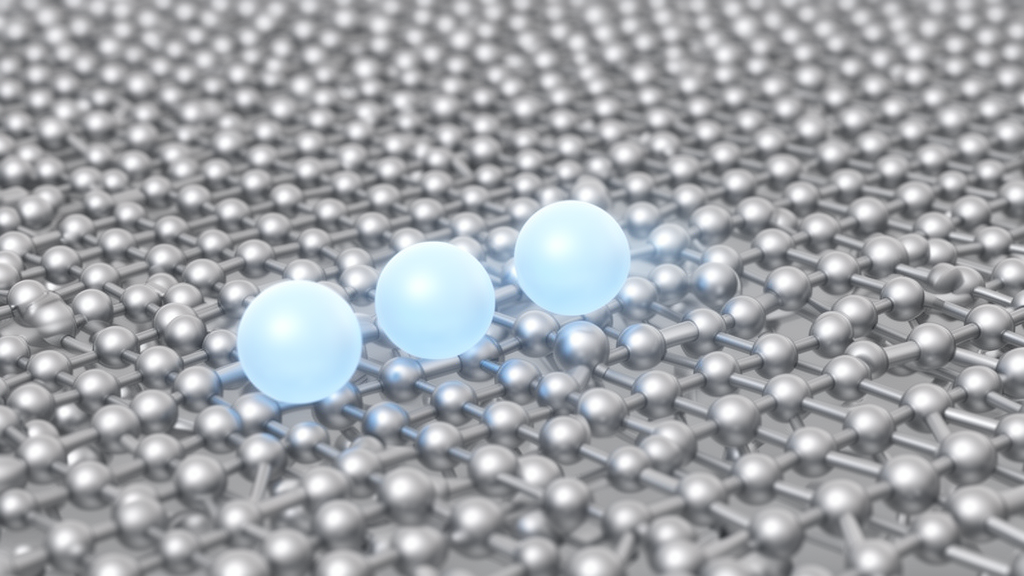
A mechanistic study of an electrochemical palladium membrane reactor found that hydrogenation is driven not only by hydrogen atoms permeating through palladium, as commonly assumed, but also by molecular hydrogen that forms near the membrane, re-disssociates on catalytic metal surfaces and contributes to the reaction. The researchers used hydrogenation of 1-hexyne as a model transformation while varying the membrane’s secondary metal layer, gas environment and physical geometry. Their results indicate that the dominant hydrogen pathway depends on metal composition, layer thickness and morphology, with the proximity of the catalyst to the palladium membrane proving critical to performance. The work is mechanistic rather than a demonstration of a new commercial reactor, but it identifies design variables that could guide more efficient electrochemical hydrogenation.
The electrochemical palladium membrane reactor separates an aqueous electrochemical compartment from an organic chemical compartment with a palladium membrane. Electrical energy can drive proton reduction on the aqueous side, generating hydrogen species that move through palladium and support reactions with organic molecules on the other side. This architecture avoids direct contact between the organic reactant and the electrode, reducing problems such as poor organic solubility, multiphase electrochemistry, electrode fouling and the interfacial mass-transfer barrier encountered in conventional water-based hydrogenation. It also removes the need to supply high-pressure molecular hydrogen, although the study does not establish a complete life-cycle advantage or a scalable process.
Initial tests with bare palladium showed that the reactor’s electrochemical behavior depended strongly on the condition of the chemical compartment. Tafel analysis produced a slope of 77 ± 2 mV per decade when that compartment was empty, 74 ± 3 mV per decade when it contained only solvent, and 83 ± 4 mV per decade when 1-hexyne was present. The authors interpreted the steeper slope in the presence of reactant as evidence that consumption of permeating hydrogen increased the contribution of the Volmer step, which generates adsorbed hydrogen, relative to the Tafel and Heyrovsky steps associated with hydrogen-gas formation. Deuterium experiments gave a different kinetic profile, consistent with slower deuterium transport and stronger competition from deuterium-gas evolution.
The hydrogenation rate itself was closely tied to the electrochemical production of hydrogen atoms. Under galvanostatic operation, hydrogenation and deuteration rates in the organic compartment were almost identical, suggesting that the chemical reaction tracked the rate at which electrochemically generated hydrogen atoms reached the membrane surface. A potentiostatically measured apparent isotope effect of 4.5, however, indicated a substantial contribution from proton-transfer steps. These results indicate a coupled system in which electron transfer, atomic-hydrogen transport and consumption by the organic reaction cannot be assigned independently. The authors also adapted Sievert’s and Fick’s laws to describe hydrogen flux through the membrane, but they described the model as a qualitative framework because the relevant diffusion and solubility parameters for electrochemically generated hydrogen remain incompletely characterized.
During galvanostatic electrolysis at 24 mA cm−2, bare palladium converted 1-hexyne through sequential hydrogenation, first producing hexenes and then n-hexane. Hexenes dominated, showing that complete hydrogenation to the alkane was comparatively slow. Lower current densities produced more efficient conversion than higher ones, a result consistent with earlier observations that changes in current can alter the balance among atomic hydrogen, proton or hydride chemistry and hydrogen-gas formation. The researchers therefore moved beyond bare palladium by electrodepositing secondary Pd, Rh or bimetallic Pd–Rh layers on the membrane surface, where those layers provide the catalytic sites for reaction with 1-hexyne.
Surface characterization revealed sharply different structures among the deposited materials. Electrodeposited Pd and Pd–Rh formed dendrite-like layers, while Rh formed a dense coating more than 200 nm thick. X-ray diffraction confirmed the characteristic crystalline planes of the deposited metals, while microscopy and elemental mapping verified that both components were present in the bimetallic material. After 12 hours, electrodeposited Pd raised the relative concentration of n-hexane to more than 88%, compared with 24% for bare palladium, while Pd–Rh reached 95%. These measurements describe relative product concentrations among quantified hydrocarbons rather than isolated Faradaic efficiencies, and the study avoided making detailed selectivity claims from the concentration distributions.
The Rh-coated membrane produced the clearest challenge to a hydrogen-atom-only explanation. Its unusually thick Rh layer was expected to impede hydrogen-atom permeation because hydrogen atoms do not readily occupy interstitial sites in rhodium under ambient conditions. Nevertheless, the reactor still achieved 73% 1-hexyne conversion and a 33% relative concentration of n-hexane after 12 hours. The authors proposed that hydrogen atoms reaching the chemical-side palladium surface could combine to form H2, which then re-disssociated on the deposited metal and hydrogenated 1-hexyne. Gas chromatography supported this interpretation: H2 was not detected in the organic compartment for the first three hours with electrodeposited Pd, but appeared early in reactions using Rh-containing membranes.
Controlled hydrogenation experiments provided additional, though not definitive, evidence for the molecular-hydrogen route. Under external H2 purging without electrolysis, bare palladium converted 36% of 1-hexyne in six hours, while the electrodeposited Pd membrane achieved complete conversion with a 58% relative concentration of n-hexane. The Rh-containing membrane converted 31% and produced a 12% relative concentration of n-hexane under the same six-hour gas-feed condition. Removing H2 with argon had little effect on bare palladium and only a slight effect on electrodeposited Pd, but it lowered conversion in the Rh system from 73% to 68% and reduced n-hexane from 33% to 29%. The greater sensitivity of the Rh configuration is consistent with a larger contribution from in situ molecular hydrogen when atomic permeation through the secondary layer is restricted.
Transport experiments showed why that molecular route can be decisive. When deposited Pd particles were detached and dispersed in the organic compartment, the relative concentration of n-hexane fell from 97% to 74%. Separating the deposited-Pd membrane from bare palladium by about 0.5 cm caused a sharper decline, to 34%. The proximity of the catalytic metal to the hydrogen-generating membrane therefore shortened the sequence of atomic permeation, molecular formation, re-disssociation and surface reaction. Overall, the study presents hydrogen atoms and H2 as complementary pathways rather than mutually exclusive mechanisms: atomic hydrogen dominates where permeation through the secondary layer remains facile, while molecular hydrogen becomes relatively more important where the metal layer obstructs transport. The authors argue that directly integrating catalytic layers with palladium membranes is a rational design strategy, although the transport model still requires experimental validation and broader testing beyond the 1-hexyne model reaction.
Subject of Research: Mechanisms of hydrogen generation, transport and reactivity in electrochemical palladium membrane reactors
Article Title: Deciphering Electrochemical Generation, Transport, and Reactivity of Hydrogen Species in the Electrochemical Palladium Membrane Reactor
Article References: Shin, S. J., Roh, S. B., Kim, H.-T., Lee, K.-Y., Kim, S. M., Park, J. H., & Park, M. (2026). Deciphering Electrochemical Generation, Transport, and Reactivity of Hydrogen Species in the Electrochemical Palladium Membrane Reactor. Advanced Science, Article e78365. https://doi.org/10.1002/advs.78365
Image Credits: AI Generated
DOI: 10.1002/advs.78365
Keywords: electrochemical hydrogenation, palladium membrane, hydrogen atoms, molecular hydrogen, hydrogen transport, rhodium catalyst, 1-hexyne, Faradaic efficiency, mass transport, Deciphering, Electrochemical, Generation
Cite Scienmag News
Denise Maddox. (October 20, 2026). Hydrogen Molecules Join Atoms in Palladium Membrane Reactors. Scienmag. https://scienmag.com/hydrogen-molecules-join-atoms-in-palladium-membrane-reactors/
Denise Maddox. "Hydrogen Molecules Join Atoms in Palladium Membrane Reactors." Scienmag, 20 October 2026, https://scienmag.com/hydrogen-molecules-join-atoms-in-palladium-membrane-reactors/. Accessed 20 October 2026.
Denise Maddox. "Hydrogen Molecules Join Atoms in Palladium Membrane Reactors." Scienmag. October 20, 2026. https://scienmag.com/hydrogen-molecules-join-atoms-in-palladium-membrane-reactors/


