

In a groundbreaking study published in Nature Geoscience, researchers have unveiled striking new insights into the emission trends of hydrofluorocarbons (HFCs) in China and other developing nations classified as non-Annex I countries. This comprehensive investigation employs advanced atmospheric observations combined with inverse modeling techniques, shedding light on long-standing discrepancies between bottom-up emission inventories and real-world atmospheric data. As Hydrofluorocarbons remain potent greenhouse gases with significant global warming potential, understanding their emission pathways is critical in meeting international climate goals, particularly those set by the Kigali Amendment to the Montreal Protocol.
Hydrofluorocarbons owe much of their notoriety to their extensive use as refrigerants, propellants, and foam-blowing agents in various industrial applications. Despite their functional benefits, HFCs possess global warming potentials thousands of times greater than carbon dioxide, making their regulation a priority in global climate agreements. The Kigali Amendment to the Montreal Protocol, adopted in 2016, mandates a phasedown of HFC production and consumption, with China committing to freeze its HFC emissions starting in 2024. However, until now, reliable top-down estimates capturing actual atmospheric emissions in China had been elusive, leading to uncertainty in global inventories.
The study meticulously analyzes data spanning from 2011 to 2021, leveraging an array of atmospheric observations gathered across diverse regions of China. By implementing inverse modeling — a method that uses atmospheric concentration measurements to forecast probable sources — the team derived more accurate emission estimates for nine key hydrofluorocarbons. These nine compounds represent the bulk of HFC emissions globally and in China, providing a robust framework for understanding national trends. The findings challenge existing nation-level inventory data, revealing a significant overestimation in reported emissions after 2017.
One of the study’s most surprising revelations pertains to the scale of discrepancy in official Chinese emissions data. The widely cited national bottom-up inventories reported considerably higher HFC emissions compared to the atmospheric-based top-down estimates. Quantitatively, the study identifies an overestimation averaging 117.2 teragrams of CO₂-equivalent per year post-2017, underscoring the critical necessity for reconciling national reporting with ambient atmospheric evidence. This discrepancy highlights the complexities inherent in estimating fugitive emissions linked to production, consumption, and end-of-life disposal of HFC-containing equipment.
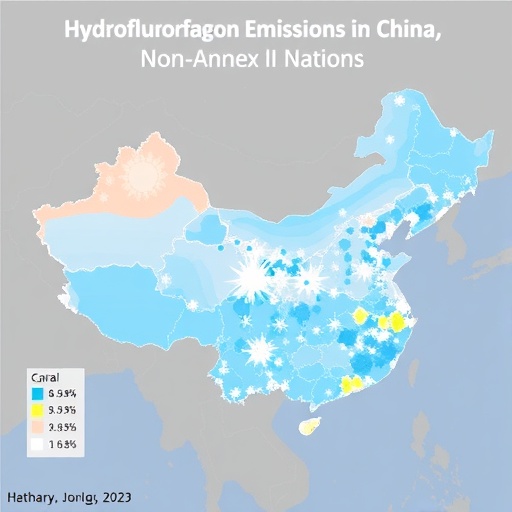
Geographical analysis within China illustrated heterogeneous emission patterns, with the eastern regions — densely populated and industrialized — accounting for 37.4% of the nation’s total HFC emissions in CO₂-equivalent terms. Interestingly, the larger share of emissions, 62.6%, emanates from non-eastern areas. This dispersion suggests that policy interventions cannot focus exclusively on eastern hubs but must target a broader spectrum of provinces, including those less industrialized but potentially significant contributors due to decentralized or informal HFC usage.
Beyond China, the study illuminates a critical yet underappreciated global trend involving non-Annex I countries, mostly developing nations under the United Nations Framework Convention on Climate Change (UNFCCC). Excluding China, these countries were responsible for a staggering 61.3% of the global HFC emissions growth between 2011 and 2020. This figure dramatically outpaces the contributions of Annex I countries, which are predominantly developed economies, at 23.9%, and even surpasses China’s share of 14.8%. These insights shed new light on the shifting geography of HFC emissions, emphasizing the pivotal role developing countries play in the future trajectory of greenhouse gases.
The methodological robustness of this study stems from the synergistic use of high-resolution atmospheric sampling and sophisticated computational inverse models. By integrating real-time air measurements with transport and chemical transformation models, the researchers achieved an unprecedented degree of spatial and temporal resolution in pinpointing emission sources. This approach addresses prior methodological limitations that relied heavily on production statistics and self-reported consumption metrics, which often overlooked illicit emissions and informal markets.
Given that HFCs have relatively short atmospheric lifetimes compared to long-lived greenhouse gases like CO₂, their rapid emission decline could yield near-term climate benefits. Therefore, accurate quantification of current emissions is imperative for verifying the effectiveness of international agreements and national regulations. This study’s findings urge a recalibration of inventories and present a strong case for enhanced atmospheric monitoring networks, especially in countries where industrial transparency is limited.
There are broader geopolitical ramifications implicit in these findings. The significant contribution of non-Annex I countries — most of which face resource constraints in environmental monitoring and regulation — spotlights the necessity for increased international cooperation and technology transfer. Assisting developing countries in adopting low-GWP alternatives, improving data collection infrastructures, and enforcing consumption controls will be crucial to realizing the full climate mitigation potential of the Kigali Amendment.
Moreover, the data underscore the importance of incorporating diverse regional emission sources within national frameworks. The disparity in emissions between eastern and non-eastern China prompts reconsiderations of regional strategies, potentially encouraging localized policy innovations and investment in green technology. These approaches could foster more equitable environmental governance tailored to distinct industrial profiles and socio-economic conditions.
The researchers emphasize that while the overestimation in China’s official numbers may initially appear positive in terms of underestimated progress, it signals an urgent need for transparent and accurate emissions reporting to build trust and guide global climate policy. Similarly, the revelation of prolific emissions growth in non-Annex I countries outside China demands intensified efforts in curbing illegal production and consumption of HFCs, along with scaling incentives for voluntary emissions reductions.
Looking ahead, this pioneering research lays the blueprint for future international collaboration. Its approach — blending cutting-edge atmospheric science with policy-relevant data — could transform emissions accounting beyond HFCs, potentially applying to other short-lived climate pollutants that evade conventional monitoring. Furthermore, the research community may leverage these findings to encourage revisions in global climate models, which have historically relied on bottom-up inventories less reflective of actual emissions.
In summation, this study redefines our understanding of hydrofluorocarbon emissions on both regional and global scales, unveiling critical gaps in official estimates and spotlighting emerging sources. By spotlighting China, the world’s largest single emitter unique in its regulatory stance, alongside the dynamic growth in other developing countries, it presents a nuanced narrative of global climate action challenges and opportunities. The implications for policymakers, scientists, and environmental advocates alike are profound, demanding urgent attention to reconciling data discrepancies and enhancing collaborative mitigation efforts.
The research not only challenges preconceived notions about HFC emissions distributions but also provides a vital empirical basis for recalibrating strategic responses under international climate frameworks. As the window for effective climate mitigation narrows, such transparency and precision in emissions assessment will prove indispensable for achieving global temperature goals and securing a sustainable future.
In conclusion, these revelations underscore the critical importance of atmospheric observational techniques and inverse modeling in delivering credible, actionable data. They also call for an urgent re-examination of current reporting practices and enhanced support for emerging economies in managing HFC emissions. The road to a cooler planet depends on our collective ability to close these data gaps and respond with informed, inclusive policy measures aligned with scientific evidence.
Subject of Research:
Estimation and analysis of hydrofluorocarbon (HFC) emissions in China and other non-Annex I developing countries using atmospheric observations and inverse modeling to address discrepancies in official emission inventories.
Article Title:
Estimation of hydrofluorocarbon emissions from China and other non-Annex I countries.
Article References:
Fang, X., Du, Q., Mühle, J. et al. Estimation of hydrofluorocarbon emissions from China and other non-Annex I countries. Nat. Geosci. (2026). https://doi.org/10.1038/s41561-025-01908-9
Image Credits: AI Generated


